Bunker Hill in Holmes County, Ohio — The American Midwest (Great Lakes)
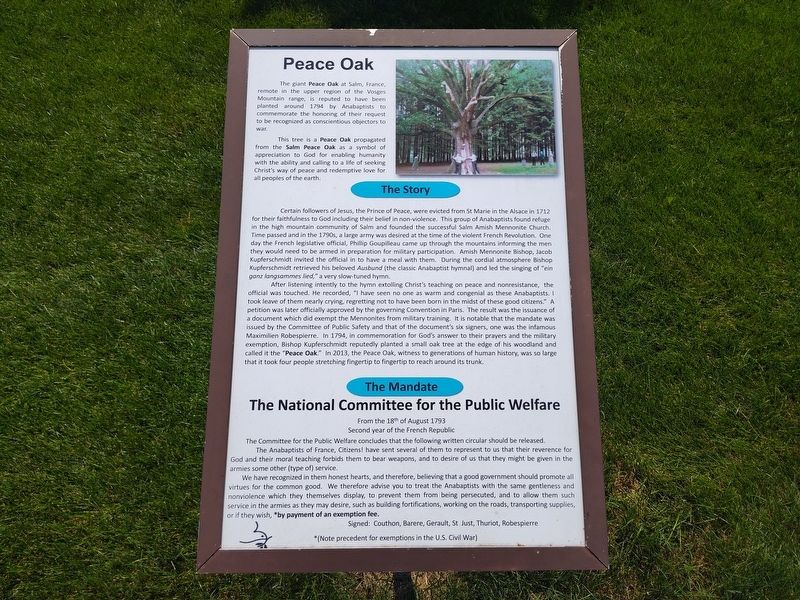
Peace Oak
Photographed by Craig Doda, July 26, 2025
1. Peace Oak Marker
This tree is a Peace Oak propagated from the Salm Peace Oak as a symbol of appreciation to God for enabling humanity with the ability and calling to a life of seeking Christ's way of peace and redemptive love for all peoples of the earth.
this page online
After listening intently to the hymn extolling Christ's teaching on peace and nonresistance, the official was touched. He recorded, "I have seen no one as warm and congenial as these Anabaptists. I took leave of them nearly crying, regretting not to have been born in the midst of these good citizens." A petition was later officially approved by the governing Convention in Paris. The result was the issuance of a document which did exempt the Mennonites from military training. It is notable that the mandate was issued by the Committee of Public Safety and that of the document's six signers, one was the infamous Maximilien Robespierre. In 1794, in commemoration for God's answer to their prayers and the military exemption, Bishop Kupferschmidt reputedly planted a small oak tree at the edge of his woodland and called it the "Peace Oak." In 2013, the Peace Oak, witness to generations of human history, was so large that
Photographed by Craig Doda, July 26, 2025
2. Peace Oak Marker
The National Committee for the Public Welfare
From the 18th of August 1793
Second year of the French Republic
The Anabaptists of France, Citizens! have sent several of them to represent to us that their reverence for God and their moral teaching forbids them to bear weapons, and to desire of us that they might be given in the armies some other (type of) service.
We have recognized in them honest hearts, and therefore, believing that a good government should promote all virtues for the common good. We therefore advise you to treat the Anabaptists with the same gentleness and nonviolence which they themselves display, to prevent them from being persecuted, and to allow them such service in the armies as they may desire, such as building fortifications, working on the roads, transporting supplies, or if they wish, *by payment of an exemption fee.
Signed: Couthon, Barere, Gerault, St Just, Thuriot, Robespierre
*(Note precedent for exemptions in the U.S. Civil War)
Topics and series. This historical marker is listed in these topic lists: Horticulture & Forestry • Peace • Religion & Religious Structures. In addition, it is included in the Historic Trees series list. A significant historical date for this entry is August 18, 1793.
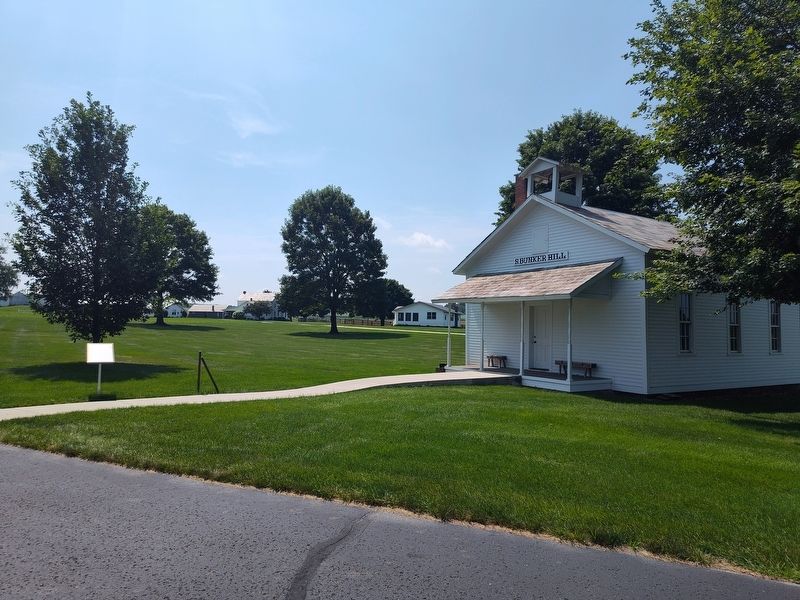
Location. 40° 34.036′ N, 81° 46.85′ W. Marker is in Bunker Hill, Ohio, in Holmes County. It is at the intersection of County Route 77 and County Route 366, on the right when traveling north on County Route 77. Touch for map. Marker is at or near this postal address: 5798 Co Hwy 77, Millersburg OH 44654, United States of America. Touch for directions.

Regionally, this marker is in Amish Country. It is also in the American Midwest, in the Corn Belt, and in Northern Appalachia. Globally, it is in North America, the Western Hemisphere, the Western World, and the Anglosphere. Historically, it finds itself in what was once the Haudenosaunee (Iroquois) Confederacy, the territory of the Mississippian Culture, and the Northwest Territory.
Other nearby markers. At least 8 other markers are within 6 miles of this marker, measured as the crow flies: Pioneer Barn (within shouting distance of this marker); Sgraffito: Immigrants Arriving in the New World (about 300 feet away, measured in a direct line); "Some Gave All..." (approx. one mile away); Arnold Cemetery (approx. 3.3 miles away); Jonas Stutzman (approx. 3.9 miles away); Peace Bridge (approx. 4.1 miles away); "Der Weiss" (approx. 4.4 miles away); West Lawn Cemetery Veterans Memorial (approx. 5.2 miles away). Touch for a list and map of all markers in Bunker Hill.
Credits. This page was last revised on August 9, 2025. It was originally submitted on August 9, 2025, by Craig Doda of Napoleon, Ohio. This page has been viewed 223 times since then and 79 times this year. Photos: 1, 2. submitted on August 9, 2025, by Craig Doda of Napoleon, Ohio. • Andrew Ruppenstein was the editor who published this page.
