Bunker Hill in Holmes County, Ohio — The American Midwest (Great Lakes)
Pioneer Barn

Photographed by Craig Doda, July 26, 2025
1. Pioneer Barn Marker
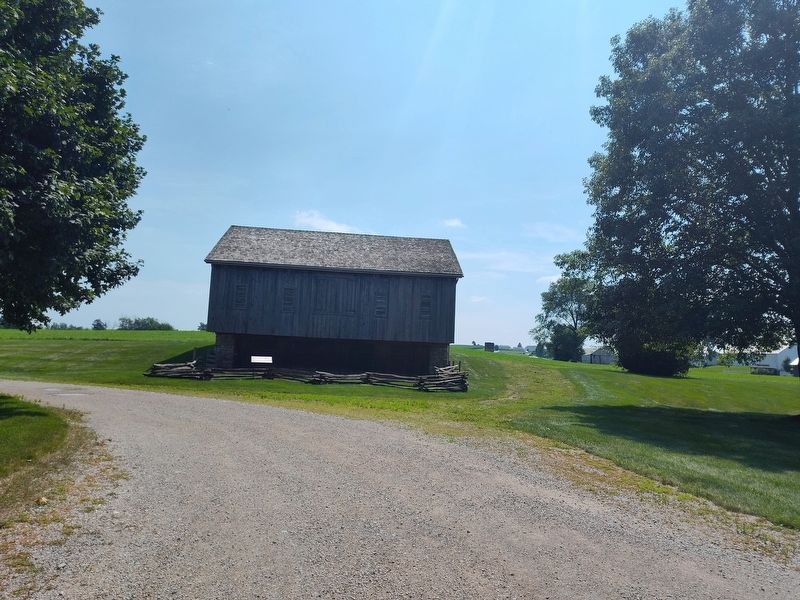
The Pioneer Barn is so-called because of its design, not its age. The 48 foot by 36 foot-barn houses the Eash & Yoder Conestoga Wagon and related artifacts of the pioneer era. Using an 1840-era Pennsylvania barn style (also known as German barn style) is built into a bank for ground level access to the threshing floor. A "forebay" or overhang protects the lower level stable entrances.
The ban design uses standard timber-frame construction joined by mortises and tenons. The beams consist of sawn native red and white oak timbers, and also includes several hand-hewn timbers salvaged from an area barn built in the 1850s. The interior siding is native poplar but the exterior siding is hemlock from north-central Pennsylvania. In a concession to technology, the barn is insulated with 11⁄2-inch foam board. The rail fence comes." from local locust trees and was split by hand.
Built in a traditional barn raising in 2002, the community gathered for a one-day work frolic to raise the barn structure! A construction supervisor with his crew laid out the timbers and cut the mortise and tenon joints in advance of the frolic.
this page online
Conestoga Wagon
The Conestoga Wagon is one of two wagons purchased by Somerset County, Pennsylvania, in about 1835. The Eash family operated the two wagons as a freight service to assist neighbors moving west. Eventually Ohio settlers, ready to move on farther west, employed the Eash wagons to help them move to Indiana, Michigan, and perhaps farther west. But the wagons found their way back to southwestern Pennsylvania.
In 1930, this wagon was sold at auction to a farm neighbor, Levi Yoder. Eventually the wagon passed to son Morgan Yoder and upon his death to his four children. This wagon remained in the two Somerset County families for 150 years.
While stored in a haymow the Conestoga Wagon slowly began to deteriorate until intervention was necessary. Descendants of the Eash and Yoder families and others formed a non-profit corporation to receive the wagon and to finance its restoration. The wagon is on loan to the church from Eash & Yoder Cones Heritage Inc.
Erected by Amish & Mennonite Heritage Center.
Topics. This historical marker
Photographed by Craig Doda, July 26, 2025
2. Pioneer Barn Marker
Location. 40° 34.04′ N, 81° 46.82′ W. Marker is in Bunker Hill, Ohio, in Holmes County. It is at the intersection of County Route 77 and County Route 366, on the right when traveling north on County Route 77. Touch for map. Marker is at or near this postal address: 5798 Co Hwy 77, Millersburg OH 44654, United States of America. Touch for directions.

Regionally, this marker is in Amish Country. It is also in the American Midwest, in the Corn Belt, and in Northern Appalachia. Globally, it is in North America, the Western Hemisphere, the Western World, and the Anglosphere. Historically, it finds itself in what was once the Haudenosaunee (Iroquois) Confederacy, the territory of the Mississippian Culture, and the Northwest Territory.
Other nearby markers. At least 8 other markers are within 6 miles of this marker, measured as the crow flies: Peace Oak (within shouting distance of this marker); Sgraffito: Immigrants Arriving in the New World (about 300 feet away, measured in a direct line); "Some Gave All..." (approx. one mile away); Arnold Cemetery (approx. 3.3 miles away); Jonas Stutzman (approx. 3.9 miles away); Peace Bridge (approx. 4.1 miles away); "Der Weiss" (approx. 4.3 miles away); West Lawn Cemetery Veterans Memorial (approx. 5.2 miles away). Touch for a list and map of all markers in Bunker Hill.
Credits. This page was last revised on August 22, 2025. It was originally submitted on August 9, 2025, by Craig Doda of Napoleon, Ohio. This page has been viewed 98 times since then and 32 times this year. Photos: 1, 2. submitted on August 9, 2025, by Craig Doda of Napoleon, Ohio. • Devry Becker Jones was the editor who published this page.
