
St. Catharines in Niagara Region, Ontario — Central Canada (North America)
St. Catharines
Also Known As
| — | St. Catharines Heritage Corridor | — |
Photographed by Anton Schwarzmueller, July 27, 2014
1. Also Known As Marker
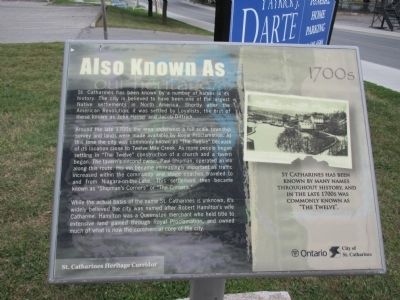
St. Catharines has been known by a number of names in its history. The city is believed to have been one of the largest Native Settlements in North America. Shortly after the American Revolution, it was settled by Loyalists, the first of these known as John Halner and Jacob Ditrick.
Around the late 1700s the area underwent a full scale township survey and lands were made available by Royal Proclamation. At this time the city was commonly known as "The Twelve" because of its location close to Twelve Mile Creek. As more people began settling "The Twelve" construction of a church and a tavern began. The tavern's second owner, Paul Shipman, operated an inn along this route. His inn became increasingly important as traffic increased within the community and stage coaches traveled to and from Niagara-on-the-Lake. This settlement then became known as "Shipman's Corners" or "The Corners."
While the actual basis of the name St. Catharines is unknown, it's widely belived the city was named afer Robert Hamilton's wife Catharine. Hamilton was a Queenston merchant who held title to extensive land gained through Royal Proclaimation,
this page online
St. Catharines has been known by many names throughout history, and in the late 1700s was commonly known as "The Twelve."
Erected by City of St. Catharines.
Topics. This historical marker is listed in this topic list: Settlements & Settlers.
Location. This marker has been replaced by another marker nearby. It was located near 43° 9.772′ N, 79° 14.629′ W. Marker was in St. Catharines, Ontario, in Niagara Region. It was at the intersection of Church Street and Court Street, on the right when traveling south on Church Street. Touch for map. Marker was at or near this postal address: 115 Church Street, St Catharines ON L2R 3C9, Canada. Touch for directions.

Regionally, this marker was on Ontario’s Golden Horseshoe and in Niagara Canada. It was also in Central Canada. Globally, it was in North America, on the Great Lakes, in the Western Hemisphere, in the Western World, and in the Anglosphere. Historically, it found itself in what was once a British colony, the Viceroyalty of New France, the
Photographed by Anton Schwarzmueller, July 27, 2014
2. Also Known As Marker
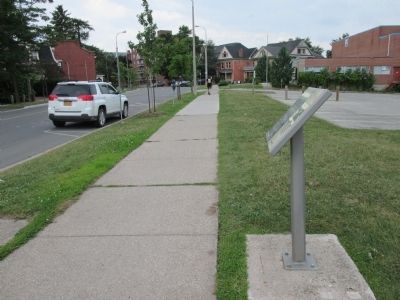
Other nearby markers. At least 8 other markers are within walking distance of this location: St. Catharines - The "Modern" Automobile City (here, next to this marker); Tribute To Women - October 17, 2000 (about 120 meters away, measured in a direct line); Mills-YWCA Building, 1868 (about 150 meters away); Wood-Graham-Bacher Home (about 180 meters away); Grantham Academy 1829 (about 180 meters away); Grantham Academy (about 210 meters away); What's In A Name: "A" not "E" (approx. 0.3 kilometers away); Former Grantham Town Hall, 1950 (approx. 0.3 kilometers away). Touch for a list and map of all markers in St. Catharines.
Photographed by Anton Schwarzmueller, July 27, 2014
3. Also Known As Marker
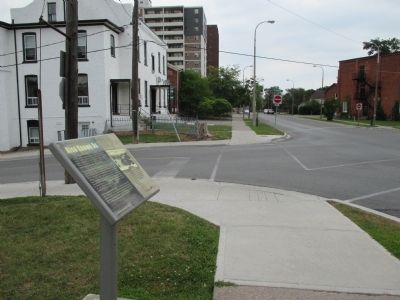
Church Street is one way here; note the do not enter signs.
Credits. This page was last revised on August 15, 2025. It was originally submitted on September 11, 2014, by Anton Schwarzmueller of Wilson, New York. This page has been viewed 665 times since then and 38 times this year. Last updated on August 9, 2025, by Kevin Westell of St. Catharines, Ontario. Photos: 1, 2, 3. submitted on September 11, 2014, by Anton Schwarzmueller of Wilson, New York. • Devry Becker Jones was the editor who published this page.
