Lakeside in Ottawa County, Ohio — The American Midwest (Great Lakes)
Central/Hoover Auditorium
Lakeside Heritage Trail
| — | Lakeside Chautauqua 150 Years 1873 - 2023 | — |
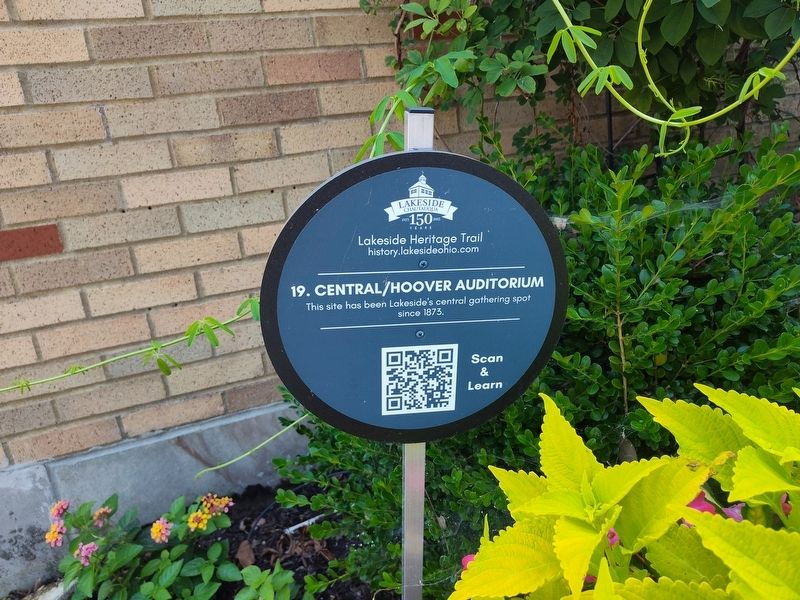
Photographed by Craig Doda, July 24, 2025
1. Central/Hoover Auditorium Marker
Erected 2023 by Lakeside Heritage Society. (Marker Number 19.)
Topics. This historical marker is listed in this topic list: Entertainment. A significant historical year for this entry is 1873.
Location. 41° 32.635′ N, 82° 44.974′ W. Marker is in Lakeside, Ohio, in Ottawa County. It is at the intersection of West 3rd Street and Walnut Avenue, on the right when traveling east on West 3rd Street. Touch for map. Marker is at or near this postal address: 115 W 3rd St, Lakeside Marblehead OH 43440, United States of America. Touch for directions.

Regionally, this marker is on the Lake Erie Shore and in the Toledo Metropolitan Area. It is also in the American Midwest and in the Corn Belt. Globally, it is in North America, on the Great Lakes, in the Western Hemisphere, in the Western World, and in the Anglosphere. Historically, it finds itself in what was once the Viceroyalty of New France, the Haudenosaunee (Iroquois) Confederacy, the territory of the Mississippian Culture, and the Northwest Territory.
Other nearby markers. At least 8 other markers
this page online
Also see . . .
1. Welcome to the Lakeside Heritage Trail. One hundred and fifty years ago, the founders of Lakeside stood on the shores of Lake Erie envisioning a place for the faithful to gather in community. Since then, millions of people have been beckoned to this beautiful, peaceful sanctuary to deepen their connection to Lakeside’s timeless mission…
To enrich the quality of life for all people, to foster traditional Christian values, and to nurture relationships through opportunities for renewal and growth – spiritually, intellectually, culturally and
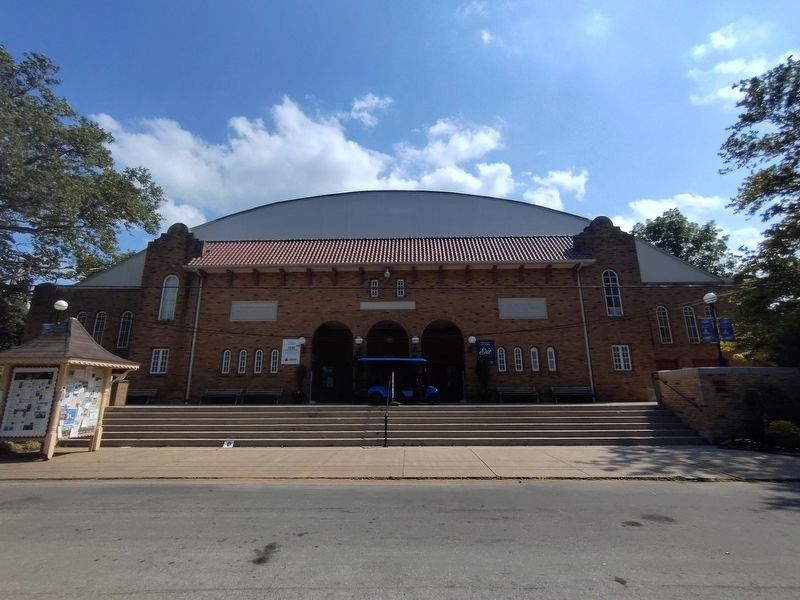
Photographed by Craig Doda, July 24, 2025
2. Central/Hoover Auditorium Marker
With the new year, we welcome Lakeside’s 150th Anniversary – a time to honor the past, celebrate the present and look to the future. This exciting Sesquicentennial Celebration connects us to the mission through enriching religious life programs, educational lectures, cultural arts performances and recreational activities. (Submitted on August 11, 2025, by Craig Doda of Napoleon, Ohio.)
2. 19. Central/Hoover Auditorium. Then
The First Central Auditorium in 1928
A central place for worship and programs was necessary from the very beginning of Lakeside. In 1873, the block where Hoover Auditorium now stands was chosen as the central meeting location. A covered preachers stand and plank bleachers were erected on the north end of the block. A canvas tent was erected over the benches shortly thereafter.
In 1876, a new rectangular 50’ X 70’ tabernacle was erected, replacing the original structure. Known as Central Auditorium, the stage end was enclosed and the sides were open. By 1900, the auditorium was enlarged twice and had a octagonal shape. The sides were covered with
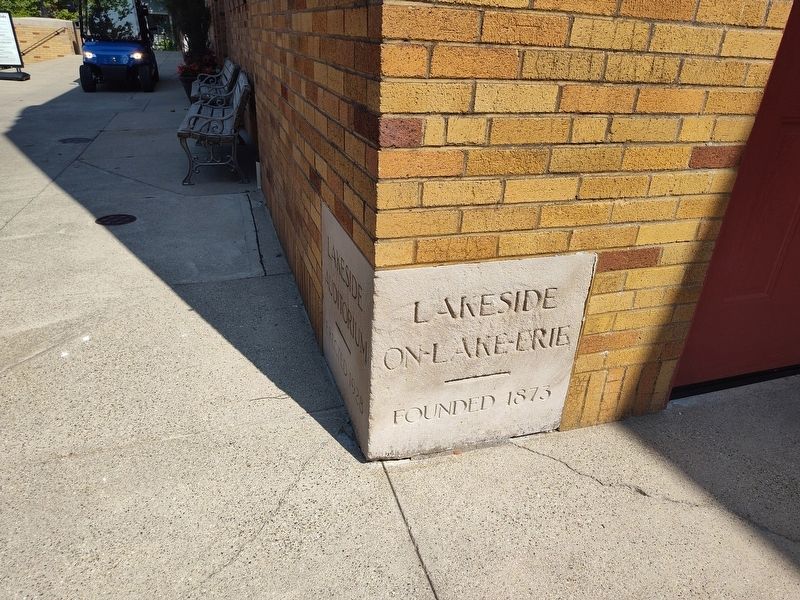
Photographed by Craig Doda, July 24, 2025
3. Central/Hoover Auditorium Marker
A New Modern Auditorium
By the mid 1920’s, it was clear that Lakeside needed a modern auditorium to replace the original Central Auditorium. Lakeside’s General Manager, Arthur L. Hoover, with Board of Trustees President Peter J. Slach and architect Granville E. Scott developed a plan for a new auditorium. The core of the plan included laminated wood arches, patterned after many skating rinks and dance halls being erected at that time. The arches would be the largest and greatest span ever attempted in those days, with the new structure covering the entire block on which stood the old Central Auditorium. The wood used to form the arches was Oregon fir and brought to Lakeside on open flat cars by the New York Central, and Lakeside and Marblehead Railroads.
The Hoover family and Mr. Slach contributed substantially to the new auditorium financing. Much of the Hoover money for the project came from income from the Hoover Potato digger, an important farm implement invented by Mr. Hoover’s
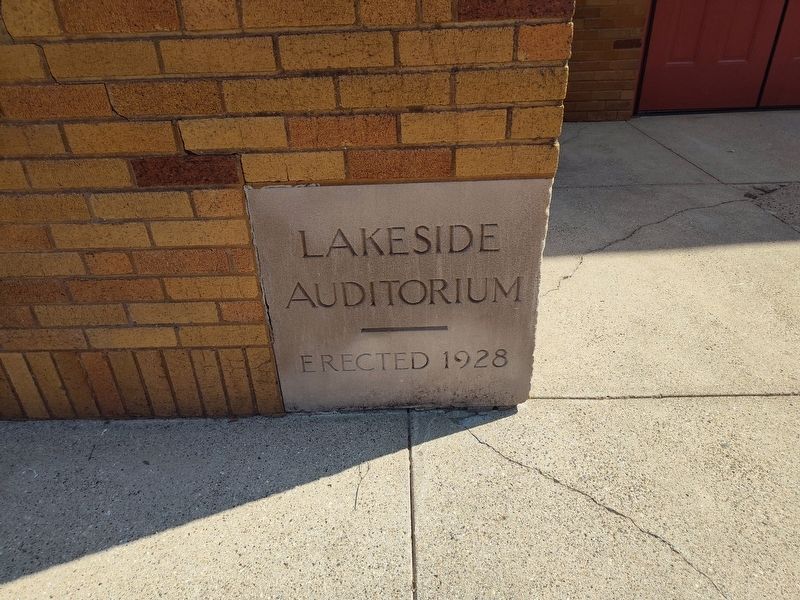
Photographed by Craig Doda, July 24, 2025
4. Central/Hoover Auditorium Marker
A contemporary masterpiece, the auditorium had 3,000 seats, a beautiful 70’ wide proscenium arch framing the 40’ X 110’ stage area, the finest of dressing rooms, rest rooms, curtains, amplification equipment, platform risers and motion picture screen. The main entrance, ticket offices and restrooms were located at the building’s north end. Above these rooms was a state-of-the-art fireproof projection room, making it possible to show the newest rage – sound motion pictures.
But within a year, it was apparent that the new Central Auditorium had major structural problems. Unfortunately, the lumber had been left uncovered throughout the construction and became saturated with water. This made the arches too flexible, and the weight of winter snow resulted in a 3’ sag at the center of the ceiling and the side walls forced out of place by 18”. It was decided to erect steel arches to support the sagging wood arches. 40 large utility

Photographed by Craig Doda, July 24, 2025
5. Central/Hoover Auditorium Marker
In 1947, General Manager Hoover passed away, and in 1949, Central Auditorium was rededicated in his name.
Now
Several interior improvements in sound and projection systems, carpeting, ventilation and seating have taken place over the course of the past 10 years. Ventilation was greatly improved when large ceiling fans were installed. Many of the original seats have been upholstered and refinished. Each was reinstalled at wider spacing for additional comfort and to comply with national disability requirements. As of 2023, Hoover had 2,519 seat spaces and 27 ADA-compliant wheelchair spaces. Dozens of exhibitions and concerts take place in Hoover Auditorium each summer, and Lakesiders will enjoy the beautiful historic building for years to come. (Submitted on August 11, 2025, by Craig Doda of Napoleon, Ohio.)
Credits. This page was last revised on August 26, 2025. It was originally submitted on August 11, 2025, by Craig Doda of Napoleon, Ohio. This page has been viewed 111 times since then and 41 times this year. Photos: 1, 2, 3, 4, 5. submitted on August 11, 2025, by Craig Doda of Napoleon, Ohio. • Devry Becker Jones was the editor who published this page.
