Blanca in Costilla County, Colorado — The American Mountains (Southwest)
Southern San Luis Valley RR D500

Photographed by Cosmos Mariner, July 11, 2025
1. Southern San Luis Valley RR D500 Marker
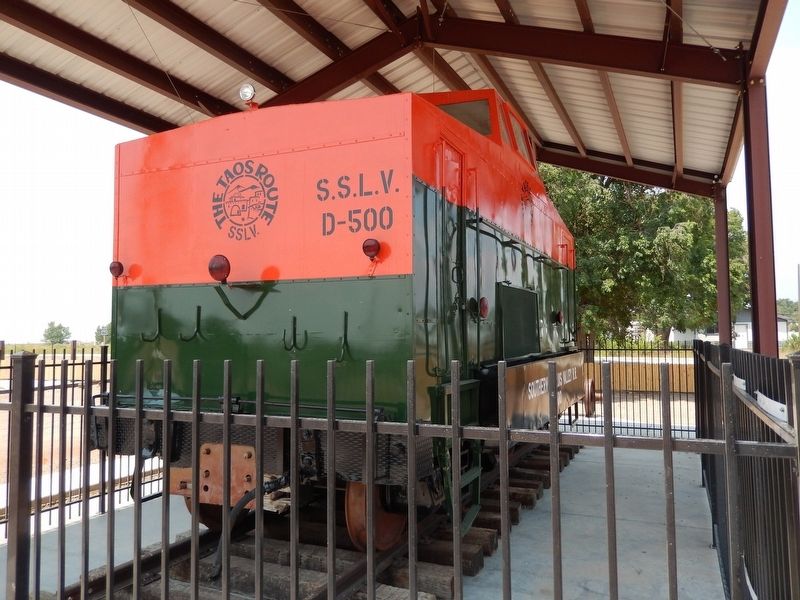
The D500 is a chain-drive diesel-mechanical locomotive built in Mesita, CO, 25 miles south of Blanca, at the workshops of the Colorado Aggregate Co. during 1954-56. It was designed and built by Channel Wilcox of Denver, CO and George Oringdulph of Mesita, CO to replace the SSLV's aging ex-D&RGW steam locomotives. A second-hand diesel was beyond the railroad's means so it decided to build its own. Available was former D&RGW idler car No.010798, which was the underframe and wheelsets (trucks) of a steam locomotive tender from which the coal bunker and water tank had been removed, and castings, each having one standard gauge and two narrow gauge coupler pockets, installed at both ends. Thus the D&RGW could use it to move both standard and narrow gauge cars in a single train over dual gauge track between Alamosa, CO and Antonito, CO. The rear coupler casting is missing but the front one remains in place.
The SSLV had no need to move narrow gauge cars but could use the idler as a basis for its project. An International Harvester UD-24 diesel, designed for bulldozers and IH's most powerful engine at the time, was installed driving,
this page online
After the D500 proved its ability to successfully operate from Blanca, CO to Jaroso, CO the SSLV, in 1957, retired its remaining operable steam locomotive. It, as the last D&RGW standard gauge survivor, is displayed at the Colorado RR Museum, Golden CO as D&RG No.583, its original number. The

Photographed by Cosmos Mariner, July 11, 2025
2. Southern San Luis Valley RR D500 Marker
This is the rightmost of two historical markers mounted on the railing in front of the SSLV D500 Locomotive.
Topics. This historical marker is listed in this topic list: Railroads & Streetcars. A significant historical year for this entry is 1954.
Location. 37° 26.121′ N, 105° 31.018′ W. Marker is in Blanca, Colorado, in Costilla County. It is at the intersection of U.S. 160 and Smith Avenue, on the right when traveling east on U.S. 160. Touch for map. Marker is in this post office area: Blanca CO 81123, United States of America. Touch for directions.

Regionally, this marker is in the San Juan Mountains and in the San Luis Valley. It is also

Photographed by Cosmos Mariner, July 11, 2025
3. Southern San Luis Valley Railroad Exhibit
This is the rightmost of two historical markers mounted on the railing in front of the SSLV D500 Locomotive.
Other nearby markers. At least 8 other markers are within 6 miles of this marker, measured as the crow flies: The San Luis Southern Railway (here, next to this marker); Trails Through Time (approx. ¼ mile away); Fort Garland / Buffalo Soldiers (approx. 4.8 miles away); a different marker also named Fort Garland (approx. 4.8 miles away); Costilla County Veterans Memorial (approx. 5.3 miles away); "The Magic Dog" (approx. 5½ miles away); On Sacred Ground (approx. 5½ miles away); Welcome "Caminante" to ... (approx. 5½ miles away). Touch for a list and map of all markers in Blanca.
Another marker is no longer nearby. Fort Garland (was approx. 4.8 miles away but has been permanently removed).
Related markers. Click here for a list of markers that are related to this marker.
Also see . . .
1. Southern San Luis Valley Railroad (Wikipedia).
Excerpt: McClintock and Oringdulph(Submitted on August 12, 2025, by Cosmos Mariner of Cape Canaveral, Florida.)knew their two steam locomotives, #105 and #106, both Consolidation types, purchased from the Denver and Rio Grande Western Railroad were too costly to maintain. They took the D&RGW steam locomotive tender frame (D&RGW #964) which they had purchased in 1950 and after an abortive attempt at building a locomotive on the tender frame, a successful machine was completed in 1955. It was a strange-looking locomotive they called the D-500. It rolled on standard locomotive tender trucks which were powered by a sprocket and chain drive. Power was from an International Harvester, 1091 cubic inch, UD24 diesel engine. The power went through a Caterpillar hydraulic transmission, which in turn powered an old Euclid truck axle, which transmitted power through sprockets and chains to the axles. The odd locomotive, which resembled a caboose, was built in a cupola style for visibility and to ease the installation of the prime mover. The locomotive was built by SSLV mechanics in Mesita, Colorado. All steam trains on the SSLV ceased operating in 1957.Photographed by Cosmos Mariner, July 11, 20254. Southern San Luis Valley RR D500 (front view)

2. A Home-built Locomotive – Southern San Luis Valley D-500.
Photographed by Cosmos Mariner, July 11, 2025
5. Southern San Luis Valley RR D500 (back view)
(includes numerous photos of the abandoned D-500 before its restoration)(Submitted on August 12, 2025, by Cosmos Mariner of Cape Canaveral, Florida.)
Excerpt: As ugly as it is, it is a true testament to shortline railroading and the ingenuity put forth to keep operating on a shoestring budget. Bob Griswold called the D-500 the “Slow moving conglomerate of Caterpillar, International Harvester, Euclid and other assorted moving parts and mechanisms” in his book Colorado’s Loneliest Railroad – the San Luis Southern.

Photographed by Cosmos Mariner, July 11, 2025
6. Southern San Luis Valley RR D500
Credits. This page was last revised on August 12, 2025. It was originally submitted on August 11, 2025, by Cosmos Mariner of Cape Canaveral, Florida. This page has been viewed 483 times since then and 161 times this year. Photos: 1, 2, 3, 4. submitted on August 11, 2025, by Cosmos Mariner of Cape Canaveral, Florida. 5, 6. submitted on August 12, 2025, by Cosmos Mariner of Cape Canaveral, Florida.
