Tinker Air Force Base in Oklahoma City in Oklahoma County, Oklahoma — The American South (West South Central)
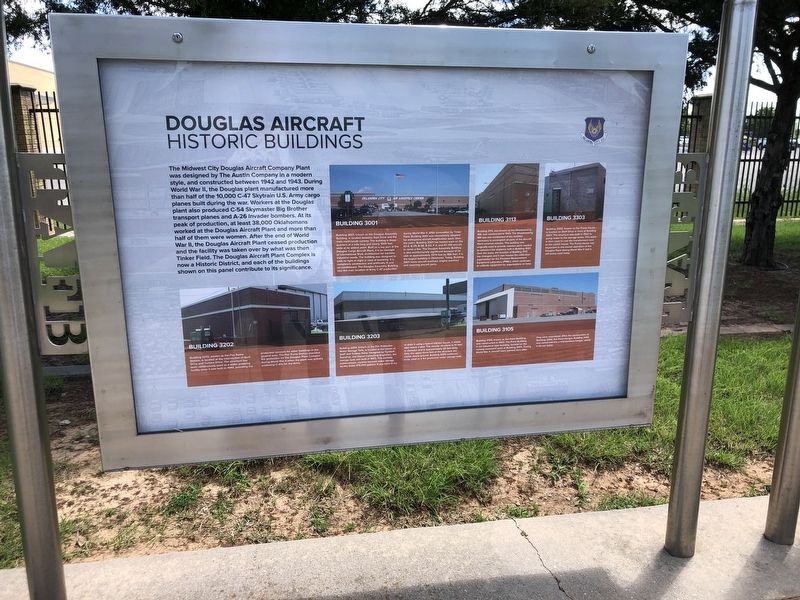
Douglas Aircraft Historic Buildings
Photographed by Duane and Tracy Marsteller, June 21, 2025
1. Douglas Aircraft Historic Buildings Marker
Building 3001
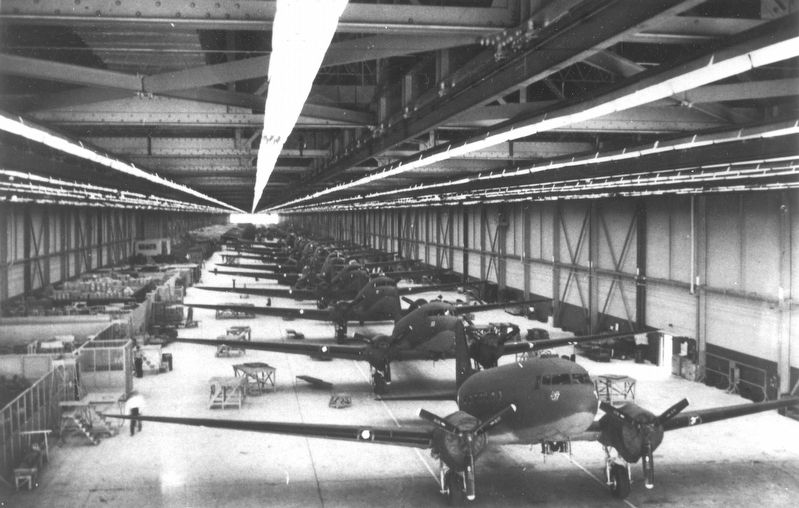
Building 3001, known as the Douglas Assembly Building, is located between East Drive and the main north/south runway. The building is three-quarters of a mile long and nearly 1000 feet wide at its widest point. Built as a key part of the Douglas Cargo Aircraft Plant, it is an example of International style architecture
this page online
Building 3113
Building 3113, also known as the Woodworking Mill, was constructed in 1943. The Woodworking Mill was one component of the facilities necessary to accomplish all parts of the Aircraft Plant common mission. This building was originally used to provide wooden parts needed to construct the airplanes built in Building 3001. Over the years, the function of Building 3113 has changed, and it now houses the calibration
Photographed by Duane and Tracy Marsteller, June 21, 2025
2. Douglas Aircraft Historic Buildings Marker
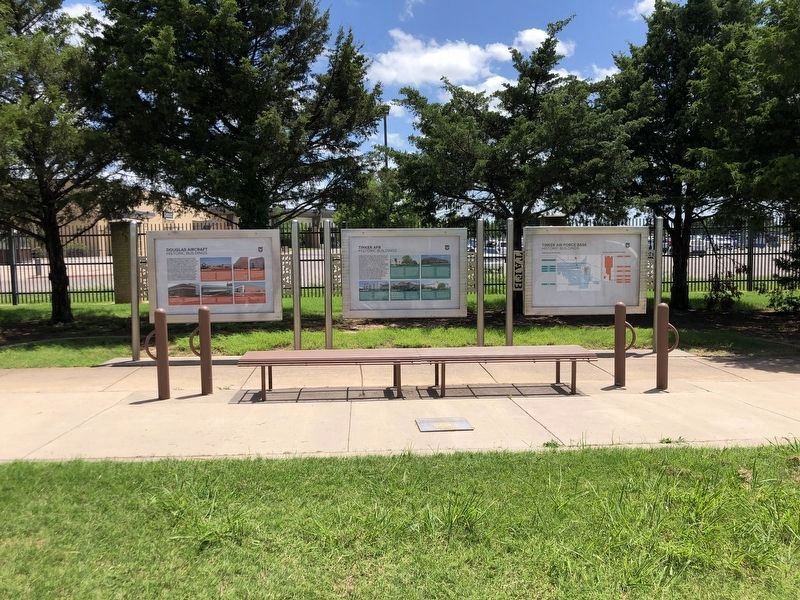
This marker is on the left.
Building 3303
Building 3303, known as the Pump House, is located on Staff Drive in front of Building 3001. The structure was built in 1943 to pump water to the storage tanks. This water is then used to cool the transformers next to the switch house. The Pump House was important to the overall operation of the Douglas Plant during World War II and is still being used today.
Building 3202
Building 3202, known as the Fire Pump Station, is located at the intersection of Staff Drive and Turbine Drive. The structure has been continuously used as a water pumping facility since it was built in 1943, providing fire protection services for other buildings in the general area. The Fire Pump Station provided fire protection for the Douglas Plant complex during World War II when the plant was actively producing C-47s for the Army.
Building 3203
Building 3203, known as the Fire Protection Water Storage Tank, is located at the corner of Staff and Turbine Drive. Designed by Turnbull, Sverdrup, and Parcel
Unidentified; via Tinker Air Force Base History Office (Public Domain), 1943
3. C-47s lined up in Building 3001
Building 3105
Building 3105, known as the Paint Building, was constructed in 1943. The Paint Building is an industrial type building, located on the runway easement west of Building 3001. During World War II, aircraft were painted here after they were assembled. After the construction of Building 2280, the Paint Hangar, Building 3105 was converted into a maintenance hangar, which is its use today.
Topics. This historical marker is listed in these topic lists: Air & Space • Architecture • Industry & Commerce • War, World II. A significant historical year for this entry is 1942.
Location. 35° 26.009′ N, 97° 24.252′ W. Marker is in Oklahoma City, Oklahoma, in Oklahoma
Photographed by Duane and Tracy Marsteller, June 21, 2025
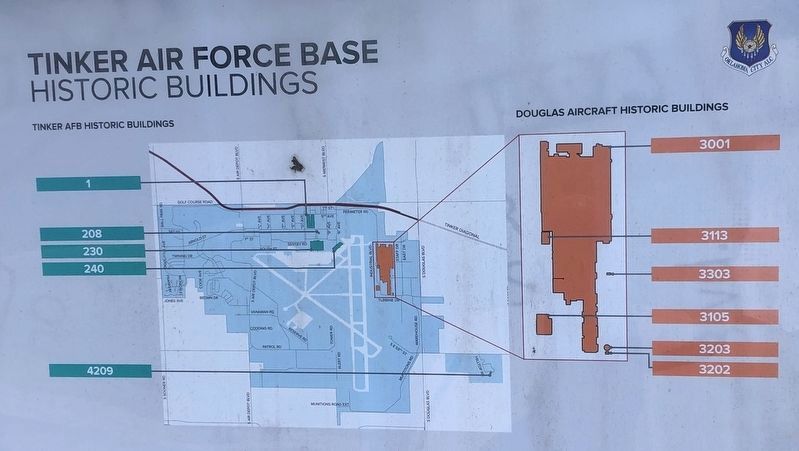
4. Douglas Aircraft Historic Buildings Map

Regionally, this marker is in Central Oklahoma—Frontier Country. It is also in the American South, specifically on the prairies, and on the Southern Plains. Globally, it is in North America, the Western Hemisphere, the Western World, and the Anglosphere. Historically, it finds itself in what was once the territory of the Mississippian Culture and also the Louisiana Purchase.
Other nearby markers. At least 8 other markers are within walking distance of this marker: Tinker AFB Historic Buildings (here, next to this marker); Tinker Air Force Base 75th Anniversary Time Capsule (here, next to this marker); C-135 “Stratolifter” (a few steps from this marker); EA-6B “Prowler” (within shouting distance of this marker); C-141 “Starlifter” (within shouting distance of this marker); “Rosie the Riveter” (within shouting distance of this marker); C-47 “Skytrain” (within shouting distance of this marker); F-4D “Phantom II” (within shouting distance of this marker). Touch for a list and map of all markers in Oklahoma City.
More about this marker. It is in Charles B. Hall Airpark at the entrance to Tinker Air Force Base. The airpark is open to the public from dawn to dusk daily unless heightened security warrants closure.
Also see . . . World War II and the Story of Douglas Aircraft Plants in Tulsa and Midwest Citv (PDF). Inside a windowless building nearly a mile long, workers in Tulsa assembled four-engine bombers, twin-engine attack planes, and dive bombers. East of Oklahoma City (now part of Midwest City), men and women built cargo aircraft used to transport soldiers, equipment, and supplies throughout Europe and the Pacific. In addition to helping launch Oklahoma's modern aviation industry, aircraft plants in Tulsa and Midwest City brought lasting economic and social change. (Thomas A. Wikle, in The Chronicles of Oklahoma, 2017) (Submitted on August 12, 2025, by Duane and Tracy Marsteller of Murfreesboro, Tennessee.)
Credits. This page was last revised on August 12, 2025. It was originally submitted on August 11, 2025, by Duane and Tracy Marsteller of Murfreesboro, Tennessee. This page has been viewed 217 times since then and 88 times this year. Photos: 1. submitted on August 11, 2025, by Duane and Tracy Marsteller of Murfreesboro, Tennessee. 2, 3, 4. submitted on August 12, 2025, by Duane and Tracy Marsteller of Murfreesboro, Tennessee.
