Tinker Air Force Base in Oklahoma City in Oklahoma County, Oklahoma — The American South (West South Central)
Tinker AFB Historic Buildings
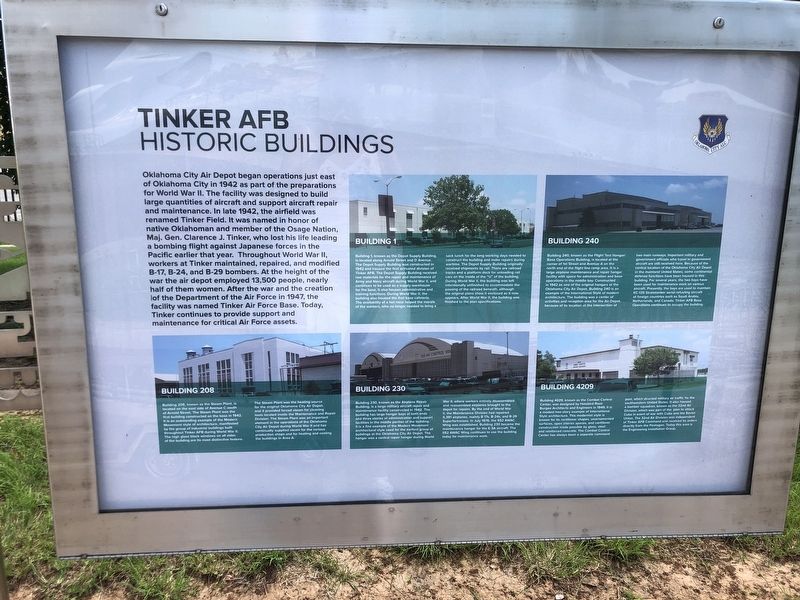
Photographed by Duane and Tracy Marsteller, June 21, 2025
1. Tinker AFB Historic Buildings Marker
Building 1
Building 1, known as the Depot Supply Building, is located along Arnold Street and O Avenue. The Depot Supply Building was constructed in 1942 and housed the first activated division of Tinker AFB. The Depot
this page online
Building 240
Building 240, known as the Flight Test Hangar/Base Operations Building, is located at the corner of 1st Street and Avenue A on the north end of the flight line ramp area. It is a large

Photographed by Duane and Tracy Marsteller, June 21, 2025
2. Tinker AFB Historic Buildings Marker
This marker is in the middle.
Building 208
Building 208, known as the Steam Plant, is located on the east side of Avenue C south of Arnold Street. The Steam Plant

Photographed by Duane and Tracy Marsteller, June 21, 2025
3. Tinker AFB Historic Buildings Map
Building 230
Building 230, known as the Airplane Repair Building, is a large military aircraft repair and maintenance facility constructed in 1942. The building has large hangar bays at both ends and three stories of administration and support facilities in the middle portion of the building. It is a fine example of the Modern Movement architectural style used for the earliest group of buildings at the Oklahoma City Air Depot. The hangar was a central repair hangar during World War II, where workers entirely disassembled and reassembled airplanes brought to the depot for repairs. By the end of World War II, the Maintenance Division had repaired 5,391 airplanes, mainly B-17s, B-24s, and B-29 Superfortresses. In July 1976, the 552 AWAC Wing was established. Building 230 became the maintenance hangar for the E-3A aircraft. The 552 AWAC Wing continues to use the building today for maintenance work.
Building 4209
Building 4209, known as the Combat Control Center, was designed by Holabird-Root-Burgee Architects and Engineers in 1949. It is a modest two-story example of International Style architecture. This modernist style is known for its rectilinear shapes, unornamented surfaces, open interior spaces, and cantilever construction made possible by glass, steel and reinforced concrete. The Combat Control Center has always been a separate command post, which directed military air traffic for the southwestern United States. It also housed a bomber squadron, known as the 32nd Air Division, which was part of the plan to attack Cuba in event of war with Cuba and the Soviet Union. The 32nd Air Division was independent of Tinker AFB Command and received its orders directly from the Pentagon. Today this area is the Engineering Installation Group.
Topics. This historical marker is listed in these topic lists: Air & Space • Architecture • Military • War, World II. A significant historical year for this entry is 1942.
Location. 35° 26.009′ N, 97° 24.254′ W. Marker is in Oklahoma City, Oklahoma, in Oklahoma County. It is in Tinker Air Force Base. It can be reached from South Air Depot Boulevard south of Interstate 40, on the left when traveling south. Touch for map. Marker is in this post office area: Oklahoma City OK 73145, United States of America. Touch for directions.

Regionally, this marker is in Central Oklahoma—Frontier Country. It is also in the American South, specifically on the prairies, and on the Southern Plains. Globally, it is in North America, the Western Hemisphere, the Western World, and the Anglosphere. Historically, it finds itself in what was once the territory of the Mississippian Culture and also the Louisiana Purchase.
Other nearby markers. At least 8 other markers are within walking distance of this marker: Douglas Aircraft Historic Buildings (here, next to this marker); Tinker Air Force Base 75th Anniversary Time Capsule (here, next to this marker); C-135 “Stratolifter” (a few steps from this marker); EA-6B “Prowler” (within shouting distance of this marker); C-141 “Starlifter” (within shouting distance of this marker); “Rosie the Riveter” (within shouting distance of this marker); C-47 “Skytrain” (within shouting distance of this marker); F-4D “Phantom II” (within shouting distance of this marker). Touch for a list and map of all markers in Oklahoma City.
More about this marker. It is in Charles B. Hall Airpark at the entrance to Tinker Air Force Base. The airpark is open to the public from dawn to dusk daily unless heightened security warrants closure.
Credits. This page was last revised on August 12, 2025. It was originally submitted on August 12, 2025, by Duane and Tracy Marsteller of Murfreesboro, Tennessee. This page has been viewed 305 times since then and 139 times this year. Photos: 1, 2, 3. submitted on August 12, 2025, by Duane and Tracy Marsteller of Murfreesboro, Tennessee.
