Bessemer in Pueblo in Pueblo County, Colorado — The American Mountains (Southwest)
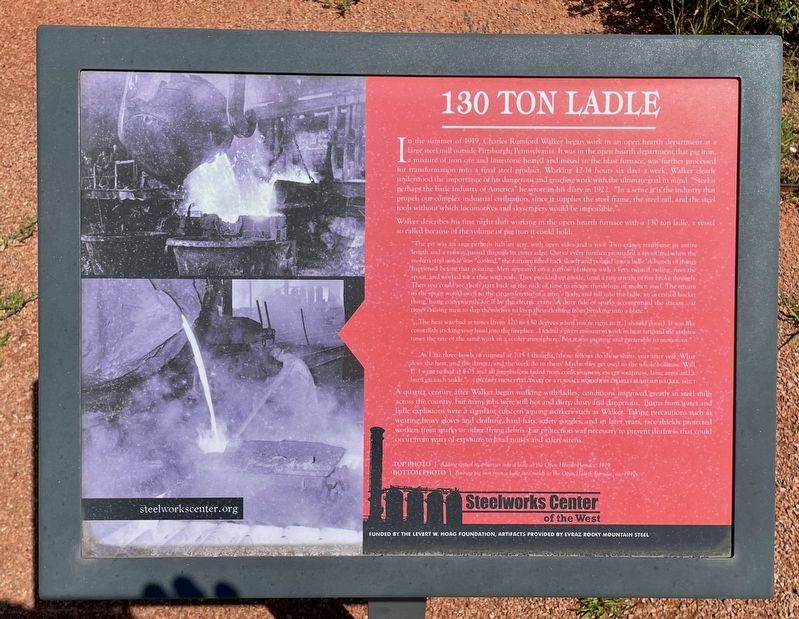
130 Ton Ladle
| — | Steelworks Center of the West | — |
Photographed by Mark Hilton, August 11, 2025
1. 130 Ton Ladle Marker
In the summer of 1919, Charles Rumford Walker began work in an open hearth department at a large steel mill outside Pittsburgh; Pennsylvania. It was in the open hearth department that pig iron, a mixture of fron ore and limestone heated and mixed in the blast furnace, was further processed for transformation into a final steel product. Working 12-14 hours six days a week, Walker clearly understood the importance of his dangerous and grueling work with the ultimate goal in mind. "Steel is perhaps the basic industry of America" he wrote in his diary in 1922. "In a sense it is the industry that propels our complex industrial civilization, since it supplies the steel frame, the steel rail, and the steel tools without which locomotives and skyscrapers would be impossible."
Walker describes his first night shift working in the open hearth furnace with a 130 ton ladle, a vessel so called because of the volume of pig iron it could hold:
"The pit was an area perhaps half an acre, with open sides and a roof. Two cranes transverse its entire length and a railway passed through its outer edge. Out of every furnace protruded a spout and when the molten steel inside was "cooked," the furnace tilted back slowly and poured into a ladle. A bunch of things happened before that pouring. Men appeared on a narrow platform with a very twisted railing, near the spout, and worked for a time with rods. They prodded up inside, until a tiny stream of fire broke through. Then you could see them start back in the nick of time to escape the deluge of molten steel. The stream in the spout would swell to the circumference of a pran's body, and fall into the ladle, an oversized bucket thing, hung conveniently for if by the electric crane. A dizzy tide of sparks accompanied the stream... at times causing men to slap themselves to keep their clothing from breaking into a blaze."
"...The heat was bad at times (from 120 to 130 degrees when you're right in it, I should guess). It was like constantly sticking your head into the fireplace... I found a given amount of work in heat fatigued ufe as three times the rate of the same work in a cooler atmosphere. But it was exciting and preferable to monotony."
"...As I ate three bowls of oatmeal at 7:15 I thought, those fellows do these shifts, year after year. What does the heat, and the danger, and the work do to them? Maybe they get used to the whole business: Will I? I went to bed at 8:05 and all impressions faded from consciousness, except weariness, lame arms and a burn on each ankle." (Excerpt from Steel Diary of a Furnace Worker by Charles Rumford Walker, 1922.)
A
this page online
Photos:
Top: Adding special recarbonizer into a ladle at the Open Hearth Furnace; 1919
Bottom: Pouring pig from a ladle into molds at the Open, Hearth Furnace, ca 1940s
Funded by the Levert W. Hoag Foundation, artifacts provided by Evraz Rocky Mountain Steel
Erected by Steelworks Center of the West.
Topics. This historical marker is listed in this topic list: Industry & Commerce. A significant historical year for this entry is 1919.
Location. 38° 14.323′ N, 104° 36.733′ W. Marker is in Pueblo, Colorado, in Pueblo County. It is in Bessemer. It can be reached
Photographed by Mark Hilton, August 11, 2025
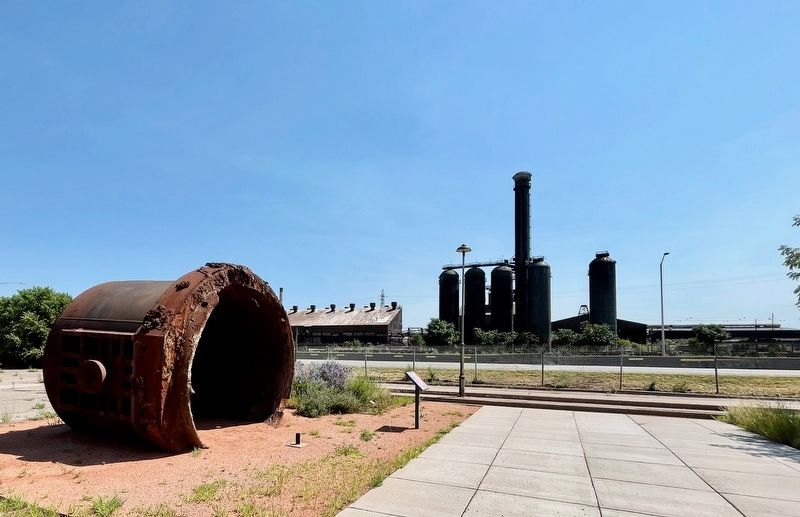
2. 130 Ton Ladle & marker.

Regionally, this marker is in Colorado’s Arkansas River Valley and in the Front Range. It is also in the American Mountain West. Globally, it is in North America, the Rocky Mountains, the Western Hemisphere, the Western World, and the Anglosphere. Historically, it finds itself in what was once the Comanchería and also the Republic of Texas.
Other nearby markers. At least 8 other markers are within 2 miles of this marker, measured as the crow flies: 1950s Allen Mine (a few steps from this marker); Rail Manufacturing (a few steps from this marker); The Colorado Fuel & Iron Company (within shouting distance of this marker); Ore Carts (within shouting distance of this marker); 10 Ton Ladle (within shouting distance of this marker); Site of YMCA #2 (within shouting distance of this marker); Karymor (about 300 feet away, measured in a direct line); The Mormon Battalion (approx. 1.3 miles away). Touch for a list and map of all markers in Pueblo.
Also see . . . Steelworks Park. (Submitted on August 13, 2025, by Mark Hilton of Montgomery, Alabama.)
Credits. This page was last revised on August 13, 2025. It was originally submitted on August 13, 2025, by Mark Hilton of Montgomery, Alabama. This page has been viewed 85 times since then and 19 times this year. Photos: 1, 2. submitted on August 13, 2025, by Mark Hilton of Montgomery, Alabama.
