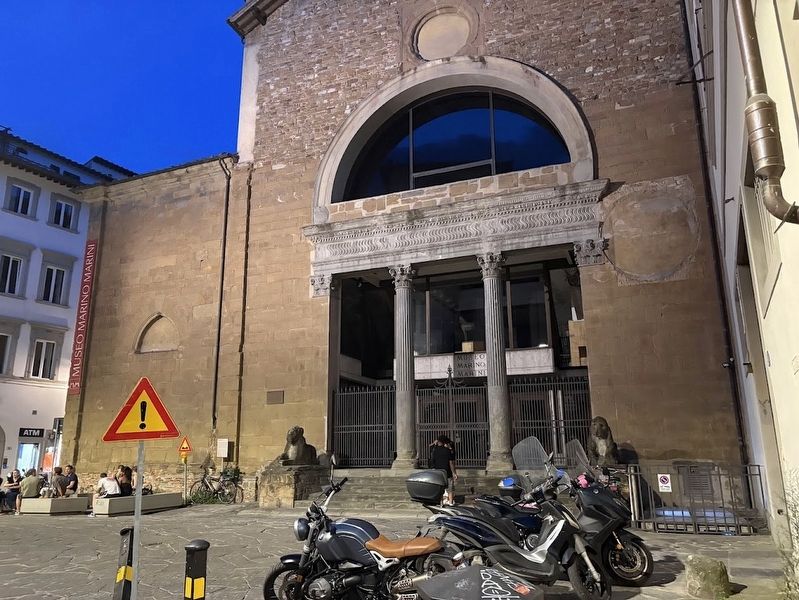
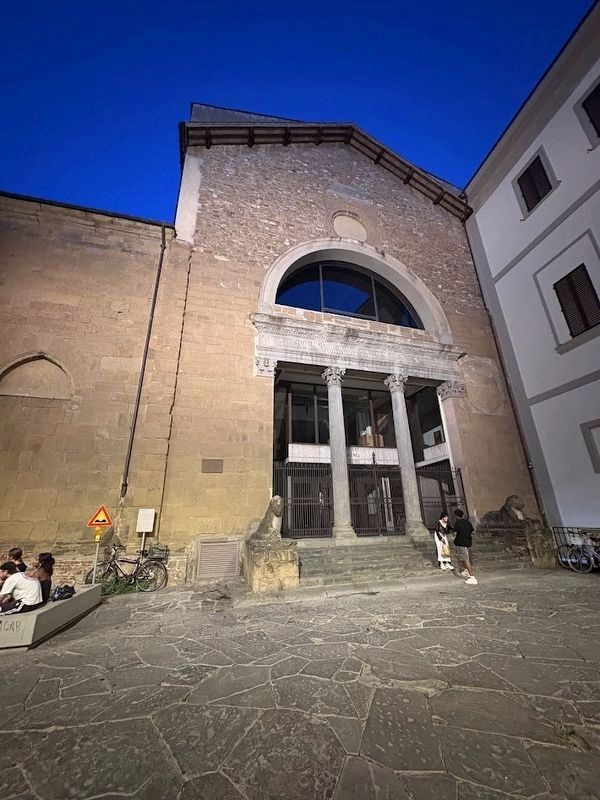
Santa Maria Novella in Firenze in Città Metropolitana di Firenze, Tuscany, Italy — Southern and Western Europe (Mediterranean)
Museo Marino Marini
Già chiesa di San Pancrazio ⎯⎯⎯ Formerly the church of San Pancrazio
Photographed by Sean P. Flynn, July 24, 2025
1. Museo Marino Marini Marker
Inscription.
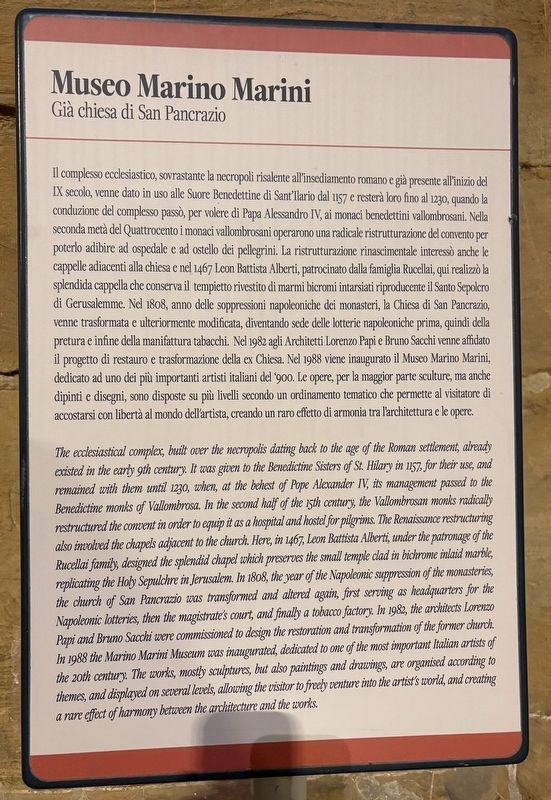
Museo Marino Marini. Già chiesa di San Pancrazio, also, Formerly the church of San Pancrazio. Il complesso ecclesiastico, sovrastante la necropoli risalente all'insediamento romano e già presente all'inizio del IX secolo, venne dato in uso alle Suore Benedettine di Sant'llario dal 1157 e resterà loro fino al 1230, quando la conduzione del complesso passò, per volere di Papa Alessandro IV, ai monaci benedettini vallombrosani. Nella seconda metà del Quattrocento i monaci vallombrosani operarono una radicale ristrutturazione del convento per poterlo adibire ad ospedale e ad ostello dei pellegrini. La ristrutturazione rinascimentale interessò anche le cappelle adiacenti alla chiesa e nel 1467 Leon Battista Alberti, patrocinato dalla famiglia Rucellai, qui realizzò la splendida cappella che conserva il tempietto rivestito di marmi bicromi intarsiati riproducente il Santo Sepolcro di Gerusalemme. Nel 1808, anno delle soppressioni napoleoniche dei monasteri, la Chiesa di San Pancrazio, venne trasformata e ulteriormente modificata, diventando sede delle lotterie napoleoniche prima, quindi della pretura e infine della manifattura tabacchi. Nel 1982 agli Architetti Lorenzo Papi e Bruno Sacchi venne affidato il progetto di restauro e trasformazione della ex Chiesa. Nel 1988 viene inaugurato il Museo Marino Marini, dedicato ad uno dei più importanti artisti italiani del '900. Le opere, per la maggior parte sculture, ma anche dipinti e disegni, sono disposte su più livelli secondo un ordinamento tematico che permette al visitatore di accostarsi con libertà al mondo dell'artista, creando un raro effetto di armonia tra l'architettura e le opere. , , The ecclesiastical complex, built over the necropolis dating back to the age of the Roman settlement, already existed in the early 9th century. It was given to the Benedictine Sisters of St. Hilary in 1157, for their use, and remained with them until 1230, when, at the behest of Pope Alexander IV, its management passed to the Benedictine monks of Vallombrosa. In the second half of the 15th century, the Vallombrosan monks radically restructured the convent in order to equip it as a hospital and hostel for pilgrims. The Renaissance restructuring also involved the chapels adjacent to the church. Here, in 1467, Leon Battista Alberti, under the patronage of the Rucellai family, designed the splendid chapel which preserves the small temple clad in bichrome inlaid marble, replicating the Holy Sepulchre in Jerusalem. In 1808, the year of the Napoleonic suppression of the monasteries, the church of San Pancrazio was transformed and altered again, first serving as headquarters for the Napoleonic lotteries, then the magistrate's court, and finally a tobacco factory. In 1982, the architects Lorenzo Papi and Bruno Sacchi were commissioned to design the restoration and transformation of the former church. In 1988 the Marino Marini Museum was inaugurated, dedicated to one of the most important Italian artists of the 20th century. The works, mostly sculptures, but also paintings and drawings, are organised according to themes, and displayed on several levels, allowing the visitor to freely venture into the artist's world, and creating a rare effect of harmony between the architecture and the works.
Il complesso ecclesiastico, sovrastante la necropoli risalente all'insediamento romano e già presente all'inizio del IX secolo, venne dato in uso alle Suore Benedettine di Sant'llario dal 1157 e resterà loro fino al 1230, quando la conduzione del complesso passò, per volere di Papa Alessandro IV, ai monaci benedettini vallombrosani. Nella seconda metà del Quattrocento i monaci vallombrosani operarono una radicale ristrutturazione del convento per poterlo adibire ad ospedale e ad ostello dei pellegrini. La ristrutturazione rinascimentale interessò anche le cappelle adiacenti alla chiesa e nel 1467 Leon Battista Alberti, patrocinato dalla famiglia Rucellai, qui realizzò la splendida cappella che conserva il tempietto rivestito di marmi bicromi intarsiati riproducente il Santo Sepolcro di Gerusalemme. Nel 1808, anno delle soppressioni napoleoniche dei monasteri, la Chiesa di San Pancrazio, venne trasformata e ulteriormente modificata, diventando sede delle lotterie napoleoniche prima, quindi della pretura e infine della manifattura tabacchi. Nel 1982 agli Architetti Lorenzo Papi e Bruno Sacchi venne affidato il progetto di restauro e trasformazione della ex Chiesa. Nel 1988 viene inaugurato il Museo Marino Marini, dedicato ad uno dei più importanti artisti italiani del '900. Le opere, per la maggior parte sculture, ma anche dipinti e disegni,
Click or scan to see this page online
sono disposte su più livelli secondo un ordinamento tematico che permette al visitatore di accostarsi con libertà al mondo dell'artista, creando un raro effetto di armonia tra l'architettura e le opere.
The ecclesiastical complex, built over the necropolis dating back to the age of the Roman settlement, already existed in the early 9th century. It was given to the Benedictine Sisters of St. Hilary in 1157, for their use, and remained with them until 1230, when, at the behest of Pope Alexander IV, its management passed to the Benedictine monks of Vallombrosa. In the second half of the 15th century, the Vallombrosan monks radically restructured the convent in order to equip it as a hospital and hostel for pilgrims. The Renaissance restructuring also involved the chapels adjacent to the church. Here, in 1467, Leon Battista Alberti, under the patronage of the Rucellai family, designed the splendid chapel which preserves the small temple clad in bichrome inlaid marble, replicating the Holy Sepulchre in Jerusalem. In 1808, the year of the Napoleonic suppression of the monasteries, the church of San Pancrazio was transformed and altered again, first serving as headquarters for the Napoleonic lotteries, then the magistrate's court, and finally a tobacco factory. In 1982, the architects Lorenzo Papi and Bruno Sacchi were commissioned to design the restoration and transformation
Photographed by Sean P. Flynn, July 24, 2025
2. Museo Marino Marini Marker
The marker is to the left of the doorway.
of the former church. In 1988 the Marino Marini Museum was inaugurated, dedicated to one of the most important Italian artists of the 20th century. The works, mostly sculptures, but also paintings and drawings, are organised according to themes, and displayed on several levels, allowing the visitor to freely venture into the artist's world, and creating a rare effect of harmony between the architecture and the works.
Location. 43° 46.316′ N, 11° 14.989′ E. Marker is in Firenze, Toscana (Tuscany), in Città Metropolitana di Firenze. It is in Santa Maria Novella. It is on Piazza di San Pancrazio, on the right. The marker is to the left of the museum's doorway. Touch for map. Marker is in this post office area: Firenze, Toscana 50123, Italy. Touch for directions.

Regionally, it is in Europe, the European Union, the Schengen Area, a coastal Mediterranean country, and the Western World. Historically, it finds itself in what was once the Byzantine Empire, the Roman Empire, and specifically the Holy Roman Empire.
Also see . . . Marino Marini: Life and History. From the museum's official site (Submitted on August 14, 2025, by Sean P. Flynn of Oak Park, Illinois.)
Credits. This page was last revised on August 14, 2025. It was originally submitted on August 14, 2025, by Sean P. Flynn of Oak Park, Illinois. This page has been viewed 140 times since then and 15 times this year. Photos:1, 2, 3. submitted on August 14, 2025, by Sean P. Flynn of Oak Park, Illinois.