Oakville in Halton Region, Ontario — Central Canada (North America)
68 and 70 Navy Street
Photographed by Tim Boyd, August 15, 2025
1. 68 and 70 Navy Street Marker
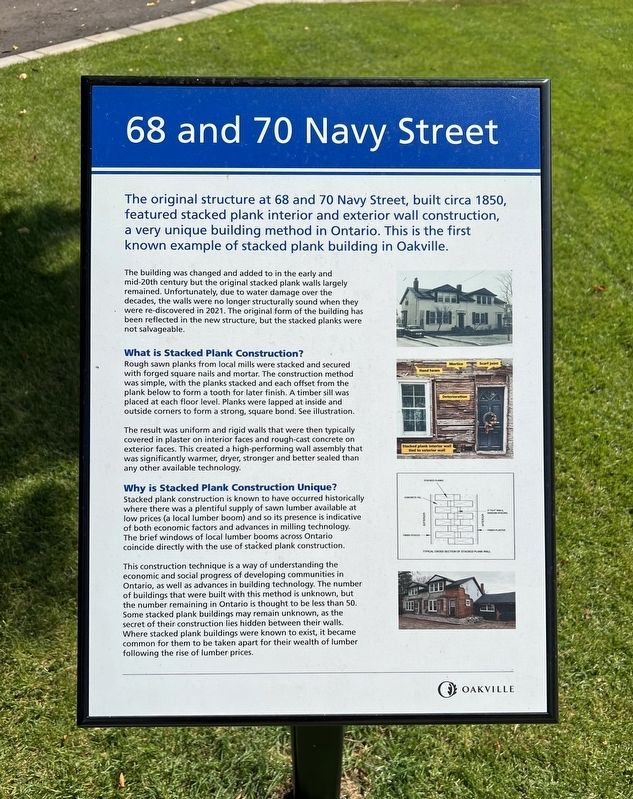
The building was changed and added to in the early and mid-20th century but the original stacked plank walls largely remained. Unfortunately, due to water damage over the decades, the walls were no longer structurally sound when they were re-discovered in 2021. The original form of the building has been reflected in the new structure, but the stacked planks were not salvageable.
What is Stacked Plank Construction?
Rough sawn planks from local mills were stacked and secured with forged square nails and mortar. The construction method was simple, with the planks stacked and each offset from the plank below to form a tooth for later finish. A timber sill was placed at each floor level. Planks were lapped at inside and outside corners to form a strong, square bond. See illustration.
The result was uniform and rigid walls that were then typically covered in plaster on interior
this page online
Why is Stacked Plank Construction Unique?
Stacked plank construction is known to have occurred historically where there was a plentiful supply of sawn lumber available at low prices (a local lumber boom) and so its presence is indicative of both economic factors and advances in milling technology. The brief windows of local lumber booms across Ontario coincide directly with the use of stacked plank construction.
This construction technique is a way of understanding the economic and social progress of developing communities in Ontario, as well as advances in building technology. The number of buildings that were built with this method is unknown, but the number remaining in Ontario is thought to be less than 50. Some stacked plank buildings may remain unknown, as the secret of their construction lies hidden between their walls. Where stacked plank buildings were known to exist, it became common for them to be taken apart for their wealth
Photographed by Tim Boyd, August 15, 2025
2. 68 and 70 Navy Street Marker
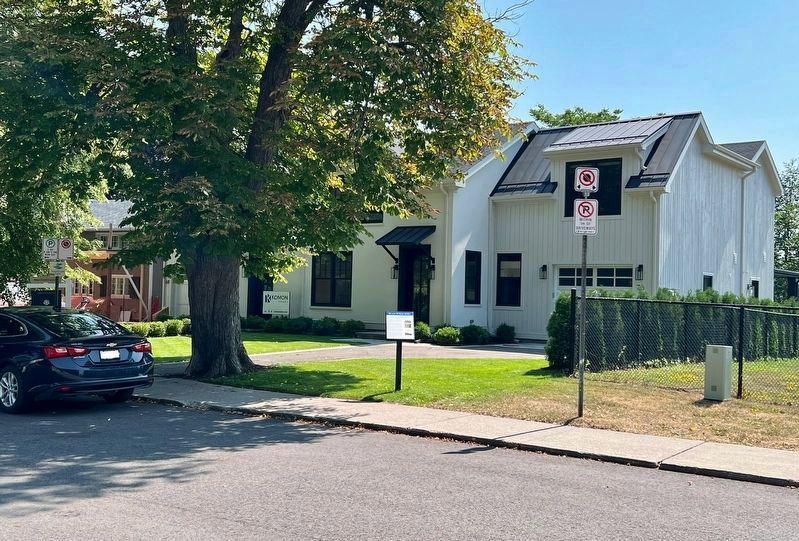
The new structures are behind the marker
Erected by Town of Oakville.
Topics. This historical marker is listed in this topic list: Architecture. A significant historical year for this entry is 1850.
Location. 43° 26.604′ N, 79° 40.133′ W. Marker is in Oakville, Ontario, in Halton Region. It is at the intersection of Navy Street and Robinson Street, on the right when traveling south on Navy Street. Touch for map. Marker is at or near this postal address: 70 Navy Street, Oakville ON L6J 2Y9, Canada. Touch for directions.

Regionally, this marker is in Greater Toronto, specifically on the Golden Horseshoe, in the Hamilton-Halton-Brant Area, and specifically in the Toronto Metropolitan Area. It is also in Central Canada. Globally, it is in North America, on the Great Lakes, in the Western Hemisphere, in the Western World, and in the Anglosphere. Historically, it finds itself in what was once a British colony, the Viceroyalty of New France, the Haudenosaunee (Iroquois) Confederacy, and Rupert’s Land.
Other nearby markers. At least 8 other markers are within walking distance of this marker: Vision for Oakville (within shouting distance of this marker); Early Leaders (within shouting distance of this marker); Commercial Buildings (within shouting distance of this marker); Period Homes (within shouting distance of this marker); a different marker also named Period Homes (within shouting distance of this marker); The Lock-up & Town Hall (within shouting distance of this marker); St. Jude’s Anglican (about 120 meters away, measured in a direct line); The Old Lighthouse (about 180 meters away). Touch for a list and map of all markers in Oakville.
Credits. This page was last revised on August 16, 2025. It was originally submitted on August 15, 2025, by Tim Boyd of Hamilton, Ontario. This page has been viewed 69 times since then and 12 times this year. Photos: 1, 2. submitted on August 15, 2025, by Tim Boyd of Hamilton, Ontario. • Andrew Ruppenstein was the editor who published this page.
