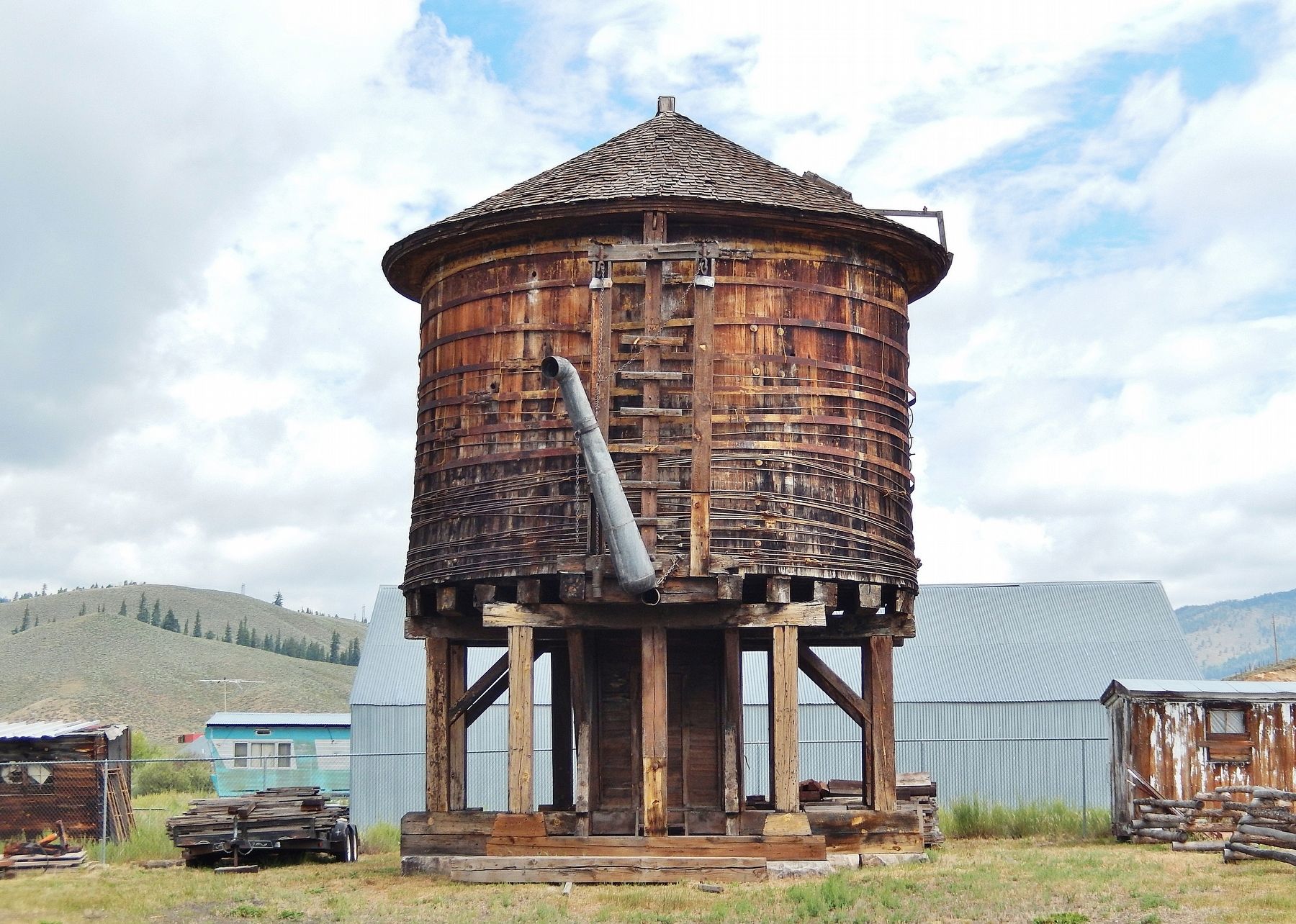
Sargents Water Tank
Denver & Rio Grande Western Railroad

Originally established as Marshalltown in 1880, the little narrow-gauge railroad town was renamed in 1882 after Local Rancher, Postmaster and Merchant, Joseph Sargent. By 1881 Sargents had become the site of a D&RGW helper station. Many helper engines were needed for the long pull up the Marshall Pass grade.
The current tank was built in 1937 to replace the smaller original tank and was one of the largest on the narrow-gauge line. Although these water tanks were located every few miles along the narrow-gauge tracks, few remain on their original site.
The Upper Tomichi Historical & Community Association acquired the structure in 2005 to ensure its preservation. Donations for this cause are accepted and appreciated. The tank sits on private property. Please respect the property owner by observing and photographing from this point. This sign funded in part by donations to the Lila Smoot Memorial Fund.
Topics and series. This historical marker is listed in these topic lists: Architecture • Railroads & Streetcars. In addition, it is included in the National Register of Historic Places (NRHP) series list. A significant historical date for this entry is June 15, 1937.
Location. 38° 24.255′ N,
this page online

Regionally, this marker is on Colorado’s Continental Divide, in the San Juan Mountains, and in the San Luis Valley. It is also in the American Mountain West. Globally, it is in North America, the Rocky Mountains, the Western Hemisphere, the Western World, and the Anglosphere. Historically, it finds itself in what was once New Spain and also the Republic of Texas.
Other nearby markers. At least one other marker is within walking distance of this marker: Sargents Schoolhouse (about 400 feet away, measured in a direct line).
Regarding Sargents Water Tank. National Register of Historic Places № 10000537 and Colorado State Register of Historic Places № 5SH.3633.
From the National Register Nomination prepared by Ruby Vocke, Madeline Jennings & Nola Means, 12/29/2009:
TheSargents Water Tank, located on the Denver and Rio Grande Railroad’s (D&RG) former Western Line, was built June 15, 1937 according to primary source documentation from the D&RG ledgers at the Colorado Railroad Museum in Golden, Colorado. This tank was built adjacent to the site of an original water tank, constructed circa 1881, that was dismantled by the railroad because it was not large enough to hold the volume of water needed for the engines traveling the long, steep climb over Marshall Pass at an elevation of 10,842 feet. The 1937 water tank remains in its original location in Sargents, Colorado at an elevation of 8,477 feet. 2. Marker detail: Water Tank & Locomotive № 268
This rail line originated in Pueblo and ran west to its termination in Salt Lake City, Utah. The D&RG referred to this rail route as Marshall Pass or the Western Line. The route operated from August 6, 1881 until 1955 from Salida west to Poncha Junction. Originally the site also featured an engine house and turntable, bunkhouse, handcar house, tool house, shed, oil house, sand house, coal house, coal chute, trestle approach, and livestock pens. These buildings either fell into disrepair or were demolished in
conjunction with the railroad’s closure in 1955. 3. Marker detail: Route of the Denver & Rio Grande Railway over Marshall Pass
The tank provided water for a vast number of steam locomotives traveling the pass from its construction in 1937 through the closing of the line in 1955. Trains were unable to ascend the pass without stocking water from the tank at Sargents. Tanks of identical design, materials, and construction were built throughout the D&RGW system with only a handful of these structures surviving. The Sargents water tank is the only surviving example in its original location along the entire length of the Marshall Pass route.
Also see . . .
1. Sargents Water Tank (History Colorado).
Excerpt: The 1937 Denver & Rio Grande Western (D&RGW) water tank at Sargents is significant for its association with the operations of the D&RGW Railroad on its Marshall Pass Route. It is further significant in the area of Engineering as representative of a distinctive design and construction method associated with water tanks for the railroad.(Submitted on August 17, 2025, by Cosmos Mariner of Cape Canaveral, Florida.)
2. Sargents, Colorado (Wikipedia).
Excerpt: The town owed its existence to(Submitted on August 17, 2025, by Cosmos Mariner of Cape Canaveral, Florida.)the Denver and Rio Grande Railroad, which crossed the Continental Divide over Marshall Pass and descended 17 miles to Sargents before following Tomichi Creek west to Gunnison. This line of the Denver & Rio Grande Railroad ultimately connected Denver, Colorado with Salt Lake City, Utah and points farther west. The station in Sargents was home to helper engines that assisted heavily laden trains over the pass. The Sargents station had a roundhouse, a turntable, and a water tank. It was an important depot for the export of mine ore and lumber produced in the area, and it was also used by passengers traveling to and from the mining camps and towns in the upper Tomichi Creek valley.Photographed by Cosmos Mariner, July 23, 20254. Sargents Water Tank MarkerThe historic water tank is about 25 meters behind the marker.

Credits. This page was last revised on August 25, 2026. It was originally submitted on August 16, 2025, by Cosmos Mariner of Cape Canaveral, Florida. This page has been viewed 156 times since then and 66 times this year. Photos: 1, 2, 3. submitted on August 16, 2025, by Cosmos Mariner of Cape Canaveral, Florida. 4, 5. submitted on August 17, 2025, by Cosmos Mariner of Cape Canaveral, Florida.
