Boley in Okfuskee County, Oklahoma — The American South (West South Central)
Boley
All-Black Towns of Oklahoma

Photographed by Duane and Tracy Marsteller, June 21, 2025
1. Boley Marker
All-Black towns grew after the Civil War when the former slaves of the Five Civilized Tribes settled together for mutual protection and economic security. When the lands of the tribes were allotted to individuals, most Indian “freedmen” chose land next to other African Americans. This created prosperous farming communities that could support towns.
When the land run of 1889 opened yet more land to non-Indian settlement, African Americans from the Old South rushed to the new territory for free land. Edwin McCabe founded Langston and encouraged African Americans to settle in his all-Black town. He even had a vision for an all-Black state. Although his dream was never realized, many all-Black communities were established on the rich topsoil of the new territory and state.
The all-Black towns of Oklahoma prospered until
this page online
Boley
Boley was founded by T.M. Haynes on land owned by Abigal Barnett, a Creek “freedman”. Lake Moore, vice president of the Ft. Smith & Western Railroad wanted to establish a depot at the Boley site believing African Americans were capable of governing themselves. Boley was named after J.B. Boley, a retired railroad official. Founded in 1903 and incorporated in 1905, Boley prospered. The Boley Progress, a weekly paper, began in 1905. The paper and advertising campaigns lured many residents to the new town. By 1911 Boley boasted more than 4,000 citizens (25,000 with surrounding areas) which supported many businesses, including two banks and three cotton gins.
Booker T. Washington visited the town and called it, “the most enterprising and in many ways the most interesting Negro town in the United States.” The towne supported
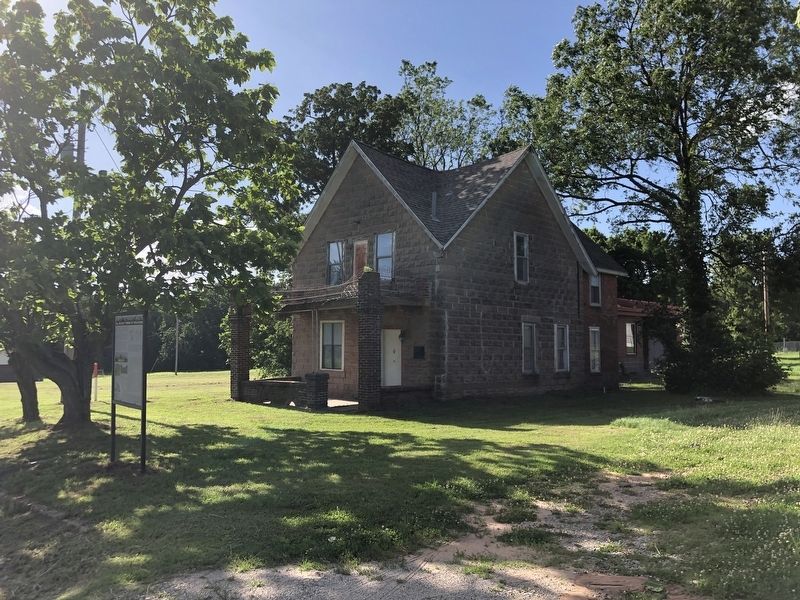
Photographed by Duane and Tracy Marsteller, June 21, 2025
2. Boley Marker
Like many rural towns, Boley suffered through the hard times of the 1920s and 1930s. By World War II the population had declined to 700 people. At the dawn of a new century, the town is hopeful again. The downtown business district is a National Historic Landmark. The John Lilly Correctional Center, Smokarama, and the Boley Public School System provide jobs to the area. The town hosts the oldest African-American community-based rodeo every Memorial Day weekend.
Captions (clockwise from top left)
• Town council, ca. 1907-10
• Main Street looking north
• Some early business owners and leaders of the community included: Thomas Haynes • Henry Cavil • Hilliard Taylor • James Holloway • Jno. Allen White • David Williamson • Robert McCornick • Thomas McCornick • Jaom Mims • Robb Smith • Isaac Finch • James Clipper • Albert Combs • James Robinson • Harrison Jones • Handy Jackson • James Oldham • Adolphea Everett • Hardy Cherry • David Turner • William Woods • Thomas Armstrong • Milton Wallace • Marcus Perry • James Hawkins • Leonard McCormick • William Chandler • T.B. Armstrong • J.H. Bagby • M.W. Brown • Joseph Cambell • Annie Cowan • W.F. David • Lewis Dolphin • E.L. Eubanks • J.S. Fisher • G.W. Harris • L.N. Holmes • J.A. Jefferson • H.J. Jones • S.J. King • W.C. Love • W.H. McLeon • J.H. McRiley • S.M. Mathonican • S.A. Montgomery • S.L. Morris • B. Oliver • G.W. Parks • R.C.B. Quinn • C.H. Russan • R.B. Smith • A.E. Stephenson • J.C. Stil1 • N.E.C. Still • G.D. Washington • S.W. Williams • T.L. Woods • Dr. R.W. Brown • Dr. F. Burnley • Dr. W. Paxton • Dr. J. Scott • Dr. C. Powell • Dr. J. White • Dr. W. Foster • E. Tyler • Wm. Peters • Moses Jones • D.C. Fitzgerald • P.H. Wells • C. Chambers • O. Bradley • M. Sorell • and D.E. Johnson.
• St. Emanuel Cemetery North is located three and one half miles southeast of Boley.
• St. Emanuel Cemetery South is located three and one half miles southeast of Boley.
• Boley High School, ca. 1917.
Topics and series.
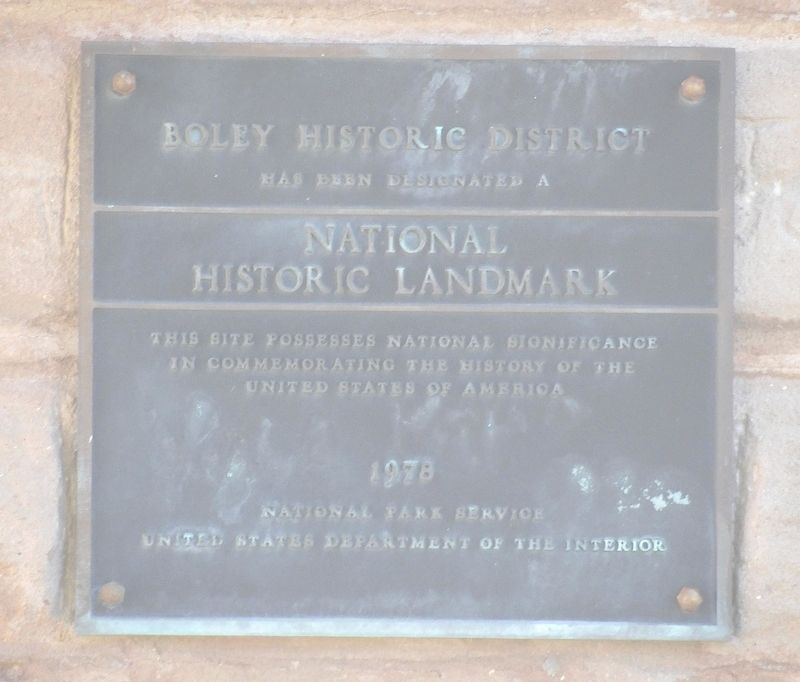
Photographed by Duane and Tracy Marsteller, June 21, 2025
3. Boley National Historic Landmark plaque
It was designated in 1979.
Location. 35° 29.604′ N, 96° 29.048′ W. Marker is in Boley, Oklahoma, in Okfuskee County. It is on Pecan Street. Touch for map. Marker is at or near this postal address: 13 Pecan St, Boley OK 74829, United States of America. Touch for directions.

Regionally, this marker is in Oklahoma’s Muscogee Nation. It is also in the American South, specifically on the prairies, and on the Southern Plains. Globally, it is in North America, the Western Hemisphere, the Western World, and the Anglosphere. Historically, it finds itself in what was once the territory of the Mississippian Culture and also the Louisiana Purchase.
Other nearby markers. At least 8 other markers are within 11 miles of this marker, measured as the crow flies: Founders of Boley-Pioneer (approx. ¼ mile away); J.B. Boley (approx. ¼ mile away); Boley, Oklahoma (approx. 0.4 miles away); Okfuskee County, Rosenwald Schools, and Boley (approx.
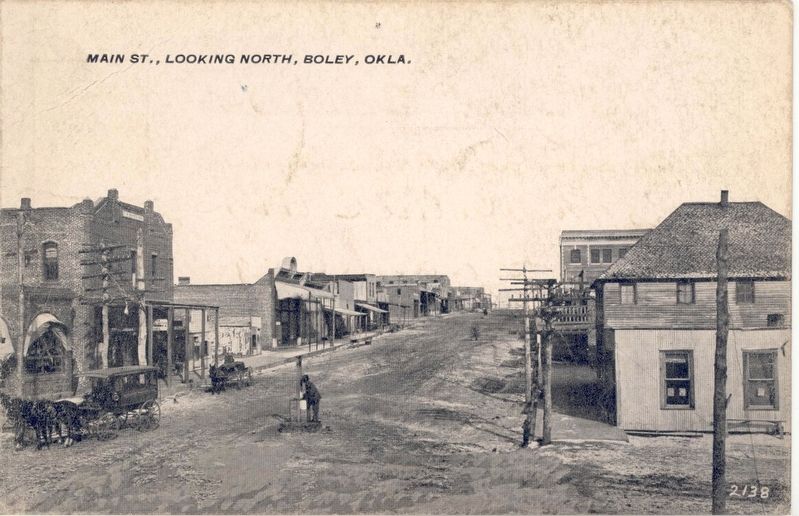
Unknown; Oklahoma Historical Society via The Gateway to Oklahoma History (fair use)
4. Main Street Looking North, Boley, Oklahoma
The men in the street is drawing water from the town well in this undated photograph.
Also see . . . Boley Historic District (PDF). National Historic Landmark nomination for the town, which was designated in 1979. (Prepared by Marcia M. Greenlee, Afro-American Bicentennial Corp.; via Oklahoma State Historic Preservation Office) (Submitted on August 17, 2025, by Duane and Tracy Marsteller of Murfreesboro, Tennessee.)
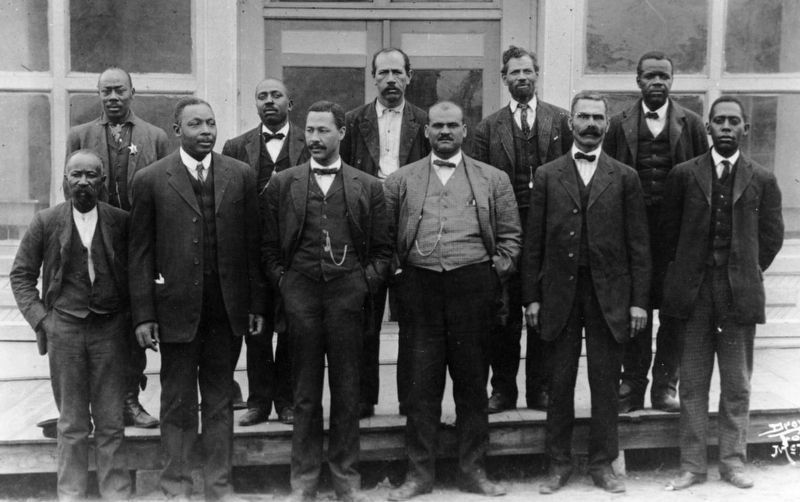
Unknown; Oklahoma Historical Society via The Gateway to Oklahoma History (fair use), circa 1907/10
5. Boley Town Council
Front row (left to right): William H. Wallace, T.B. Armstrong, D.J. Turner, Thomas M. Haynes, H.C. Cavil, and M.J. Jones. Back row (left to right): Wash Williams, Dr. Calvin Bethel Powell, C.C. Chambers, T.R. Ringo, and W.A. Kennedy.
Credits. This page was last revised on August 17, 2025. It was originally submitted on August 16, 2025, by Duane and Tracy Marsteller of Murfreesboro, Tennessee. This page has been viewed 141 times since then and 54 times this year. Photos: 1. submitted on August 16, 2025, by Duane and Tracy Marsteller of Murfreesboro, Tennessee. 2, 3, 4, 5. submitted on August 17, 2025, by Duane and Tracy Marsteller of Murfreesboro, Tennessee.
