
Garden District in Toronto, Ontario — Central Canada (North America)
O’Donohoe Row (Walnut Hall)
Photographed by Andrew Ruppenstein, August 11, 2025
1. O’Donohoe Row (Walnut Hall) Marker
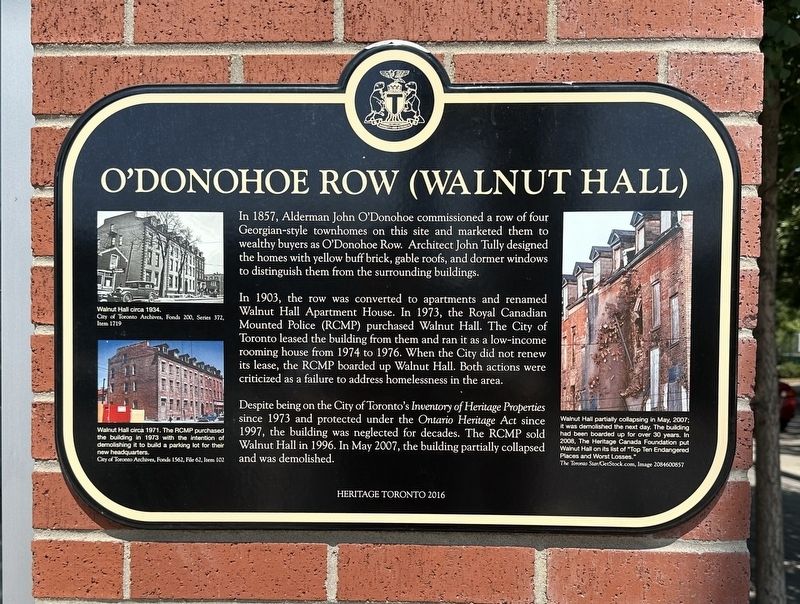
In 1857, Alderman John O'Donohoe commissioned a row of four Georgian-style townhomes on this site and marketed them to wealthy buyers as O'Donohoe Row. Architect John Tully designed the homes with yellow buff brick, gable roofs, and dormer windows to distinguish them from the surrounding buildings.
In 1903, the row was converted to apartments and renamed Walnut Hall Apartment House. In 1973, the Royal Canadian Mounted Police (RCMP) purchased Walnut Hall. The City of Toronto leased the building from them and ran it as a low-income rooming house from 1974 to 1976. When the City did not renew its lease, the RCMP boarded up Walnut Hall. Both actions were criticized as a failure to address homelessness in the area.
Despite being on the City of Toronto's Inventory of Heritage Properties since 1973 and protected under the Ontario Heritage Act since 1997, the building was neglected for decades. The RCMP sold Walnut Hall in 1996. In May 2007, the building partially collapsed and was demolished.
Erected 2016 by Heritage Toronto.
Topics and series. This historical marker is listed in this topic list:
this page online
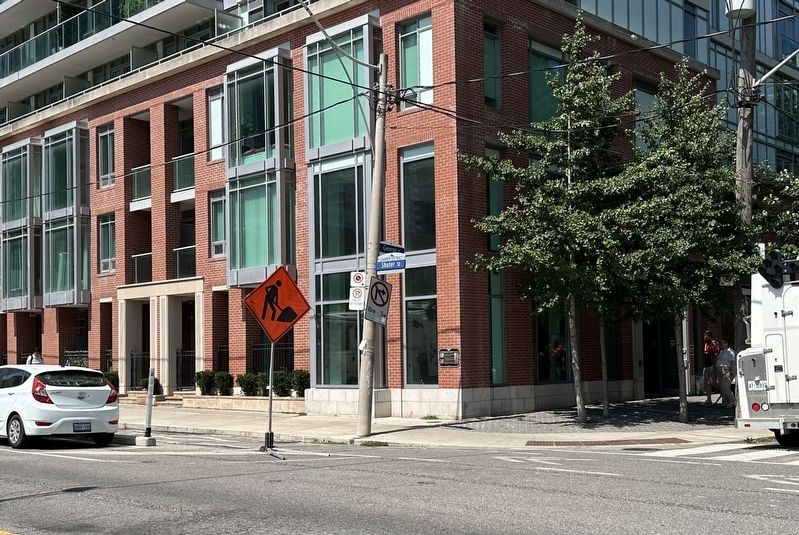
Location. 43° 39.342′ N, 79° 22.376′ W. Marker is in Toronto, Ontario. It is in the Garden District. It is at the intersection of Shuter Street and George Street, on the right when traveling west on Shuter Street. Touch for map. Marker is at or near this postal address: 220 George Street, Toronto ON M5A 2N1, Canada. Touch for directions.

Regionally, this marker is in Greater Toronto and on the Golden Horseshoe. It is also in Central Canada. Globally, it is in North America, on the Great Lakes, in the Western Hemisphere, in the Western World, and in the Anglosphere. Historically, it finds itself in what was once a British colony, the Viceroyalty of New France, the Haudenosaunee (Iroquois) Confederacy, and Rupert’s Land.
Other nearby markers. At least 8 other markers are within walking distance of this marker: Early Greek Orthodox Community (about 90 meters away, measured in a direct line); Cooper and Gillespie Houses (about 210 meters away); International Union of Operating Engineers Local 793
Photographed by Andrew Ruppenstein, August 11, 2025
2. O’Donohoe Row (Walnut Hall) Marker - wide view
Also see . . . Walnut Hall (Wikipedia). The ending:
In 2004, Walnut Hall appeared in the film Cinderella Man when the derelict building was used to portray a 1930s New York City-streetscape.(Submitted on August 17, 2025.)
In March 2007, Trisan Realty Corp. purchased the property with the intention of restoring Walnut Hall. On May 19, 2007, however, police and fire officials were called to the site when pedestrians noticed bricks falling from the second and third storeys. By the end of the afternoon, parts of the rear walls had begun to cave in. That evening, a city building inspector recommended that Walnut Hall be demolished for safety reasons, and the demolition was undertaken that night.
In 2008, Heritage Canada included Walnut Hall in its annual list of "Worst Losses", referring to the building's neglect and demolition as "a case of architectural euthanasia". Michael McClelland, a heritage architect and a founding member of the Canadian Association of Professional Heritage Consultants, described the loss of Walnut Hall as being emblematic of a "broken" heritage preservation system in Toronto.
Credits. This page was last revised on February 24, 2026. It was originally submitted on August 17, 2025, by Andrew Ruppenstein of Lamorinda, California. This page has been viewed 131 times since then and 22 times this year. Photos: 1, 2. submitted on August 17, 2025, by Andrew Ruppenstein of Lamorinda, California.
