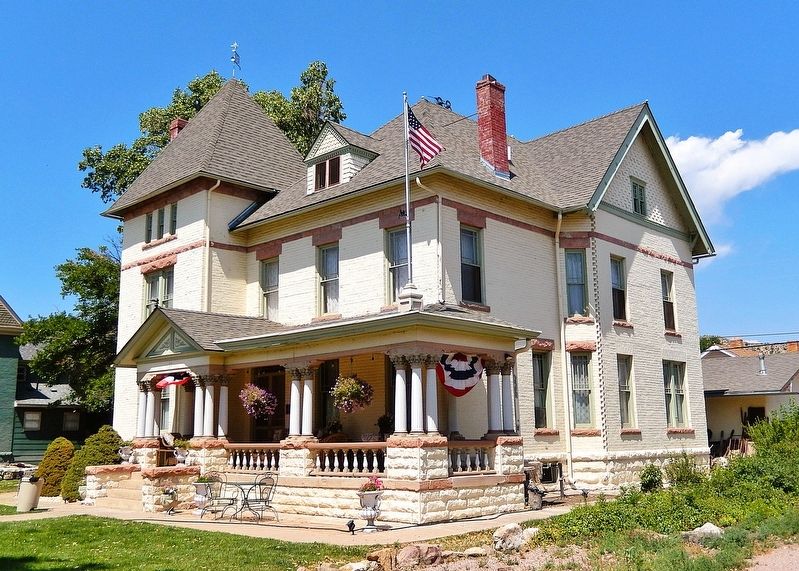
Samuel H. Atwater House

This property has been placed on the
National Register of Historic Places
by the United States Department of the Interior
Topics and series. This historical marker is listed in these topic lists: Architecture • Industry & Commerce • Notable Buildings. In addition, it is included in the National Register of Historic Places (NRHP) series list. A significant historical year for this entry is 1890.
Location. 38° 26.626′ N, 105° 14.207′ W. Marker is in Cañon City, Colorado, in Fremont County. It is on Macon Avenue just west of North 9th Street, on the right when traveling west. The marker is mounted at eye-level on the right side of the main front entrance. Touch for map. Marker is at or near this postal address: 821 Macon Avenue, Canon City CO 81212, United States of America. Touch for directions.

Regionally, this marker is in the Arkansas River Valley and in Pikes Peak Region. It is also in the American Mountain West. Globally, it is in North America, the Rocky Mountains, the Western Hemisphere, the Western World, and the Anglosphere. Historically, it finds itself in what was once the Comanchería and also
this page online
Other nearby markers. At least 8 other markers are within walking distance of this marker: First United Methodist Church / Christ First Community Church (about 400 feet away, measured in a direct line); Christ Episcopal Church (about 600 feet away); First Presbyterian Church (about 700 feet away); Memorial (approx. 0.2 miles away); St. Cloud Hotel (approx. 0.2 miles away); Hotel St. Cloud (approx. 0.2 miles away); Ward/Graves Hospital Building (approx. 0.2 miles away); Between the Bars (approx. ¼ mile away). Touch for a list and map of all markers in Cañon City.
Regarding Samuel H. Atwater House. National Register of Historic Places № 96000241 and Colorado State Register of Historic Places № 5FN.1202.
From the National Register Nomination prepared by Kathleen M. Hudson, 9/11/1985:
The Atwater House is a good example of a local interpretation of the Queen Anne style, both in its original 1890 design and with its 1908 porch modifications. The house exhibits most of the defining characteristics of the style, including:• Asymmetrical massing;The Atwater House is significant for its association with Samuel Henry Atwater, one of the early developers of Cañon City who not only bought and sold land for residential development but was a key individual in the planning and construction of community infrastructure. Atwater platted the Orchard Park sub-division and the Atwater South Cañon Addition to Cañon City; bought two large area nurseries to supply new residents in his communities with appropriate growing stock; purchased water rights on Four Mile Creek to insure a dependable water supply for Orchard Park and the South Cañon addition; and spearheaded the funding drive which culminated in the construction of the National Register listed First Presbyterian Church.
• Corner tower and bay;
• Steeply pitched roof of irregularshape;Photographed by Cosmos Mariner, July 25, 20252. Samuel H. Atwater House MarkerThe marker is mounted on the right side of the front entrance.
• Dormer;
• Scalloped and shaped shingles;
• Prominent decorative porches; and
• Contrasting wall materials.Samuel Atwater arrived in Cañon City in 1889 from Windham, New York, with his wife, Selina and nine-year-old daughter Winifred. The late 1880s and early 1890s witnessed tremendous growth within the city limits and Atwater followed this pattern by purchasing lots three and four plus thirteen and fourteen in
Block eight of the Macon addition from Rosella Phillips on January 28, 1890. Construction on the house began that winter with completion the following spring.Photographed by Cosmos Mariner, July 25, 20253. Samuel H. Atwater House (southwest elevation)From the National Register Nomination: The walls of the structure are constructed of solid fired brick three layers thick. The brick is laid in running bond with flush mortar. Though the exterior brick walls have been painted, the rose sandstone lintels, sills and belt courses have been left natural. The west elevation bay extension contains a balcony on the second story but has (since 1944) been enclosed with windows. The west elevation chimney is decorated with a series of recessed vertical panels at the second story level.The house he built suggests a degree of financial success prior to his arrival in Cañon City. By the turn of the century, S.H. Atwater had built an extremely successful business, but his interests included more than personal finance. Atwater was actively involved with the Chamber of Commerce in Cañon City. As a member of the Chamber, Atwater was appointed to represent the city at various meetings and conventions.
Though not thoroughly documented, the Atwater family seems to have moved from Cañon City to Colorado Springs in 1908 or 1909. The short time that Samuel Atwater lived in Cañon City, from 1889 to 1908, belies his impact on the area. The 1906 Cañon City Directory lists Atwater as president of the Cañon Land and Investment Company and Park Center Water Company. Atwater platted a subdivision and a city addition which still exist. His tree planting efforts left a visible legacy for modern Cañon City. Atwater's house at 821 Macon provides a visible connection to his efforts
to create a beautiful and stately city.Photographed by Cosmos Mariner, July 25, 20254. Samuel H. Atwater House (southeast elevation)


Also see . . .
1. Samuel H. Atwater House (Wikipedia).
Excerpt: The Samuel H. Atwater House was built in Queen Anne style around 1890 and its porches and exterior were substantially modified in 1908. It was listed on the National Register of Historic Places in 1996. The house was deemed significant for NRHP listing for its architecture, and also "for its association with Samuel Henry Atwater, one of the early developers of Cañon City who not only bought and sold land for residential development but was a key individual in the planning and construction of community infrastructure.(Submitted on August 21, 2025, by Cosmos Mariner of Cape Canaveral, Florida.)
2. Atwater House (History Colorado).
Excerpt: Site Number 5FN.1202. This 1890 house is associated with Samuel H. Atwater, an early developer of Cañon City, who not only bought and sold land for residential development but was a key individual in the planning and construction of community infrastructure.(Submitted on August 21, 2025, by Cosmos Mariner of Cape Canaveral, Florida.)

The original porch, which was replaced in 1908, had turned columns supporting a three-quarter-width shed roof. The replacement was built with a hipped roof, an ornamented triangular pediment, and Composite columns. The columns, grouped in twos and threes, are steel posts with wood veneer. The capitals display an ornate acanthus leaf pattern made of plaster.
Credits. This page was last revised on August 21, 2025. It was originally submitted on August 17, 2025, by Cosmos Mariner of Cape Canaveral, Florida. This page has been viewed 181 times since then and 32 times this year. Photos: 1, 2, 3, 4, 5. submitted on August 21, 2025, by Cosmos Mariner of Cape Canaveral, Florida.
