Cañon City in Fremont County, Colorado — The American Mountains (Southwest)
Christ Episcopal Church

Photographed by Cosmos Mariner, July 25, 2025
1. Christ Episcopal Church Marker
This property has been placed on the
National Register of Historic Places
by the United States Department of the Interior
Topics and series. This historical marker is listed in these topic lists: Architecture • Notable Buildings • Religion & Religious Structures. In addition, it is included in the National Register of Historic Places (NRHP) series list. A significant historical year for this entry is 1902.
Location. 38° 26.687′ N, 105° 14.296′ W. Marker is in Cañon City, Colorado, in Fremont County. It is on Harrison Avenue just east of North 8th Street, on the right when traveling east. The marker is mounted at eye-level, directly on the subject building, on the right side of the front/north entrance. Touch for map. Marker is at or near this postal address: 802 Harrison Avenue, Canon City CO 81212, United States of America. Touch for directions.

Regionally, this marker is in the Arkansas River Valley and in Pikes Peak Region. It is also in the American Mountain West. Globally, it is in North America, the Rocky Mountains, the Western Hemisphere, the Western World, and the Anglosphere. Historically, it finds
this page online
Other nearby markers. At least 8 other markers are within walking distance of this marker: Samuel H. Atwater House (about 600 feet away, measured in a direct line); First Presbyterian Church (about 700 feet away); First United Methodist Church / Christ First Community Church (approx. 0.2 miles away); St. Cloud Hotel (approx. 0.2 miles away); Hotel St. Cloud (approx. 0.2 miles away); Ward/Graves Hospital Building (approx. 0.2 miles away); Memorial (approx. ¼ mile away); Between the Bars (approx. ¼ mile away). Touch for a list and map of all markers in Cañon City.
Regarding Christ Episcopal Church. National Register of Historic Places № 94001011. Colorado State Register of Historic Places Site № 5FN.1194.
From the National Register Nomination prepared by Lorraine Deppe, 3/25/1994:
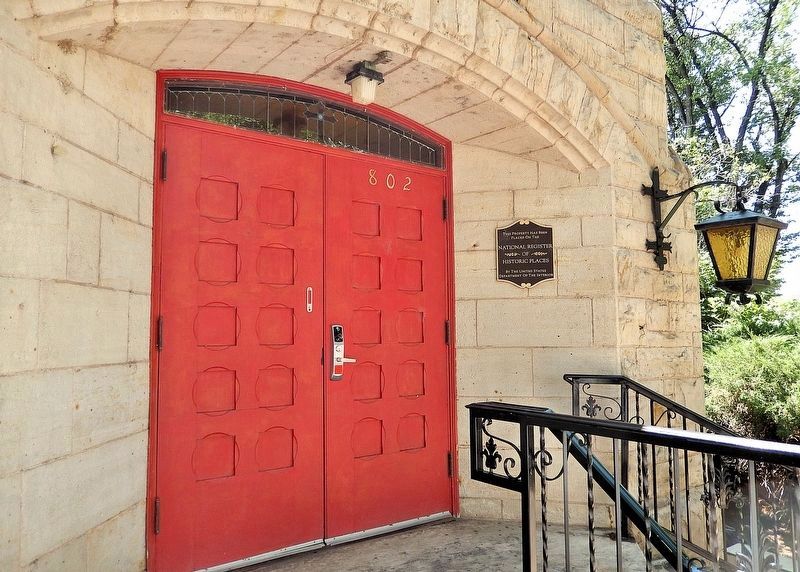
Christ Episcopal Church began as a mission on December 19, 1871. The cornerstone of the first Episcopal Church in Cañon City was laid on July 31, 1876. The first worship service was held there on December 17, 1876. Christ Episcopal Church remained a mission until January11, 1893, when a self-supporting parish formed.Photographed by Cosmos Mariner, July 25, 20252. Christ Episcopal Church MarkerThe marker is mounted at eye-level on the right/west side of the front entrance.
By early 1898, the members of Christ Episcopal Church felt the need for a larger building. On January 31, 1902 the plans of Thomas MacLaren were accepted. George E. Trout, a local contractor, was given the contract to build the church. Ground was broken in July of that same year and the cornerstone for the new building was laid October 22nd. The limestone used to build the church came from the Skyline quarries near Cañon City. The quarry also provided the limestone for the walls and buildings of the original (Old Territorial) prison. Dedication of the building and the first church service were held on June 28, 1903.
Christ Episcopal Church is an unusual example of the work of prominent architect Thomas MacLaren. The design of this building includes elements from several architectural styles and represents an early use of Mission elements by MacLaren. The Mission style would permeate much of MacLaren's later work in Colorado. Constructed in 1902, the church is an early example of MacLaren's developing eclecticism.
The design of Christ Episcopal Church employs elements of Early English Gothic,Richardsonian Romanesque, and Mission. The steeply pitched roof emphasizes the vertical expression of Gothic architecture and the lancet windows without tracery are indicative of Early English Gothic. The fleur-de-lis used in the stained-glass windows, and still visible in the large window on the north elevation, is a popular ornament in Late Gothic architecture.Photographed by Cosmos Mariner, July 25, 20253. Christ Episcopal Church (north/front elevation)From the National Register Nomination: Facing north on Harrison Avenue is the entrance to the church which is marked by the projecting vestibule/narthex with a very low-pitched gable roof behind a parapet wall. Three stone steps and a wrought-iron railing lead up to the narthex with its segmentally arched entry. The deeply recessed double doors are hand-carved oak and topped with a segmentally arched transom light of amber glass. On each side of the entrance is a wrought-iron wall bracket holding a light fixture of wrought-iron and amber glass. Above the narthex, on the wall of the gabled end is a large round-arched stained-glass window which contains four lancets and a cinquefoil. Within the apex of the gabled end is a cross of smooth finished stone.

Also see . . .
1. Christ Episcopal Church (Wikipedia).
Excerpt: The Christ Episcopal Church in Cañon City, Colorado was built in 1902. It was added to the National Register of Historic Places in 1994. It is a T-shaped ashlar building consisting of a front-gabled, main section plus a gabled west wing, built in an L-shape in 1902, and a gabled east wing built in 1960.(Submitted on August 21, 2025, by Cosmos Mariner of Cape Canaveral, Florida.)
2. Christ Episcopal Church (History Colorado).
Excerpt: Colorado Springs architect Thomas MacLaren employed elements from several architectural styles in his design for this 1902 church. The T-shaped building with its steeply pitched roof, rough-faced limestone walls, and striking campanario bell tower(Submitted on August 21, 2025, by Cosmos Mariner of Cape Canaveral, Florida.)forms an eclectic mix unusual for this prominent architect.Photographed by Cosmos Mariner, July 25, 20254. Christ Episcopal Church (northeast elevation)


Photographed by Cosmos Mariner, July 25, 2025
5. Christ Episcopal Church (northwest elevation)
From the National Register Nomination: Between the church and the chapel is a vertical wall projection with cutouts that hold two bells. This campanario rises 50 feet above the ground and is topped with curvilinear coping of smooth stone and an elaborate wrought iron weathervane.

Photographed by Cosmos Mariner, July 25, 2025
6. Christ Episcopal Church (bell tower)
From the National Register Nomination: Smooth stone in the shape of a cross separates the two bell openings. There is a narrow vertical opening in the stone below the bells for ventilation. The campanario is a characteristic feature of many of the California Missions constructed in the late 18th and early 19th centuries. The curvilinear coping that caps the campanario and the use of wrought iron show more Spanish influences.

Photographed by Cosmos Mariner, July 25, 2025
7. Christ Episcopal Church (west elevation)
Credits. This page was last revised on August 21, 2025. It was originally submitted on August 17, 2025, by Cosmos Mariner of Cape Canaveral, Florida. This page has been viewed 108 times since then and 43 times this year. Photos: 1, 2, 3, 4, 5, 6, 7. submitted on August 21, 2025, by Cosmos Mariner of Cape Canaveral, Florida.
