Clearview in Okfuskee County, Oklahoma — The American South (West South Central)
All-Black Towns of Oklahoma – Clearview
Photographed by Duane and Tracy Marsteller, June 21, 2025
1. All-Black Towns of Oklahoma – Clearview Marker
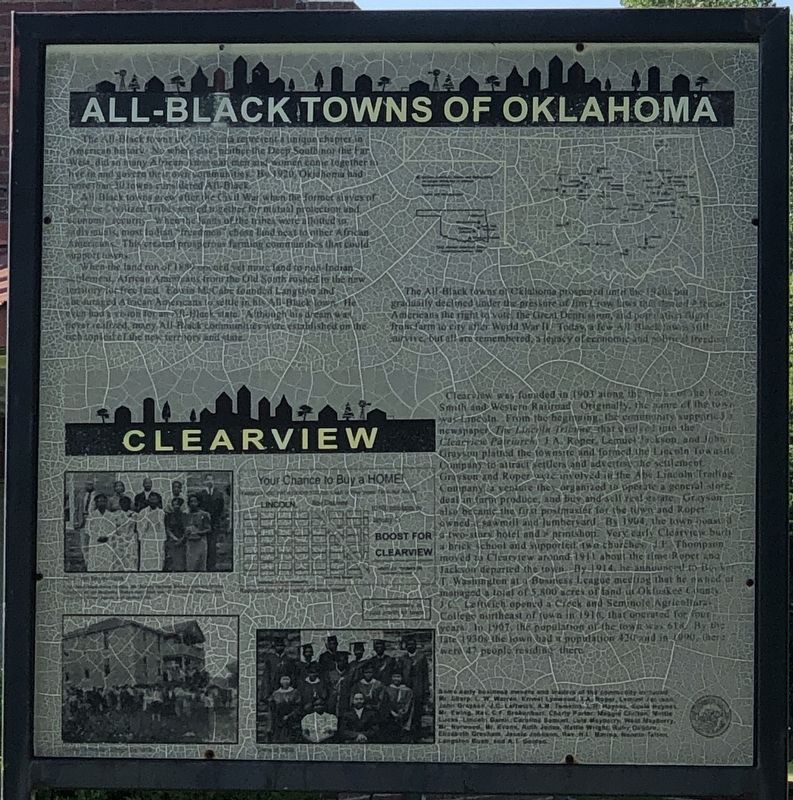
All-Black towns grew after the Civil War when former slaves of the Five Civilized Tribes settled together for mutual protection and economic security. When the lands of the tribes were allotted to individuals, most Indian “freedmen” chose land next to other African Americans. This created prosperous farming communities that could support towns.
When the land run of 1889 opened yet more land to non-Indian settlement, African Americans from the Old South rushed to the new territory for free land. Edwin McCabe founded Langston and encouraged African Americans to settle in his all-Black town. He even had a vision for an all-Black state. Although his dream was never realized, many all-Black communities were established on the rich topsoil of the new territory and state.
The all-Black towns of Oklahoma prospered until the
this page online
Clearview
Clearview was founded in 1903 along the tracks of the Fort Smith and Western Railroad. Originally, the name of the town was Lincoln. From the beginning, the community supported a newspaper, The Lincoln Tribune, that evolved into the Clearview Patriarch. J.A. Roper, Lemuel Jackson and John Grayson platted the townsite and formed the Lincoln Townsite Company to attract settlers and advertise the settlement. Grayson and Roper were involved in the Abe Lincoln Trading Company, a venture they organized to operate a general store, deal in farm produce, and buy and sell real estate. Grayson also became the first postmaster for the town and Roper owned a sawmill and lumberyard. By 1904 the town boasted a two-story hotel and a printshop. Very early Clearview built a brick school and supported two churches. J.E. Thompson moved
Photographed by Duane and Tracy Marsteller, June 21, 2025
2. All-Black Towns of Oklahoma – Clearview Marker
Some early business owners and leaders of the community included Mr. Sharp, L.W. Warren, Ernest Lynwood, J.C. Leftwich, A.M. Tomkins, L.H. Haynes, Susie Haynes, Mr. Ewing, Rev. C.F. Brokenburr, Charly Porter, Maggie Chilton, Mattie Lucas, Lincoln Gamil, Caroline Samuel, Lula Mayberry, West Mayberry, Mr. Norwood, Mr. Evans, Ruth Jones, Hattie Wright, Ruby Osborn, Elizabeth Gresham, Jessie Johnson, Rev. H.L. Marina, Nannie Talton, Langston Bush and A.T. Golden.
Captions (clockwise from top left)
• Clearview faculty, 1938 Front row: Miss Amos Daniels, Ms. Bolsey Haynes, Edna Armstrong Moore, Elizabeth Alford Mayberry, Rubye Hall. Back row: C.C. Collins, Minnie Dalton, Mr. D. Hall, Olive Owens and James Ellis.
• Reproduction of an early advertisement.
• Class of 1938.
• Creek-Seminole College ca. 1916.
Topics. This historical marker is listed in these topic lists: African Americans • Industry & Commerce • Settlements & Settlers. A significant historical year for this entry is 1903.
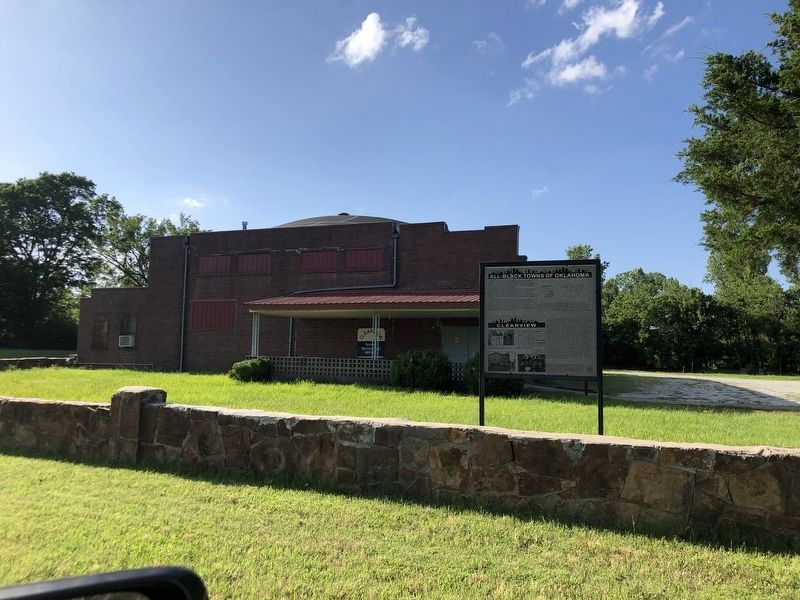
Location. 35° 23.883′ N, 96° 11.454′ W. Marker is in Clearview, Oklahoma, in Okfuskee County. It is at the intersection of Gibbs Street and Hettie Street, on the left when traveling east on Gibbs Street. Marker is in front of the old school. Touch for map. Marker is in this post office area: Okemah OK 74859, United States of America. Touch for directions.

Regionally, this marker is in the Muscogee Nation. It is also in the American South, specifically on the prairies, and on the Southern Plains. Globally, it is in North America, the Western Hemisphere, the Western World, and the Anglosphere. Historically, it finds itself in what was once the territory of the Mississippian Culture and also the Louisiana Purchase.
Other nearby markers. At least 4 other markers are within 12 miles of this marker, measured as the crow flies: Clearview War Memorial (approx. 0.2 miles away); Woody Guthrie (approx. 6.8 miles away); Woody Guthrie in Okemah, Oklahoma (approx. 6.8 miles away); Henryetta War Memorial (approx. 11.8 miles away).
Credits. This page was last revised on August 18, 2025. It was originally submitted on August 17, 2025, by Duane and Tracy Marsteller of Murfreesboro, Tennessee. This page has been viewed 273 times since then and 109 times this year. Photos: 1, 2. submitted on August 17, 2025, by Duane and Tracy Marsteller of Murfreesboro, Tennessee.
