
Garden District in Toronto, Ontario — Central Canada (North America)
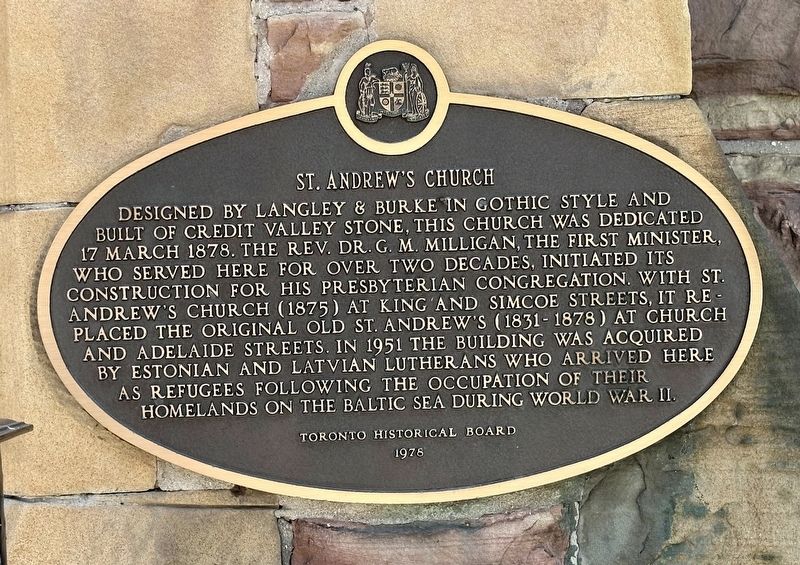
St. Andrew’s Church
Photographed by Andrew Ruppenstein, August 11, 2025
1. St. Andrew’s Church Marker
Designed by Langley & Burke in gothic style and built of Credit Valley stone, this church was dedicated 17 March 1878. The Rev. Dr. G. M. Milligan, the first minister, who served here for over two decades, initiated its construction for his Presbyterian congregation. With St. Andrew's Church (1875) at King and Simcoe Streets, it replaced the original old St. Andrew's (1831-1878) at Church and Adelaide Streets. In 1951 the building was acquired by Estonian and Latvian Lutherans who arrived here as refugees following the occupation of their homelands on the Baltic Sea during World War II.
Erected 1978 by Toronto Historical Board.
Topics and series. This historical marker is listed in this topic list: Religion & Religious Structures. In addition, it is included in the Canada, Toronto Heritage series list. A significant historical date for this entry is March 17, 1878.
Location. 43° 39.74′ N, 79° 22.589′ W. Marker is in Toronto, Ontario. It is in the Garden District. It is at the intersection of Jarvis Street and Carlton Street, on the left when traveling south on Jarvis Street. Touch for map. Marker is at or near this postal
this page online

Regionally, this marker is in Greater Toronto and on the Golden Horseshoe. It is also in Central Canada. Globally, it is in North America, on the Great Lakes, in the Western Hemisphere, in the Western World, and in the Anglosphere. Historically, it finds itself in what was once a British colony, the Viceroyalty of New France, the Haudenosaunee (Iroquois) Confederacy, and Rupert’s Land.
Other nearby markers. At least 8 other markers are within walking distance of this marker: Northfield (about 180 meters away, measured in a direct line); Jarvis Collegiate Institute (approx. 0.4 kilometers away); Ontario College of Pharmacy (approx. 0.4 kilometers away); Layers of Change (approx. 0.4 kilometers away); a different marker also named Jarvis Collegiate Institute (approx. 0.4 kilometers away); Toronto Normal School Coat of Arms (approx. 0.4 kilometers away); The Toronto Normal and Model School (approx. half a kilometer away); Oakham House (approx. half a kilometer away). Touch for a list and map of all markers in Toronto.
Also see . . . Grace Toronto Church (Wikipedia).
Photographed by Andrew Ruppenstein, August 11, 2025
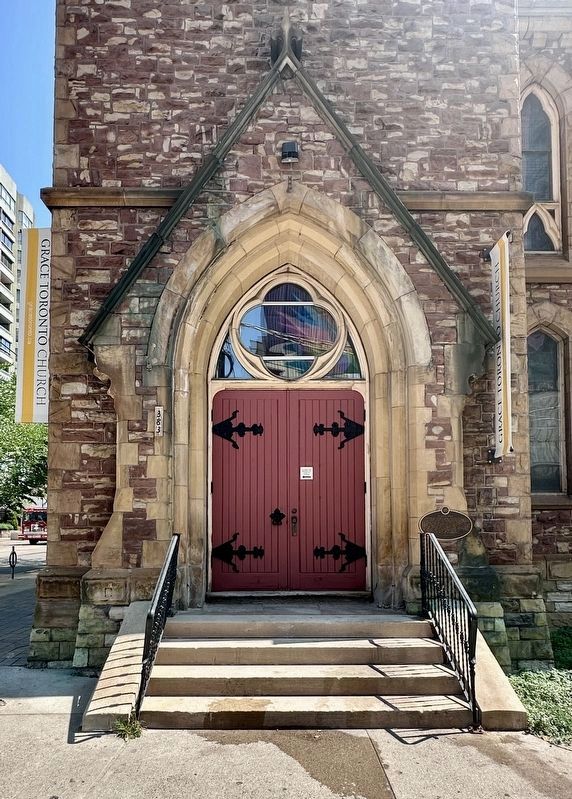
2. St. Andrew’s Church Marker - wide view
The marker is visible to the right of the door.
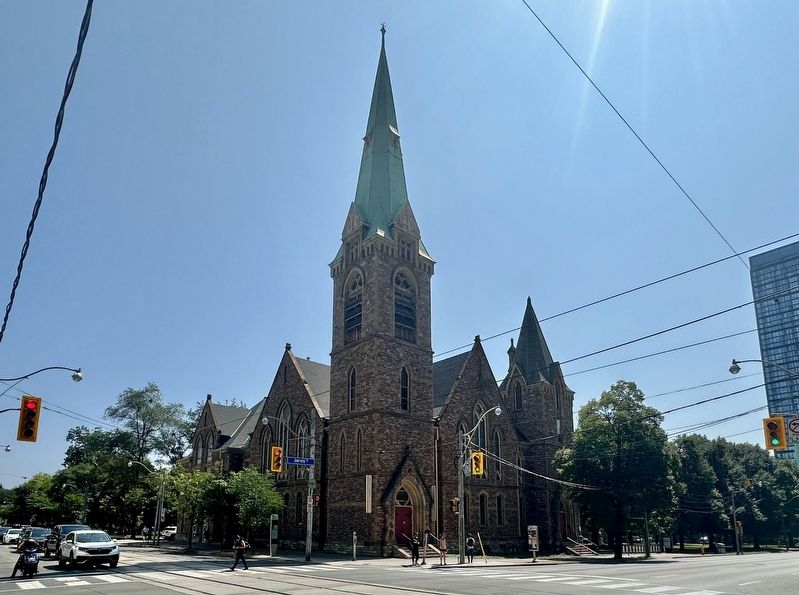
The original St. Andrew's Church congregation (of the Church of Scotland) dated back to 1830, when Toronto was still the Town of York. This congregation split in 1874 over whether it should move west from its home at the corner of Adelaide and Church streets. In 1876, the majority moved to a new site at King and Simcoe streets that became known as "New St. Andrew's", and it remains there to this day. The church building at Adelaide and Church streets was renovated by Henry Langley in 1877–78. Those who wished to stay in that area remained with the "Old St. Andrew's" congregation. There was, however, a need for a new building, and in 1878, the congregation moved northeastward to a newly constructed church building at 383 Jarvis Street, on the corner of Carlton Street. During the 1940s, the Soviet occupation of the Baltic states produced an influx of refugees from that area into Toronto. At the same time, the United Church of Canada, which Old St. Andrew's had joined in 1925, was in relative decline within the downtown core of Toronto. In 1950, Old St. Andrew's joined with Westminster-Central to become St.(Submitted on August 18, 2025.)Andrew's United Church near the corner of Bloor Street East and Yonge Street. By 1951, the Old St. Andrew's building on Jarvis Street was sold, and it became the main church of Toronto's Latvian and Estonian worshippers. Saint Andrew, as a renowned saint of the Christian Church, was retained in the name by the congregations. Until September 30, 2015, the church building remained home to two congregations of both the Estonian Evangelical Lutheran and Latvian Evangelical Lutheran Churches. As of October 1, 2015, St. Andrew's became the new home of Grace Toronto Church. The historic building housed a Presbyterian congregation once again.Photographed by Andrew Ruppenstein, August 11, 20253. The former St. Andrew’s Church, now Grace Toronto Church
Credits. This page was last revised on August 18, 2025. It was originally submitted on August 18, 2025, by Andrew Ruppenstein of Lamorinda, California. This page has been viewed 114 times since then and 34 times this year. Photos: 1, 2, 3. submitted on August 18, 2025, by Andrew Ruppenstein of Lamorinda, California.
