Milton in Halton Region, Ontario — Central Canada (North America)
Milton’s World War I Field Gun
Photographed by Tim Boyd, August 17, 2025
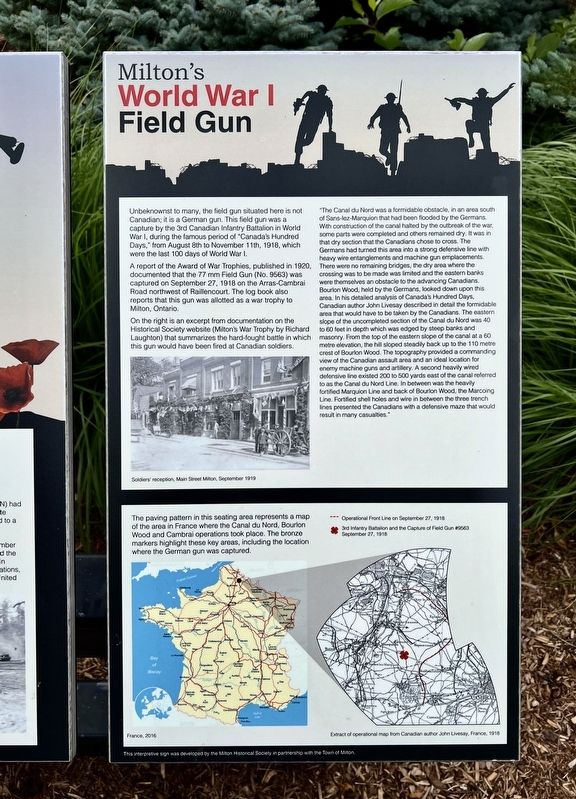
1. Milton’s World War I Field Gun Marker
A report of the Award of War Trophies, published in 1920, documented that the 77 mm Field Gun (No. 9563) was captured on September 27, 1918 on the Arras-Cambrai Road northwest of Raillencourt. The log book also reports that this gun was allotted as a war trophy to Milton, Ontario.
On the right is an except from documentation on the Historical Society website (Milton's War Trophy by Richard Laughton) that summarizes the hard-fought battle in which this gun would have been fired at Canadian soldiers.
"The Canal du Nord was a formidable obstacle, in an area south of Sans-lez-Marquion that had been flooded by the Germans. With construction of the canal halted by the outbreak of the war, some parts were completed and others remained dry. It was in that dry section that the Canadians chose to cross. The Germans had
this page online
Photographed by Tim Boyd, August 17, 2025
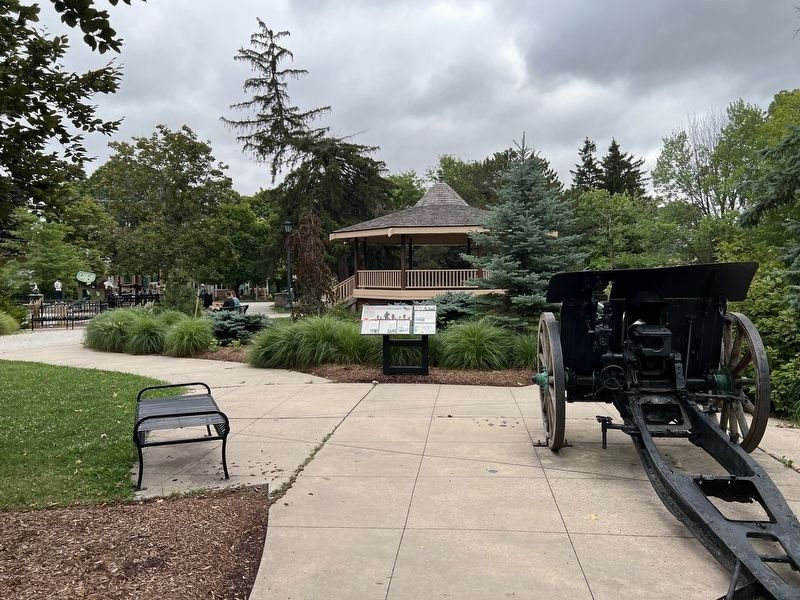
2. Milton’s World War I Field Gun Marker
The marker is the smaller of the two, on the right. The field gun is at the right of the photo
Topics. This historical marker is listed in this topic list: War, World I. A significant historical year for this entry is 1918.
Location. 43° 30.611′ N, 79° 53.063′ W. Marker is in Milton, Ontario, in Halton Region. It is at the intersection of Mary Street and Brown Street, on the right when traveling east on Mary Street. The marker is in Victoria Park, near the Cenotaph. Touch for map. Marker is at or near this postal address: 100 Mary Street, Milton ON L9T 1L8, Canada. Touch for directions.

Regionally, this marker is in Greater Toronto, specifically on the Golden Horseshoe, in the Hamilton-Halton-Brant Area, and specifically in the Toronto Metropolitan Area. It is also in Central Canada. Globally, it is in North America, on the Great Lakes, in the Western Hemisphere, in the Western World, and in the Anglosphere. Historically, it finds itself in what was once a British colony, the Viceroyalty of New France, the Haudenosaunee (Iroquois) Confederacy, and Rupert’s Land.
Other nearby markers. At
Photographed by Tim Boyd, August 17, 2025
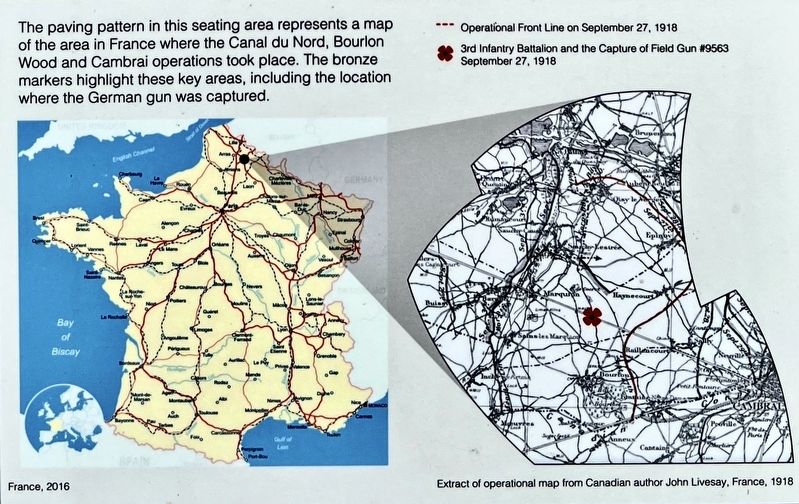
3. Milton’s World War I Field Gun marker map illustrations and captions
Credits. This page was last revised on August 19, 2025. It was originally submitted on August 19, 2025, by Tim Boyd of Hamilton, Ontario. This page has been viewed 75 times since then and 17 times this year. Photos: 1, 2, 3. submitted on August 19, 2025, by Tim Boyd of Hamilton, Ontario. • Andrew Ruppenstein was the editor who published this page.
