San Giovanni in Firenze in Città Metropolitana di Firenze, Tuscany, Italy — Southern and Western Europe (Mediterranean)
“Il Porcellino”
⎯⎯⎯
“The Metal Pig”
Photographed by Sean P. Flynn, July 25, 2025
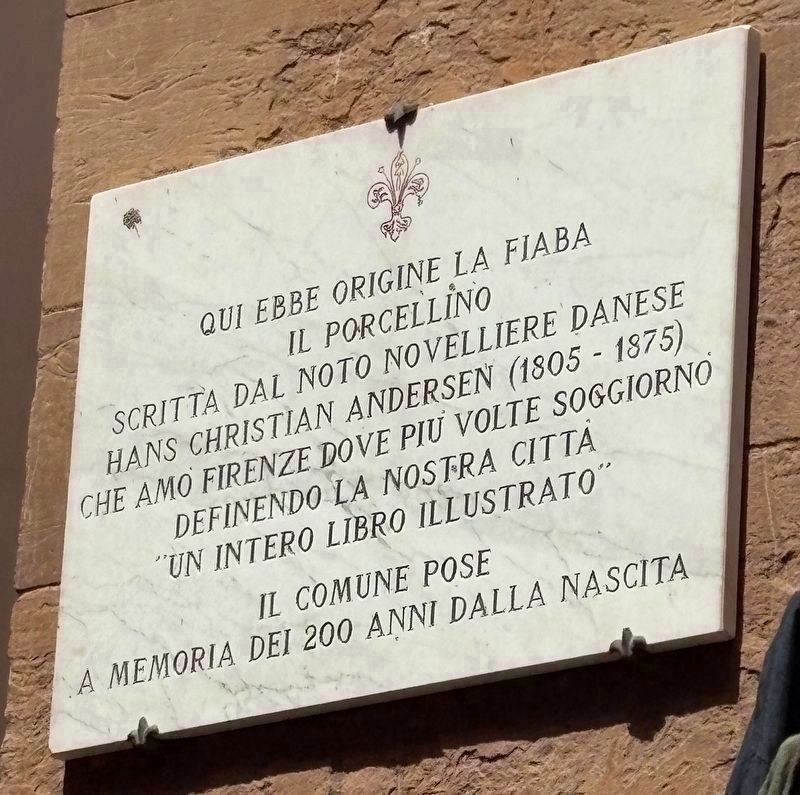
1. "Il Porcellino" / "The Metal Pig" Marker
"Il Porcellino" translates to "The Little Pig" or "Piglet," however the name of Andersen's story is most commonly translated in English to "The Metal Pig."
Che amo Firenze dove piu volte soggiorno definendo la nostra citta "un intero libro illustrato"
Il comune pose a memoria dei 200 anni dalla nascita
[English translation of Italian text:]
The fairy tale "The Metal Pig" originated here, written by the famous Danish storyteller Hans Christian Andersen (1805-1875).
I love Florence, where I stayed several times, and I define our city as "an entire illustrated book."
The municipality commemorated the 200th anniversary of his birth.
Erected 2005 by City of Florence.
Topics. This historical marker is listed in these topic lists: Animals • Arts, Letters, Music. A significant historical date for this entry is April 2, 1805.
Location. 43° 46.193′ N, 11° 15.251′ E.
this page online

Regionally, it is in Europe, the European Union, the Schengen Area, a coastal Mediterranean country, and the Western World. Historically, it finds itself in what was once the Roman Empire and specifically also the Holy Roman Empire.
Other nearby markers. At least 8 other markers are within walking distance of this marker: Chiesa e Museo di Orsanmichele / The Church and Museum of Orsanmichele (about 90
Photographed by Sean P. Flynn, July 25, 2025
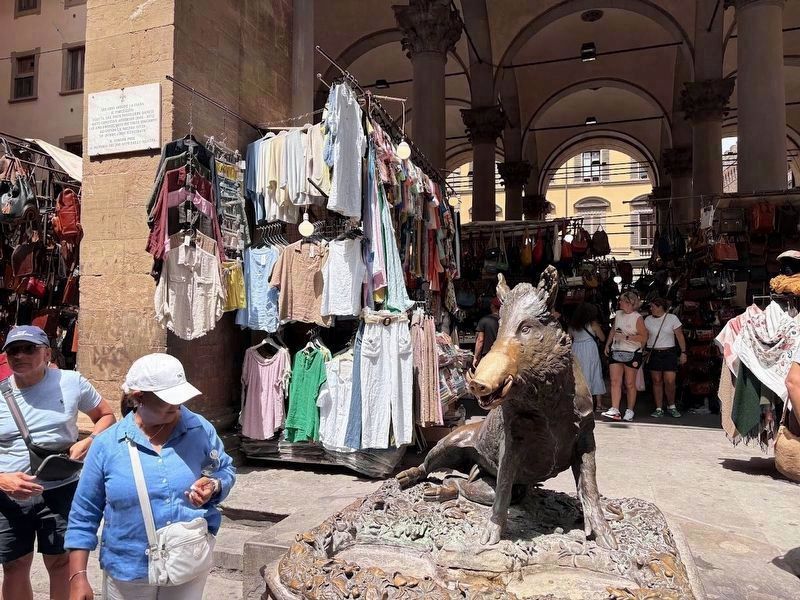
2. Il Porcellino
Regarding “Il Porcellino” / “The Metal Pig”. Il Porcellino translates to "The Little Pig" or "Piglet." The statue by that name dates to about 1636. However, the name of Andersen's story about the statue is most commonly translated in English to "The Metal Pig."
Also see . . .
1. The Metal Pig.

Courtesy of Wikimedia Commons, 1836
3. Hans Christian Andersen
Excerpt: "Everyone who goes to Florence surely finds the place; you only have to ask the first beggar you see about the metal pig, and he will find it for you."(Submitted on August 19, 2025, by Sean P. Flynn of Oak Park, Illinois.)
2. Il Porcellino. The Wikipedia page for the pig statue, whose name translates to "Little Pig" or "Piglet."
Excerpt: "Visitors to Il Porcellino put a coin into the boar's gaping jaws, with the intent to let it fall through the underlying grating for good luck, and they rub the boar's snout to ensure a return to Florence, a tradition that the Scottish literary traveller Tobias Smollett already noted in 1766, which has kept the snout in a state of polished sheen while the rest of the boar's body has patinated to a dull brownish-green."(Submitted on August 19, 2025, by Sean P. Flynn of Oak Park, Illinois.)
Credits. This page was last revised on August 20, 2025. It was originally submitted on August 19, 2025, by Sean P. Flynn of Oak Park, Illinois. This page has been viewed 117 times since then and 28 times this year. Photos: 1, 2, 3. submitted on August 19, 2025, by Sean P. Flynn of Oak Park, Illinois.
