Milton in Halton Region, Ontario — Central Canada (North America)
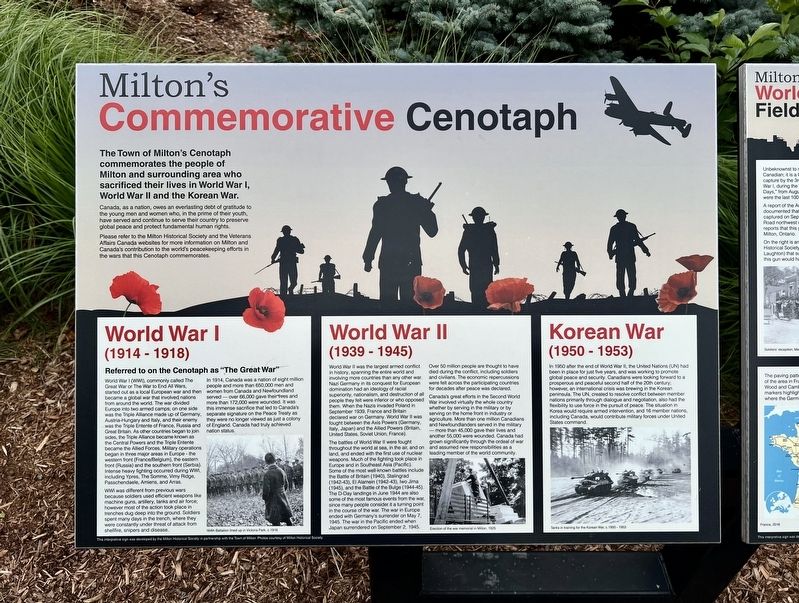
Milton’s Commemorative Cenotaph
Photographed by Tim Boyd, August 17, 2025
1. Milton’s Commemorative Cenotaph Marker
Canada, as a nation, owes an everlasting debt of gratitude to the young men and women who, in the prime of their youth have served and continue to serve their country to preserve global peace and protect fundamental human rights.
Please refer to the Milton Historical Society and the Veterans Affairs Canada websites for more information on Milton and Canada's contribution to the world's peacekeeping efforts in the wars that this Cenotaph commemorates.
World War I
(1914 - 1918)
Referred to on the Cenotaph as "The Great War"
World War I (WWI), commonly called The Great War or The War to End All Wars, started out as a local European war and then became a global war that involved nations from around the world. The war divided Europe into two armed camps; on one side was the Triple Alliance made up of Germany, Austria-Hungary and Italy, and their enemy was the Triple Entente of France, Russia and Great Britain. As other countries began to join sides, the
this page online
WWI was different from previous wars because soldiers used efficient weapons like machine guns, artillery, tanks and air force; however most of the action took place in trenches dug deep into the ground. Soldiers spent many days in the trench, where they were constantly under threat of attack from shellfire, snipers and disease.
In 1914, Canada was a nation of eight million people and more than 650,000 men and women from Canada and Newfoundland served — over 66,000 gave their lives and more than 172,000 were wounded. It was this immense sacrifice that led to Canada's separate signature on the Peace Treaty as they were no longer viewed as just a colony of England. Canada had truly achieved nation status.
World War II (1939 - 1945)
World War II was the largest
Photographed by Tim Boyd, August 17, 2025
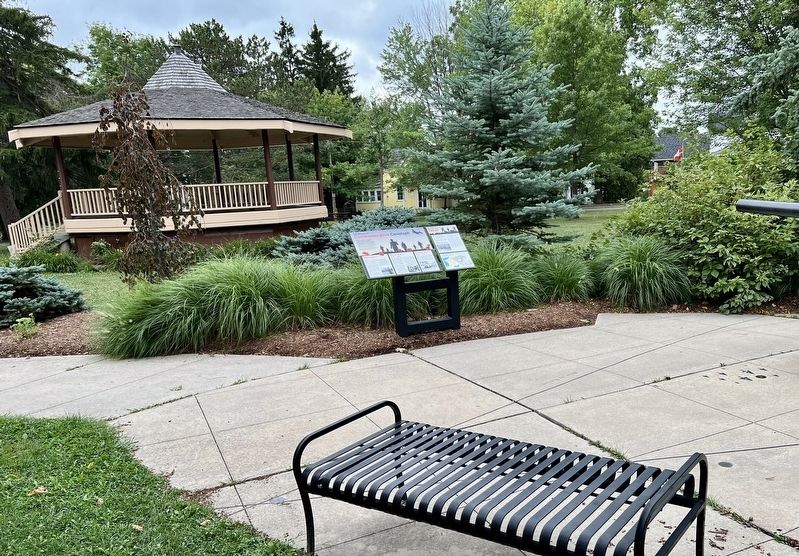
2. Milton’s Commemorative Cenotaph Marker
The larger of the two, on the left
The battles of World War II were fought throughout the world at sea, in the air, and on land, and ended with the first use of nuclear weapons. Much of the fighting took place in Europe and in Southeast Asia (Pacific). Some of the most well-known battles include the Battle of Britain (1940), Stalingrad (1942-43), El Alamein (1942-43), Iwo Jima (1945), and the Battle of the Bulge (1944-45). The D-Day landings in June 1944 are also some of the most famous events from the war, since many people consider it a turning point in the course of the war. The war in Europe ended with Germany's surrender on May 7, 1945. The war in the

Photographed by Tim Boyd, August 17, 2025
3. The Milton Cenotaph
Canada's great efforts in the Second World War involved virtually the whole country whether by serving in the military or by serving on the home front in industry or agriculture. More than one million Canadians and Newfoundlanders served in the military - more than 45,000 gave their lives and another 55,000 were wounded. Canada had grown significantly through the ordeal of war and assumed new responsibilities as a leading member of the world community.
Korean War
(1950 - 1953)
In 1950 after the end of World War II, the United Nations (UN) had been in place for just five years, and was working to promote global peace and security. Canadians were looking forward to a prosperous and peaceful second half of the 20th century; however, an international crisis was brewing in the Korean peninsula. The UN, created to resolve conflict between member nations primarily through dialogue and negotiation, also had the flexibility to use force in the pursuit of peace. The situation in Korea would require armed intervention, and 16 member nations, including Canada, would contribute military forces under United States command.
Erected by Milton Historical Society/ Town of Milton.
Topics. This memorial is listed in these topic lists: War, Korean • War, World I • War, World II. A significant historical date for this entry is May 7, 1945.
Location. 43° 30.611′ N, 79° 53.063′ W. Memorial is in Milton, Ontario, in Halton Region. It is at the intersection of Mary Street and Brown Street, on the left when traveling west on Mary Street. The marker is in Victoria Park, near the Milton Cenotaph. Touch for map. Memorial is at or near this postal address: 100 Mary Street, Milton ON L9T 1L8, Canada. Touch for directions.

Regionally, this memorial is in Greater Toronto, specifically on the Golden Horseshoe, in the Hamilton-Halton-Brant Area, and specifically in the Toronto Metropolitan Area. It is also in Central Canada. Globally, it is in North America, on the Great Lakes, in the Western Hemisphere, in the Western World, and in the Anglosphere. Historically, it finds itself in what was once a British colony, the Viceroyalty of New France, the Haudenosaunee (Iroquois) Confederacy, and Rupert’s Land.
Other nearby markers. At least 8 other markers are within 5 kilometers of this marker, measured as the crow flies: Milton’s World War I Field Gun (here, next to this marker); Milton Cenotaph (a few steps from this marker); Victoria Park (within shouting distance of this marker); Halton County Court House (within shouting distance of this marker); The Fred W. Armstrong Arena (within shouting distance of this marker); Former Milton Town Hall (approx. 0.4 kilometers away); The P.L. Robertson Manufacturing Company (approx. 0.6 kilometers away); Milton Outlier (approx. 4.4 kilometers away). Touch for a list and map of all markers in Milton.
Credits. This page was last revised on August 20, 2025. It was originally submitted on August 19, 2025, by Tim Boyd of Hamilton, Ontario. This page has been viewed 87 times since then and 23 times this year. Photos: 1, 2, 3. submitted on August 19, 2025, by Tim Boyd of Hamilton, Ontario. • Andrew Ruppenstein was the editor who published this page.
