Grassy Butte in McKenzie County, North Dakota — The American Midwest (Upper Plains)
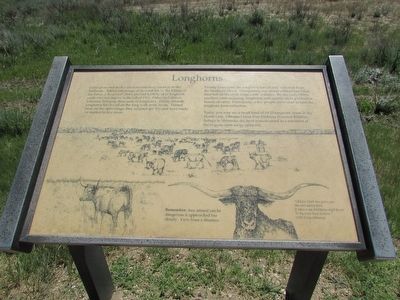
Longhorns
Photographed by Bill Coughlin, July 21, 2015
1. Longhorns Marker
Good grass and shelter attracted ranching interests to the badlands. Taking advantage of the void left by the killing of the bison, a Texas trail drive pushed 4,000 head of longhorn cattle into this region in the fall of 1884. Other trail drives followed, bringing thousands of longhorns. Hardy animals, longhorns fared well on the long walk from Texas. Turned loose on the open range, they adapted quickly and were ready for market in two years.
Twenty years later, the longhorns had almost vanished from the Northern Plains. Overgrazing and severe winters had taken their toll on the open range cattle industry. By the early 1900’s, ranchers were replacing longhorns with newer, more productive breeds of cattle. Fortunately, a few people intervened to save the longhorn from extinction.
Today you may see a small herd of 10-25 longhorn steers in the North Unit. Obtained from Fort Niobrara National Wildlife Refuge in Nebraska, the herd is maintained as a reminder of the bygone open range cattle era.
“Old Joe Clark has got a cow -
She was muley born.
It takes a jay bird forty-eight hours
To fly from horn to horn.”
(Old Texas folksong)
Erected by National
this page online
Topics. This historical marker is listed in these topic lists: Animals • Industry & Commerce. A significant historical year for this entry is 1884.
Location. Marker has been permanently removed. It was located near 47° 35.469′ N, 103° 17.398′ W. Marker was in Grassy Butte, North Dakota, in McKenzie County. It was on Scenic Drive, on the left when traveling north. Marker is located at the Longhorn Pullout in the North Unit of Theodore Roosevelt National Park. Touch for map. Marker was in this post office area: Grassy Butte ND 58634, United States of America.
We have been informed that this marker is no longer there and will not be replaced. This page is an archival view of what was.
Regionally, this marker was in the Bakken Oil Patch. It was also in the American Lewis & Clark Corridor, on the prairies, and on the Northern Plains. Globally, it was in North America, the Western Hemisphere, the Western World, and the Anglosphere. Historically, it found itself in what was once Rupert’s Land and also the Louisiana Purchase.

Other nearby markers. At least 8 other markers are
Photographed by Bill Coughlin, July 21, 2015
2. Longhorns Marker
Other markers no longer nearby. Slump Formation (was approx. 0.6 miles away but has been permanently removed); “Cannon Ball” Concretions (was approx. 2 miles away but has been permanently removed); Long X Cattle Trail (was approx. 2.7 miles away but has been permanently removed).
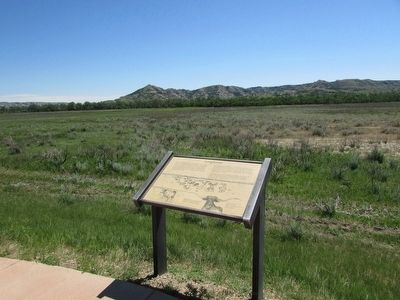
More about this marker. A picture of longhorns on the range appears at the bottom of the marker.
Related marker. Click here for another marker that is related to this marker. To better understand the relationship, study each marker in the order shown.
Photographed by Bill Coughlin, July 21, 2015
3. Marker in Theodore Roosevelt National Park
Photographed by Bill Coughlin, July 21, 2015
4. Longhorns Marker
Credits. This page was last revised on October 13, 2025. It was originally submitted on September 14, 2015, by Bill Coughlin of Woodland Park, New Jersey. This page has been viewed 479 times since then and 25 times this year. Last updated on August 20, 2025, by Susan Van Den Bosch of Almond, Wisconsin. Photos: 1, 2, 3, 4. submitted on September 14, 2015, by Bill Coughlin of Woodland Park, New Jersey. • Devry Becker Jones was the editor who published this page.
