Brewster in Barnstable County, Massachusetts — The American Northeast (New England)
Higgins Farm Windmill
c.1795

Photographed by Sandra Hughes Tidwell, July 15, 2025
1. Higgins Farm Windmill Marker
The Old Higgins Farm Windmill was originally located in E. Brewster, about 5 miles from its present site. It is authenticated in a map dated 1795, which shows the mill standing close to what is now the corner of Rte. 6A and Ellis Landing Rd. Around 1890, it was moved across the road to the Roland Nickerson estate (now Ocean Edge Resort) to serve as a clubhouse for the Nickersons' private golf course.
In 1973, Mrs. Samuel Nickerson gave the mill to The Brewster Historical Society in memory of her husband, stipulating it should be moved, restored, and open to the public. Moving mills is an old tradition; often, when they changed ownership, they changed location as well. In December 1974, Brewster's mill was hoisted onto a flatbed trailer and moved down Rte. 6A to its present site on the former Drummer Boy Museum land, given by Mr. and Mrs. Lewis McGowan. The rolling field and sweeping ocean breezes make this an ideal location for Brewster's windmill.
Restoration was largely completed by July 1976 in time for the nation's Bicentennial. The restoration is as authentic as knowledge, experience, and skilled artisans have
this page online
The Mill stands 30 feet tall, with a 20-foot diameter base. The boat-shaped cap is constructed with curved members like those in the hull of a ship, the better to cut through the wind, some say. By hauling the long tail pole around, via horse or ox, the miller could rotate the cap to turn the attached canvas-covered arms directly into the wind, no matter from what direction it blew. America's Early Colonists considered three things requisite to start a settlement — a minister, a blacksmith, and a miller.
How Brewster's Windmill Works
As the Wind Turns the Arms, they turn the horizontal windshaft into which the arms are slotted. Mounted also on this shaft, the great brake wheel is set in motion; its cogs engage a smaller gear called a wallower, which in turn, rotates a vertical shaft or quant, which sets the runner stone spinning. Thus does the simple but ingenious system of gears turn horizontal wind power into vertical energy, driving the mill and grinding
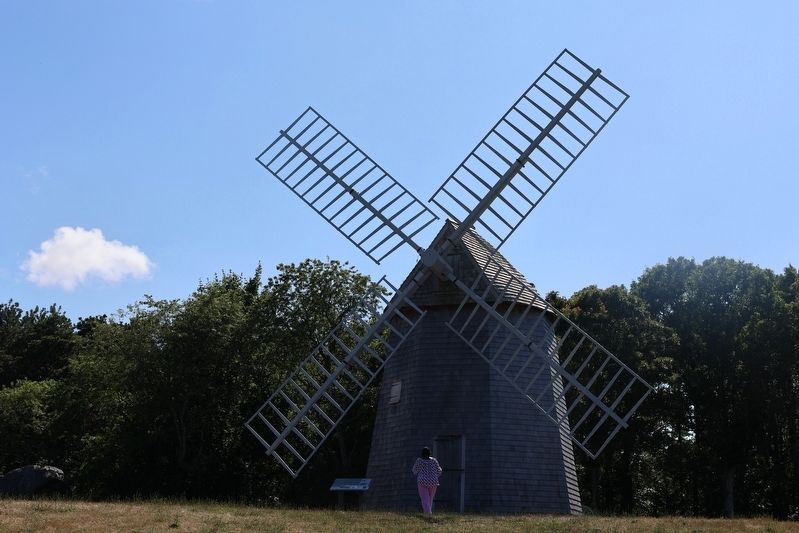
Photographed by Sandra Hughes Tidwell, July 15, 2025
2. Higgins Farm Windmill Marker
The Top Level of the mill allows the miller access to the wooden machinery under the cap. Because the entire cap must be turned to set the arms and sails into the wind, the miller would climb up here to grease the wooden curb upon which the cap rotates (wood on wood without the benefit of any bearings). Other moving parts would also be greased to make them move smoothly and minimize wear. The miller probably used lard or mutton tallow, there being no petroleum products then. You can still see the grease stains on the wood.
On the Second Floor are the millstones, 5 feet in diameter. The bottom, or bedstone, is fixed and does not turn. The upper runner-stone may travel at 90 to 100 rpms to grind the corn. Suspended above the runner stone, a hopper feeds the grain into a hole or eye in the center of the stone. When operating well, stones can grind a bushel of corn in 10 to 12 minutes. The turning stone sweeps the meal outward, where it is caught in the wooden stone casing, called a vat. From here, it automatically feeds down to the first-floor meal bin.
On the First Floor, a long wooden chute carries
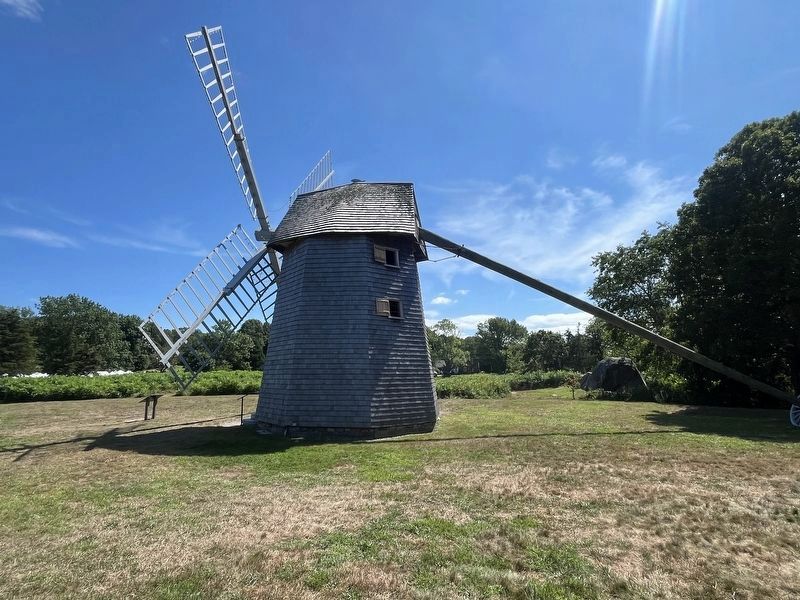
Photographed by Ralph Cahoon, August 29, 2026
3. Higgins Farm Windmill Marker
Maintained and operated by the Brewster Historical Society
Topics and series. This historical marker is listed in these topic lists: Industry & Commerce • Notable Buildings. In addition, it is included in the Windmills series list. A significant historical year for this entry is 1795.
Location. 41° 45.126′ N, 70° 7.215′ W. Marker is in Brewster, Massachusetts, in Barnstable County. It is on Drummer Boy Road west of Main Street (Massachusetts Route 6A), on the left when traveling west. Located in Drummer Boy Park. Touch for map. Marker is at or near this postal address: 51 Drummer Boy Rd, Brewster MA 02631, United States of America. Touch for directions.

Regionally, this marker is on Cape Cod. It is also in the American Northeast, in New England, and on the Eastern Seaboard. Globally, it is in the North Atlantic Region, North America, the Western Hemisphere, the Western World, and the Anglosphere. Historically, it finds itself in what was once one of the original Thirteen Colonies.
Other nearby markers. At least 8 other markers are within 2 miles of this marker, measured as the crow flies: Hopkins Blacksmith Shop (a few steps from this marker); Harris-Black House (within shouting distance of this marker); Jacob Sears Memorial Library (approx. 1.4 miles away); Town of Brewster World War I Memorial (approx. 1.6 miles away); Town of Brewster Korean War and Vietnam Campaign Memorial (approx. 1.6 miles away); Brewster World War II Memorial (approx. 1.6 miles away); Battle Of The Bulge (approx. 1.6 miles away); Town of Brewster Veterans of Foreign Campaigns Memorial (approx. 1.6 miles away). Touch for a list and map of all markers in Brewster.
Regarding Higgins Farm Windmill. The Old Higgins Farm Windmill was added to the National Historic Register of Historic Places in 1975. The windmill was donated by its owner, Mrs. Samuel Nickerson, in memory of her husband, to the Brewster Historical Society which continues to maintain it.
Also see . . .
1. Brewster Historical Society. (Submitted on August 28, 2025, by Michael Herrick of Southbury, Connecticut.)
2. Old Higgins Farm Windmill (Wikipedia). (Submitted on August 20, 2025, by Sandra Hughes Tidwell of Killen, Alabama, USA.)
Credits. This page was last revised on September 4, 2026. It was originally submitted on August 20, 2025, by Sandra Hughes Tidwell of Killen, Alabama, USA. This page has been viewed 126 times since then and 46 times this year. Photos: 1, 2. submitted on August 20, 2025, by Sandra Hughes Tidwell of Killen, Alabama, USA. 3. submitted on August 30, 2026, by Ralph Cahoon of Barnstable, Massachusetts. • Michael Herrick was the editor who published this page.
