Wooster in Baytown in Harris County, Texas — The American South (West South Central)
Wooster Community
Photographed by James Hulse, August 20, 2025
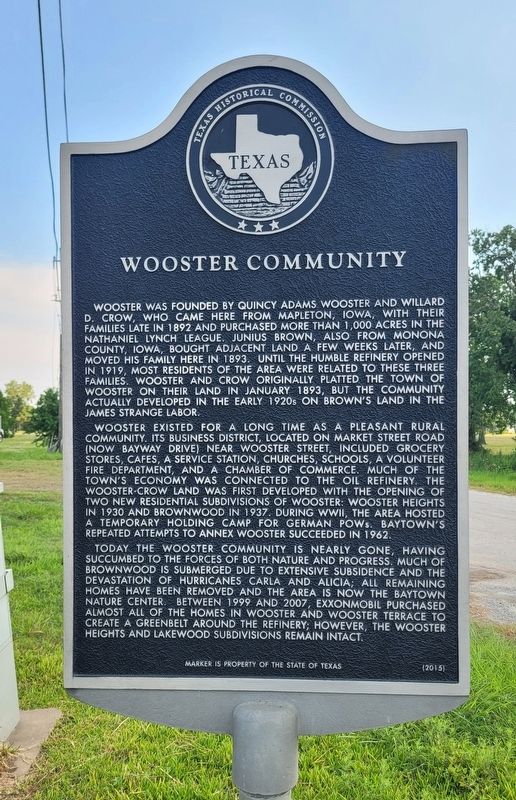
1. Wooster Community Marker
Wooster existed for a long time as a Pleasant rural community. Its business district, located on Market Street Road (now Bayway Drive) near Wooster Street, included grocery stores, cafes, a service station, churches, schools, a volunteer fire department, and a chamber of commerce. Much of the town's economy was connected to the oil refinery. The Wooster-Crow land was first developed with the opening of two new residential subdivisions of Wooster: Wooster Heights in 1930 and Brownwood in 1937. During WWII, the area hosted a temporary holding camp for German POWs. Baytown's repeated attempts to annex Wooster succeeded in 1962.
Today the Wooster community is nearly gone, having succumbed to the forces of both nature and progress. Much of Brownwood is submerged due to extensive subsidence and the devastation of hurricanes Carla and Alicia; all remaining homes have been removed and the area is now the Baytown Nature Center. Between 1999 and 2007, Exxonmobil purchased almost all of the homes in Wooster and Wooster Terrace to create a greenbelt around the refinery; however, the Wooster Heights and Lakewood subdivisions remain intact.
Erected 2015 by Texas Historical Commission. (Marker Number 18119.)
Topics.
this page online
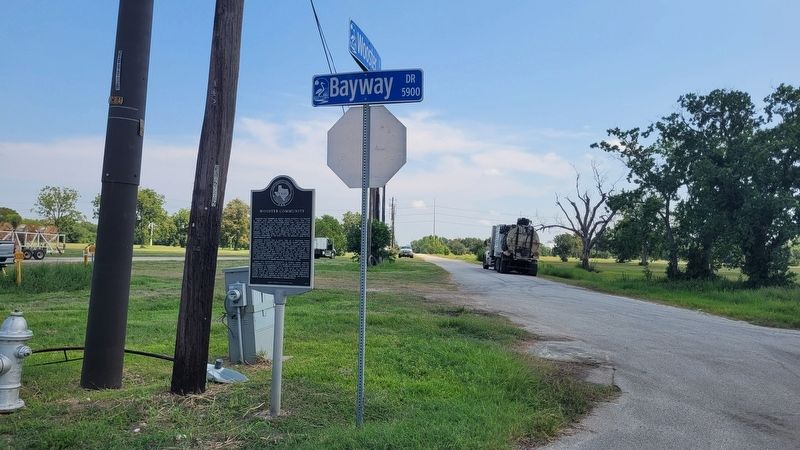
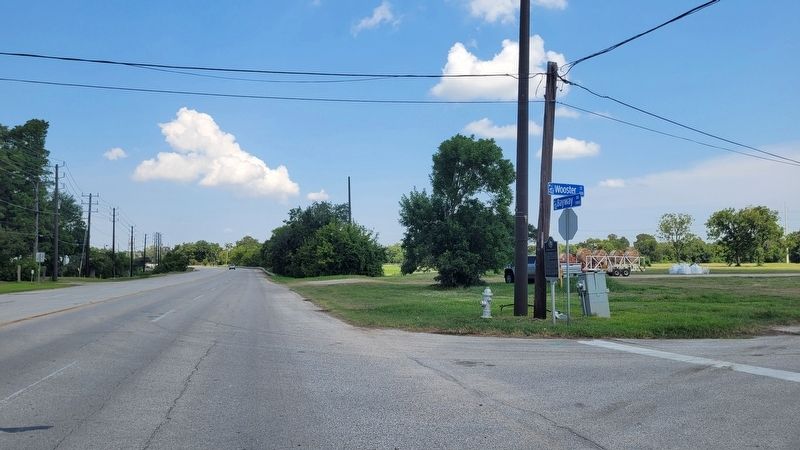
Location. 29° 44.957′ N, 95° 1.923′ W. Marker is in Baytown, Texas, in Harris County. It is in Wooster. It is at the intersection of Bayway Drive and Wooster Street, on the right when traveling west on Bayway Drive. The marker is located along the street at the corner of the street. Touch for map. Marker is at or near this postal address: 5900 Bayway Drive, Baytown TX 77520, United States of America. Touch for directions.

Regionally, this marker is in the Houston Metropolitan Area. It is also in the American South and on the Gulf Coast. Globally, it is in North America, a Gulf of Mexico state, the Western Hemisphere, the Western World, and the Anglosphere. Historically, it finds itself in what was once New Spain, the Republic of Texas, one of the Confederate States of America, and the Antebellum South.
Other nearby markers. At least 8 other markers are within 3 miles of this marker, measured as the crow flies: The Lynchburg Volunteers (approx. 0.7 miles away); Homesite of William Scott (approx.
Photographed by James Hulse, August 20, 2025
2. Wooster Community Marker
Also see . . . History of Wooster, Texas: From Settlement to Incorporation. Texas State Historical Association (TSHA)
Wooster, on Scott Bay in eastern Harris County, was settled in 1891 by Quincy Adams Wooster of Iowa and New England. The area was part of Stephen F. Austin's Old Three Hundred colony, from which Wooster purchased over 1,000 acres, including the home built by William Scott shortly after the battle of San Jacinto. The community is located on land the Mexican government granted to Nathaniel Lynch, and the property abstract includes names such as Estevan (Stephen) F. Austin and David G. Burnet. Wooster intended to develop a town.(Submitted on August 21, 2025, by James Hulse of Medina, Texas.)
Photographed by James Hulse, August 20, 2025
3. The view of the Wooster Community Marker along the street
Credits. This page was last revised on August 21, 2025. It was originally submitted on August 20, 2025, by James Hulse of Medina, Texas. This page has been viewed 84 times since then and 24 times this year. Photos: 1, 2, 3. submitted on August 21, 2025, by James Hulse of Medina, Texas.
