San Giovanni in Firenze in Città Metropolitana di Firenze, Tuscany, Italy — Southern and Western Europe (Mediterranean)
Il Museo
⎯⎯⎯
The Museum
Museo Nazionale del Bargello
Photographed by Sean P. Flynn, July 26, 2025
1. Il Museo / The Museum Marker
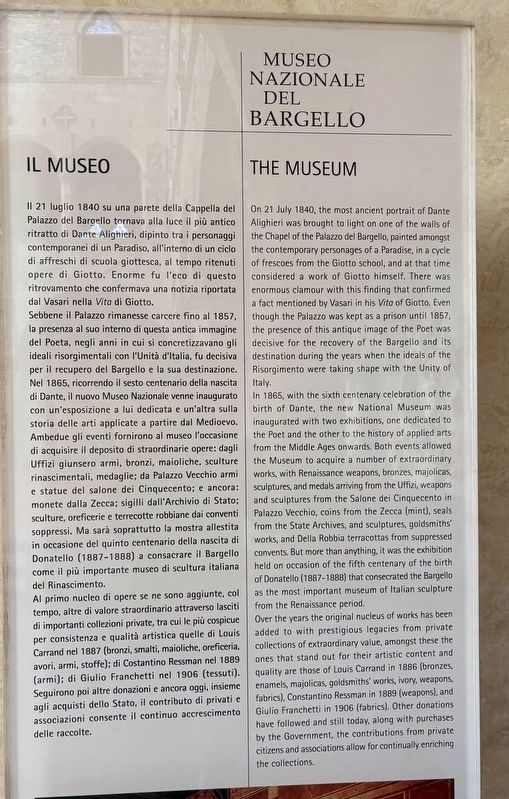
Il 21 luglio 1840 su una parete della Cappella del Palazzo del Bargello tornava alla luce il più antico ritratto di Dante Alighieri, dipinto tra i personaggi contemporanei di un Paradiso, all'interno di un ciclo di affreschi di scuola giottesca, al tempo ritenuti opere di Giotto. Enorme fu l'eco di questo ritrovamento che confermava una notizia riportata dal Vasari nella Vito di Giotto.
Sebbene il Palazzo rimanesse carcere fino al 1857, la presenza al suo interno di questa antica immagine del Poeta, negli anni in cui si concretizzavano gli ideali risorgimentali con l'Unità d'Italia, fu decisiva per il recupero del Bargello e la sua destinazione. Nel 1865, ricorrendo il sesto centenario della nascita di Dante, il nuovo Museo Nazionale venne inaugurato con un'esposizione a lui dedicata e un'altra sulla storia delle arti applicate a partire dal Medioevo. Ambedue gli eventi fornirono al museo l'occasione di acquisire il deposito di straordinarie opere: dagli Uffizi giunsero armi, bronzi, maioliche, sculture rinascimentali, medaglie; da Palazzo Vecchio armi e statue del salone dei Cinquecento; e ancora: monete dalla Zecca: sigilli dall'Archivio di Stato; sculture, areficerie e terrecotte robbiane dai conventi soppressi. Ma sară soprattutto la mostra allestita in occasione del quinto centenario della nascita di Donatello (1887-1888) a consacrare il Bargello come il più importante museo di scultura italiana del Rinascimento.
Al primo nucleo di opere se ne sono aggiunte, col tempo, altre di valore straordinario attraverso lasciti di importanti collezioni private, tra cui le più cospicue per consistenza e qualità artistica quelle di Louis Carrand nel 1887 (bronzi, smalti, maioliche, oreficeria, avori, armi, stoffe): di Costantino Ressman nel 1889 (armi); di Giulio Franchetti nel 1906 (tessuti). Seguirono poi
this page online
On 21 July 1840, the most ancient portrait of Dante Alighieri was brought to light on one of the walls of the Chapel of the Palazzo del Bargello, painted amongst the contemporary personages of a Paradise, in a cycle of frescoes from the Giotto school, and at that time considered a work of Giotto himself. There was enormous clamour with this finding that confirmed a fact mentioned by Vasari in his Vita of Giatto. Even though the Palazzo was kept as a prison until 1857, the presence of this antique image of the Poet was decisive for the recovery of the Bargello and its destination during the years when the ideals of the Risorgimento were taking shape with the Unity of Italy.
In 1865, with the sixth centenary celebration of the birth of Dante, the new National Museum was inaugurated with two exhibitions, one dedicated to the Poet and the other to the history of applied arts from the Middle Ages onwards. Both events allowed the Museum to acquire a number of extraordinary works,
Photographed by Sean P. Flynn, July 26, 2025
2. Il Museo / The Museum Marker
Over the years the original nucleus of works has been added to with prestigious legacies from private collections of extraordinary value, amongst these the ones that stand out for their artistic content and quality are those of Louis Carrand in 1886 (bronzes, eriamels, majolicas, goldsmiths works, ivory, weapons, fabrics), Constantino Ressman in 1889 (weapons), and Giulio Franchetti in 1906 (fabrics). Other donations have followed and still today, along with purchases by the Government, the contributions from private citizens and associations allow for continually enriching the collections.
Erected by Museo
Photographed by Sean P. Flynn, July 26, 2025
3. The Bargello
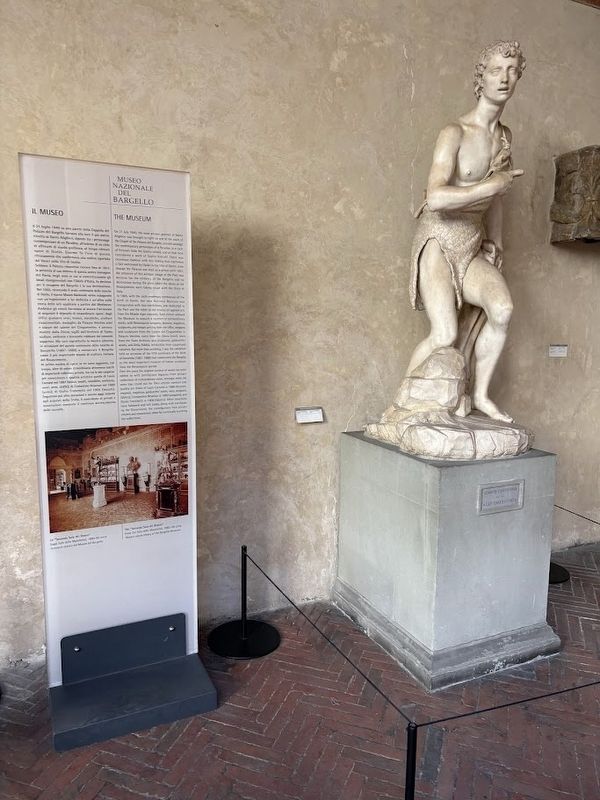
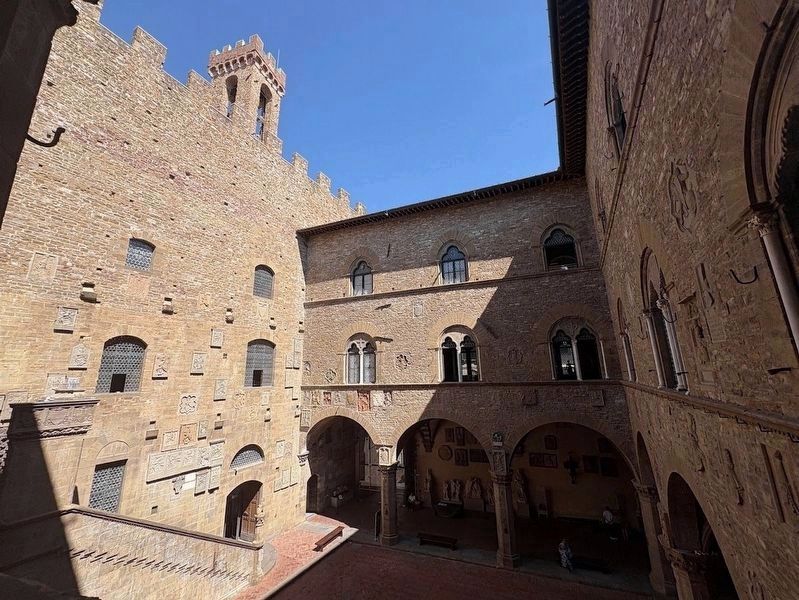
The Museo marker is in the open-air courtyard at the center of the Bargello.
Topics. This historical marker is listed in this topic list: Arts, Letters, Music. A significant historical date for this entry is July 21, 1840.
Location. 43° 46.23′ N, 11° 15.505′ E. Marker is in Firenze, Toscana (Tuscany), in Città Metropolitana di Firenze. It is in San Giovanni. It is on Via del Proconsolo near Via Ghibellina. The sign is is in the open-air courtyard in the middle of the Bargello museum. Touch for map. Marker is at or near this postal address: Via del Proconsolo 4, Firenze, Toscana 50122, Italy. Touch for directions.

Regionally, it is in Europe, the European Union, the Schengen Area, a coastal Mediterranean country, and the Western World. Historically, it finds itself in what was once the Roman Empire and specifically also the Holy Roman Empire.
Other nearby markers. At least 8 other markers are within walking distance of this marker: Il Palazzo / The Palazzo (here, next to this marker); L'incoronazione di Ferdinando I d'Aragona e Sei Musici (a few steps from this marker); Fontana di Sala Grande / Fountain for the Sala Grande (a few steps from this marker); Sarcofago / Sarcophagus (a few steps from this marker); Il Pescatore / The Fisher Boy (within shouting distance of this marker); Gli Stemmi / The Coats of Arms (within shouting distance of this marker); Cannone di San Paolo / Cannon (within shouting distance of this marker); Verone (within shouting distance of this marker). Touch for a list and map of all markers in Firenze.
Also see . . . National Museum of Bargello. A history of the Bargello from the Museums in Florence website. (Submitted on August 21, 2025, by Sean P. Flynn of Oak Park, Illinois.)
Credits. This page was last revised on August 21, 2025. It was originally submitted on August 21, 2025, by Sean P. Flynn of Oak Park, Illinois. This page has been viewed 92 times since then and 10 times this year. Photos: 1, 2. submitted on August 21, 2025, by Sean P. Flynn of Oak Park, Illinois. 3. submitted on August 20, 2025, by Sean P. Flynn of Oak Park, Illinois.
