Capitol Hill in Southeast Washington in Washington, District of Columbia — The American Northeast (Mid-Atlantic)
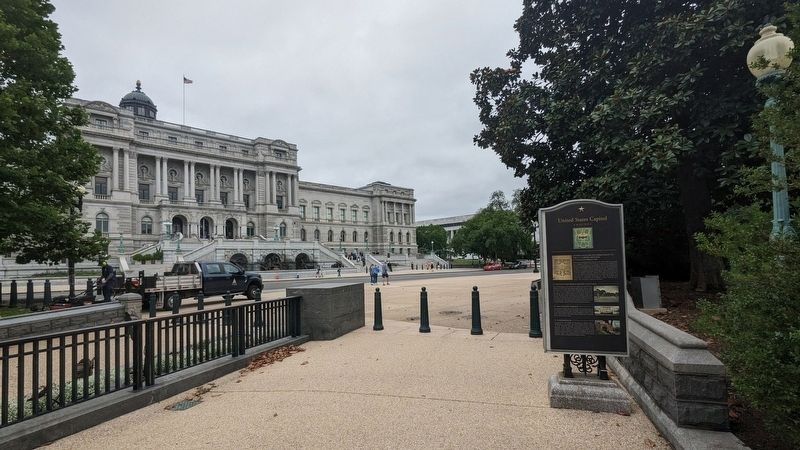
United States Capitol
Grounds

Photographed by Bernard Fisher, August 21, 2025
1. United States Capitol Marker
General Plan for the Improvement of the U.S. Capitol Grounds
by Frederick Law Olmstead, 1874
Following the extension of the Capitol in the 1850s-1860s, the grounds were enlarged in 1872. In 1874 Congress commissioned Frederick Law Olmstead to design landscape improvements, and he soon produced this drawing which guided the project over the next two decades. He described the plan as “very simple, with the purpose of its perfect subordination in interest to the architectural design of the Capitol.” Olmstead’s objective was to provide a dignified “park-like” setting for the Capitol, with groupings of trees and expansive vistas designed to set the Capitol square apart, as an oasis from the surrounding, developing city. Today the grounds have evolved into an arboretum with hundreds of mature botanical specimens—many of which are rarely seen elsewhere.
1. Granite Lamp Piers & Bronze Fountains
Bay of Fundy Granite was used for the massive piers that Olmstead designed to hold bronze, gas-burning light fixtures. Electric sparks from copper wires and a remote battery originally ignited the lamps. The piers were constructed in 1875. Olmstead also designed the large granite basins, within which bronze fountains created rainbows by fine water sprays; the effect was continued at night under gas lights. The bronze was cast in 1875 by Janes, Kirkland, and Company of New York, the same firm that cast most of the ironwork for the Capitol dome. The lamps, piers, fountains and basins were restored during the Capitol Visitor Center construction project.
2. The Olmstead Terrace
Constructed in 1884-1892 on the north, west and south sides of the Capitol the marble terrace provided a strong visual platform, correcting the illusion that the massive building was about to slide down Capitol Hill. It also added much needed-space
this page online
3. Summerhouse
Constructed in 1879-1889, the Summerhouse offered visitors a shaded place to rest, admire views of the Capitol, and have a drink of water. Olmstead’s principal architectural assistant, Thomas Wisedell, was the designer. The Summerhouse is a tribute to the bricklayer’s craft—constructed of carved and radial brick, creating elaborate architectural features. Nestled in the hillside, the structure features a “grotto” with running water that, along with the central fountains, adds a cooling affect during the summer.
Topics. This historical marker is listed in this topic list: Architecture. A significant historical year for this entry is 1874.
Location. 38° 53.333′ N, 77° 0.375′ W. Marker is in Southeast Washington in Washington, District of Columbia. It is in Capitol Hill. It is on 1st Street Southeast north of Independence Avenue Southeast, on the left when traveling north. Touch for map. Marker is in this post office area: Washington DC 20004, United States of America. Touch for directions.

Regionally, this marker is in the Washington Metropolitan Area. It is also in the American
Photographed by Bernard Fisher, August 21, 2025
2. United States Capitol Marker
Other nearby markers. At least 8 other markers are within walking distance of this marker: A different marker also named United States Capitol (here, next to this marker); Jefferson (within shouting distance of this marker); a different marker also named Jefferson (within shouting distance of this marker); Madison (about 600 feet away); a different marker also named United States Capitol (about 700 feet away); a different marker also named United States Capitol (about 700 feet away); a different marker also named Madison (about 700 feet away); The Old Brick Capitol (about 700 feet away). Touch for a list and map of all markers in Southeast Washington.
Other markers no longer nearby. War Gardens Over the Top (was about 400 feet away, measured in a direct line but has been permanently removed); War Garden (was about 400 feet away but has been permanently removed); a different marker also named War Garden (was about 400

Photographed by Bernard Fisher, August 21, 2025
3. United States Capitol
More about this marker. An identical marker is located 225 yds north.
Credits. This page was last revised on September 5, 2025. It was originally submitted on August 23, 2025, by Bernard Fisher of Richmond, Virginia. This page has been viewed 103 times since then and 22 times this year. Photos: 1, 2, 3. submitted on August 23, 2025, by Bernard Fisher of Richmond, Virginia.
