
Trinidad in Las Animas County, Colorado — The American Mountains (Southwest)
Zion's German Lutheran Church
1889
Photographed by Cosmos Mariner, July 10, 2025
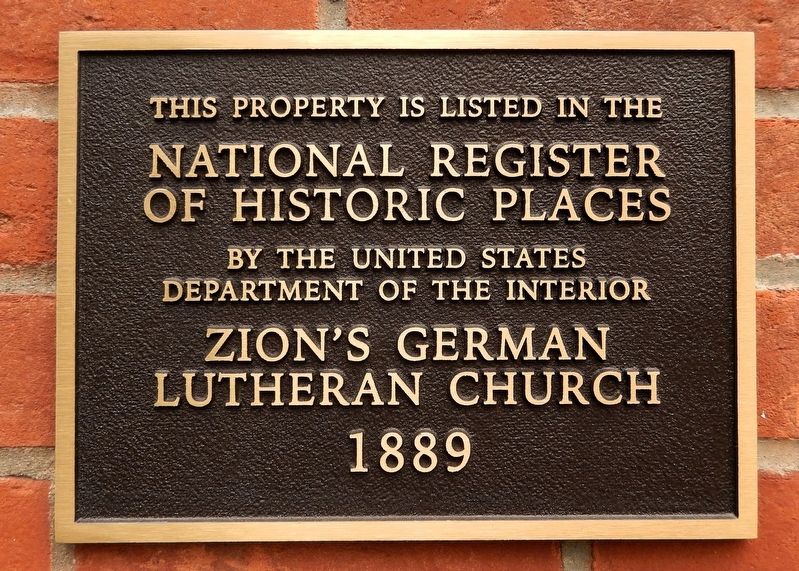
1. Zion's German Lutheran Church Marker
This property is listed in the
National Register of Historic Places
by the United States Department of the Interior
Topics and series. This historical marker is listed in these topic lists: Architecture • Notable Buildings • Religion & Religious Structures. In addition, it is included in the National Register of Historic Places (NRHP) series list. A significant historical year for this entry is 1889.
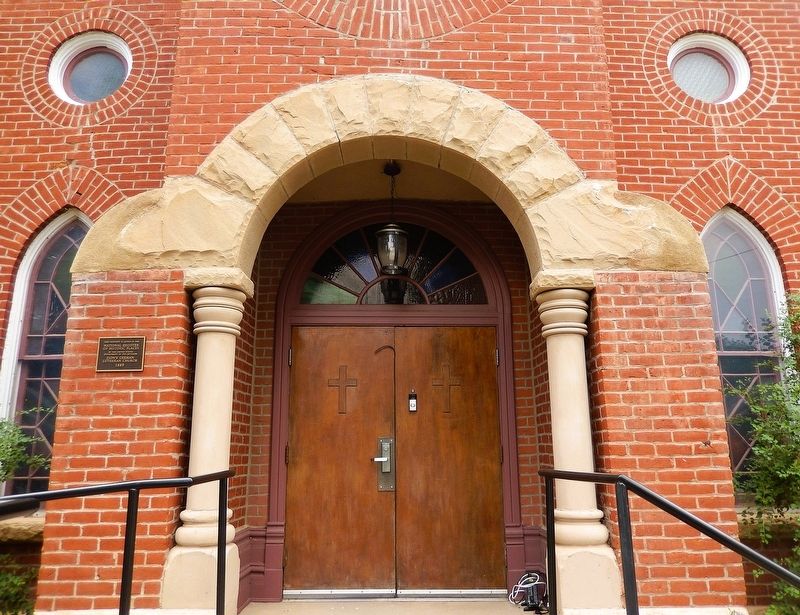
Location. 37° 10.419′ N, 104° 30.861′ W. Marker is in Trinidad, Colorado, in Las Animas County. It can be reached from the intersection of Pine Street and Prospect Street, on the right when traveling east. The marker is mounted at eye-level, directly on the subject building, on the left side of the north/front entrance. Touch for map. Marker is at or near this postal address: 510 Pine Street, Trinidad CO 81082, United States of America. Touch for directions.

Regionally, this marker is in the American Mountain West, on the Great Plains, on the Southern Plains, and on the Santa Fe Trail Corridor. Globally, it is in North America, the Western Hemisphere, the Western World, and the Anglosphere. Historically, it
this page online
Other nearby markers. At least 8 other markers are within walking distance of this marker: The Methodist Church of Trinidad (approx. 0.2 miles away); Trinidad (approx. 0.3 miles away); Welcome to Colorado / Trinidad Country / Trinidad / Army of the West (approx. 0.3 miles away); World War II Veterans Memorial (approx. 0.3 miles away); Viet-Nam War Memorial (approx. 0.3 miles away); The Last Coal Burning Steam Engine (approx. 0.4 miles away); Christopher Carson (approx. half a mile away); Trinidad's First City Building (approx. half a mile away). Touch for a list and map of all markers in Trinidad.
Regarding Zion's German Lutheran Church. National Register of Historic Places № 06000950 and Colorado State Register of Historic Places Site № 5LA.1096.
From the National Register Nomination prepared by George H. Hagen and Ken Fletcher, 12/2005:
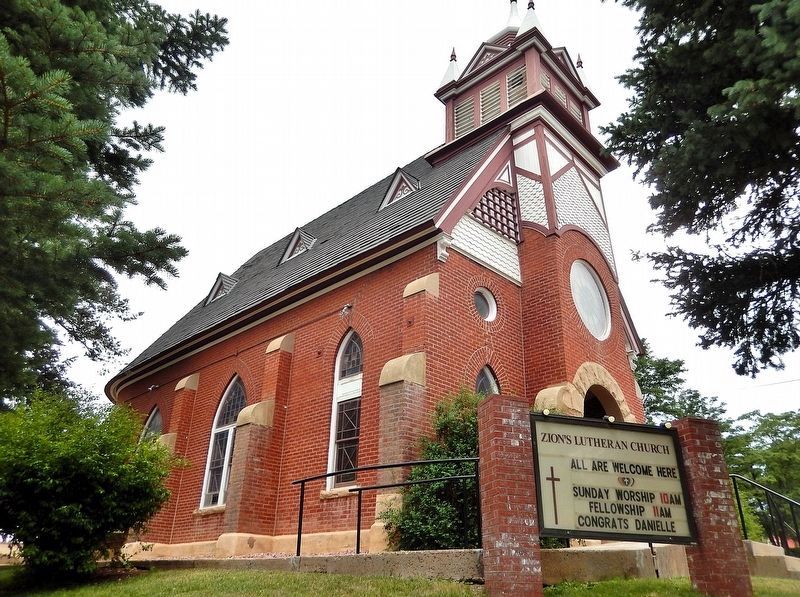
The 1890 Zion's German Lutheran Church derives its primary significance from architectural distinction. This well-preserved church possesses high artistic value as evident by thegauged brick window surrounds, the decorative shingles with a stick work overlay, and the elaborate German-inspired tower roof. The Late Victorian construction is primarily Gothic, but with elements of Romanesque, Queen Anne and the Stick Style along with Germanic influences.Photographed by Cosmos Mariner, July 10, 20252. Zion's German Lutheran Church MarkerThe marker is mounted on the left side of the north/front entrance.
The church is also architecturally significant as it represents the work of Charles W. Bulger and Isaac Hamilton Rapp. Although the partnership lasted only a few years, it resulted in several fine buildings that are an important part of Trinidad's architectural heritage. This was the firm's second commission for a religious building, and it easily illustrates their talent for designing unusual buildings that expressed the eclecticism of the Victorian Age.
Also see . . .
1. Zion's German Lutheran Church (Wikipedia).
Excerpt: It was added to the National Register in 2006. It is 26 by 61 feet in plan. It is described in its NRHP nomination as a distinctive red brick building with stone trim and a steeply pitched, wood shingle roof. The building has decorative gabled trim, pointed-arch windows, buttressing, and a central tower/narthex with an elaborate(Submitted on August 24, 2025, by Cosmos Mariner of Cape Canaveral, Florida.)roof and a round arched entry below a large rose window.Photographed by Cosmos Mariner, July 10, 20253. Zion's German Lutheran Church (northeast elevation)From the National Register Nomination: There is a recently constructed sign diagonally positioned beyond the sidewalk near the northeast corner of the building. The rectangular signboard is suspended between two square, red brick piers. The west and east sides of the church are similar. A stepped buttress anchors the corner, and three more buttresses are evenly spaced across the brick wall. A pointed arched window is centered in each of the three bays created by the buttressing. The first bay has a double-hung window with a wide transom bar and a pointed arched sash window. (The wide transom bar corresponds to the floor of the balcony inside.) The second and third bays contain a window opening that consists of paired double hung sash windows surmounted by a transom bar and pointed arched sash.
2. Zion’s German Lutheran Church (History Colorado).
Excerpt: Constructed in 1890, the eclectic building almost defies architectural classification. Primarily Victorian Gothic (as evident by its steeply pitched roof, pointed arched windows, and polychromatic exterior of contrasting materials), the church includes elements from several other styles of the Late Victorian period.(Submitted on August 24, 2025, by Cosmos Mariner of Cape Canaveral, Florida.)
Photographed by Cosmos Mariner, July 10, 2025
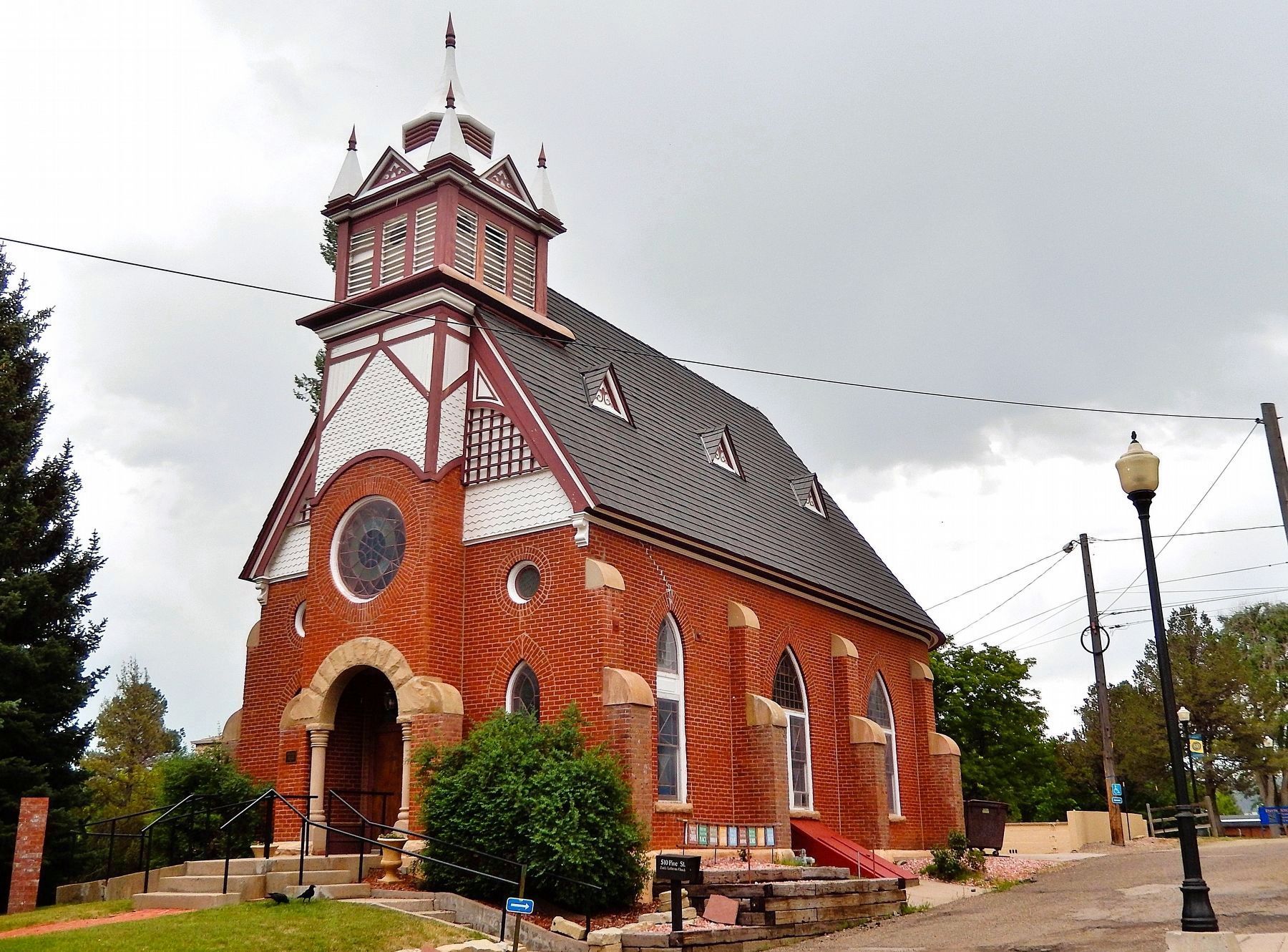
4. Zion's German Lutheran Church (northwest elevation)
From the National Register Nomination: The symmetrically designed building faces north where the dominant feature, an elaborate tower, marks the main entrance. A series of concrete steps from the east, a series of steps from the north and a concrete ramp from the east all converge at a concrete landing in front of the central projecting bay that contains the narthex and then extends up to form the tower. A semi-circular arch of quarry faced sandstone leads to a recessed entry and solid wood, double doors with a semi-circular fanlight with tracery. The radiating voussoirs of the arch come to rest on two unusual columns. Showing influences of the Egyptian Revival style, the columns have a smooth shaft with broad bands of torus molding forming the capital and base. The impost of each column extends to form the caps on the buttresses that flank the bay. The projecting bay continues upward to form the tower. The large rose window with its gauged brick surround is positioned above the arched entry. Above the rose window the wall of the tower is faced with hexagonal wood shingles. Horizontal, vertical and diagonal boards create a stick work effect over the shingles. The painted white shingles and the dark red trim create a colorful contrast. The projecting bay bisects the north facade of the building. Flanking the bay is a narrow pointed arched window with a small oculus window above it. The gabled ends are faced with hexagonal wood shingles; the upper portions have an overlay of dark red lattice work. The top of the tower is the dominant feature of the building. A square wood framed section occupies the apex of the gable and a portion of the roof; each side is comprised of three vertical louvered panels. The elaborate roof of the tower reflects a Germanic influence. The triangular shape and decorative motif of the eyebrow dormer is repeated on each side of the tower roof. The four corners are marked with a finial, and it all culminates in a central spire. The white paint with red trim highlights the various forms on the tower.
Credits. This page was last revised on August 24, 2025. It was originally submitted on August 23, 2025, by Cosmos Mariner of Cape Canaveral, Florida. This page has been viewed 103 times since then and 25 times this year. Photos: 1, 2, 3, 4. submitted on August 24, 2025, by Cosmos Mariner of Cape Canaveral, Florida.
