River Arts District in Asheville in Buncombe County, North Carolina — The American South (South Atlantic)
The Asheville Black Cultural Heritage Trail
⎯⎯⎯
Asheville's Black Newspapers
⎯⎯⎯
The Flood of 1916
| — | Black Cultural Heritage Trail | — |
Photographed by Mark Parker, July 18, 2025
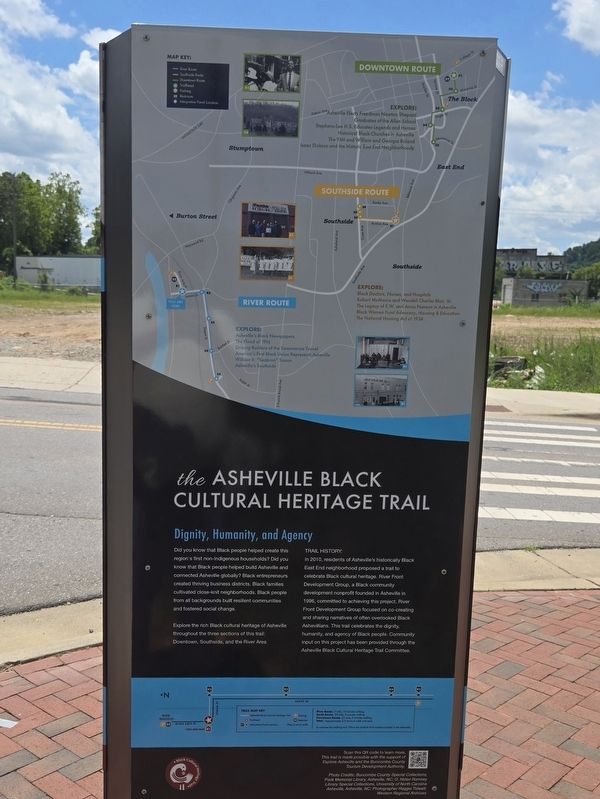
1. The Asheville Black Cultural Trail side of marker
The Asheville Black Cultural Heritage Trail
Dignity, Humanity, and Agency
Did you know that Black people helped create this region's first non-indigenous households? Did you know that Black people helped build Asheville and connected Asheville globally? Black entrepreneurs created thriving business districts. Black families cultivated close-knit neighborhoods. Black people from all backgrounds built resilience communities and fostered social change.
Explore the rich Black cultural heritage throughout the three sections of this trail: Downtown, Southside, and the River Area.
Trail History
In 2010, residents of Asheville's historically Black East End neighborhood proposed a trail to celebrate Black cultural heritage. River Front Development Group, a Black community development non-profit founded in Asheville in 1996, committed to achieving this project. River Front Development Group focused on co-creating and sharing narratives of often overlooked Black Ashevillians. This trail celebrates the dignity, humanity and agency of Black people. Community input on this project has been provided through the Asheville
this page online
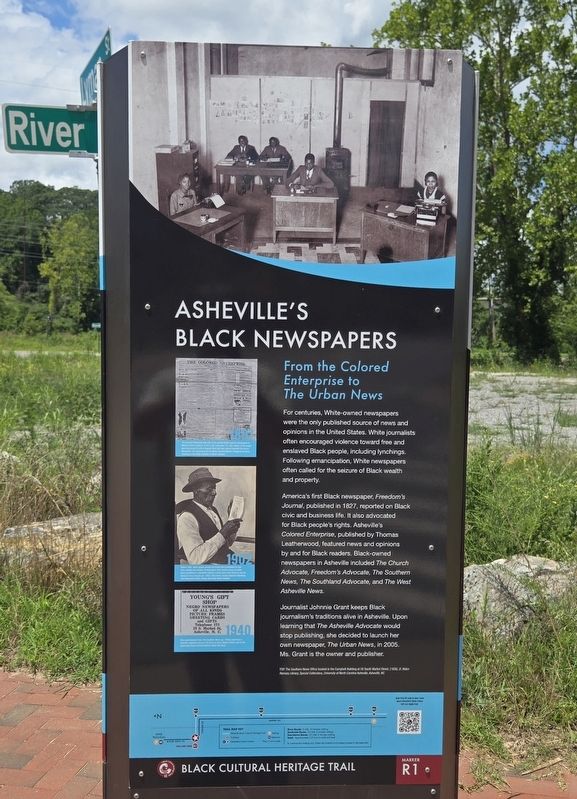
Asheville's Black Newspapers
From the Colored Enterprise to the Urban News
For centuries, White-owned newspapers were the only published source of news and opinions in the United States. White journalists often encouraged violence toward free and enslaved Black people, including lynchings. Following emancipation, White newspapers often called for the seizure of Black wealth and property.
America's first Black newspaper, Freedom's Journal, published in 1827, reported on Black civic and business life. It also advocated for Black people's rights. Asheville's Colored Enterprise, published by Thomas Leatherwood, featured news and opinions by and for Black readers. Black-owned newspapers in Asheville included The Church Advocate, Freedom's Advocate, The Southern News, The Southland Advocate, and The West Asheville News.
Journalist Johnnie Grant keeps Black journalism's traditions alive in Asheville. Upon learning that The Asheville Advocate would stop publishing, she decided to launch her own newspaper, The Urban News, in 2005. Ms. Grant is the owner and publisher.
(captions)
1897: The Colored Enterprise was one of the earliest black-owned newspapers in Western North Carolina. In 2015, The December 18, 1897 edition of the paper was discovered in a time capsule that had been placed beneath the Vance Monument. It is preserved by the Western North Carolina Regional Archives.Courtesy of the State Archives of North Carolina
1902: Before 1865, Black people across the South were prohibited by law from reading and writing. Photographer John Tolbert shows an older Black gentleman in Asheville reading a book about John Brown's raid on Harpers Ferry, Virginia (ca.1902). Buncombe County Special Collections, Pack Memorial Library, Asheville North Carolina
1940: This advertisement from The Southern News (ca. 1940) published in Asheville highlights Young's Gift Shop on South Market Street, part of the historically Black downtown district called The Block.
Top:The Southern News Office located in the Campbell Building at 38 South Market Street (1938). D. Hiden Ramsey Library. Special Collections, University of North Carolina, Asheville, Asheville, NC
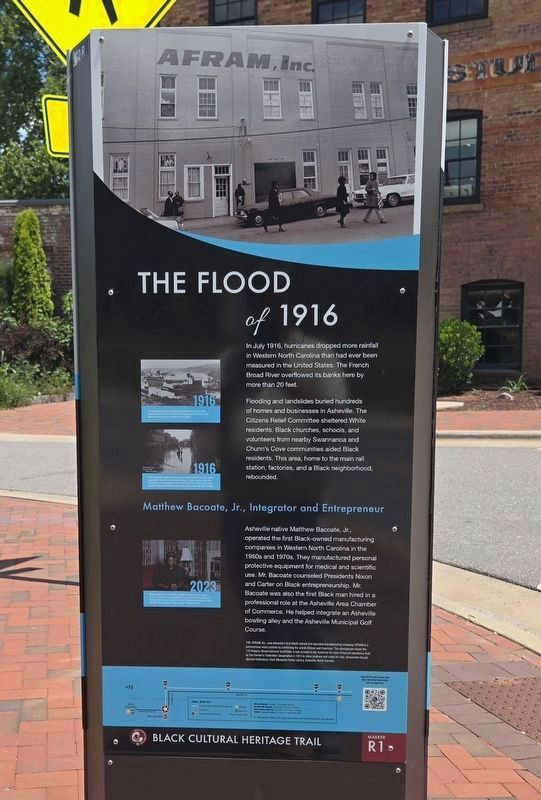
The Flood of 1916
In
Photographed by Mark Parker, July 18, 2025
2. Asheville's Black Newspapers side of marker
Flooding and landslides buried hundreds of homes and businesses in Asheville. The Citizens Relief Committee sheltered White residents. Black churches, schools, and volunteers from nearby Swannanoa and Chunn's Cove communities aided Black residents.
Matthew Bacoate, Jr., Integrator and Entrepreneur
Asheville native Matthew Bacoate, Jr., operated the first Black-owned manufacturing companies in Western North Carolina in the 1960s and 1970s. They manufactured personal protective equipment for medical and scientific use. Mr. Bacoate counseled Presidents Nixon and Carter on Black entrepreneurship. Mr. Bacoate was also the first Black man hired in a professional role at the Asheville Area Chamber of Commerce. He helped integrate an Asheville bowling alley and the Asheville Municipal Golf Course.
(captions)
1916: This photograph shows the Broad's devastating effect on the Black neighborhood Southside. Buncombe County Special Collections, Pack Memorial Public Library, Asheville, North Carolina
Top: AFRAM, Inc., was Asheville's first black-owned and operated manufacturing company. AFRAM is a portmanteau word created by combining the words African and American. This photo shows the 129 Roberta Street entrance to AFRAM. It was located in the historical six-story fireproof warehouse built by the Farmer's Federation Cooperative in 1915 to store produce and crops for sale. Buncombe County Special Collections, Pack Memorial Public Library, Asheville, North Carolina,
[Note 1916 and 2023 captions were blurred in the photo]
Erected by Black
Photographed by Mark Parker, July 18, 2025
3. The Flood of 1916 Marker
Topics and series. This historical marker is listed in these topic lists: African Americans • Arts, Letters, Music • Communications • Disasters • Industry & Commerce. In addition, it is included in the Time Capsules series list. A significant historical year for this entry is 1916.
Location. 35° 35.068′ N, 82° 33.98′ W. Marker is in Asheville, North Carolina, in Buncombe County. It is in the River Arts District. It is at the intersection of River Arts Place and Lyman Street, on the left when traveling north on River Arts Place. Touch for map. Marker is at or near this postal address: 1 River Arts Pl, Asheville NC 28801, United States of America. Touch for directions.

Regionally, this marker is in the Mountains. It is also in the American South, specifically in the Upper South, in Appalachia, and specifically in Southern Appalachia. Globally, it is in North America, the Western Hemisphere, the Western World, and the Anglosphere. Historically, it finds itself in what was once the original Cherokee Nation, the territory of the Mississippian Culture, one of the original Thirteen Colonies, one of the Confederate States of America, and the Antebellum South.
Other nearby markers. At least 8 other markers are within walking distance of this marker: Welcome to the River Arts District (within shouting distance of this marker); Unsung Builders of the Swannanoa Tunnel (about 400 feet away, measured in a direct line); America's First Black Union Represents Ashevillians (approx. 0.2 miles away); William R. "Seaborn" Saxon (approx. ¼ mile away); Electric Streetcars (approx. 0.3 miles away); Asheville's Southside (approx. 0.4 miles away); Lynching in America / The Lynching of Hezekiah Rankin (approx. half a mile away); The Legacy of E.W. and Annis Pearson in Asheville

Photographed by Mark Parker, July 18, 2025
4. Full kiosk at corner of Lyman Street and River Arts Place
Another marker is no longer nearby. Daniel K. Moore (was approx. 0.6 miles away but has been confirmed missing).
Also see . . .
1. Asheville Icon: Meet Matthew Bacoate, Jr.
Matthew Bacoate, Jr., has always looked at himself as a problem solver. It was this mindset that turned him into one of Asheville's greatest advocates for integration and a community leader for Black-owned businesses and jobs.(Submitted on August 23, 2025, by Mark Parker of Hickory, North Carolina.)
2. A Long Legacy of Black Media in Asheville.
Before 1865, laws across the South prohibited Black individuals from reading and writing. Even after these restrictions were lifted, operating a Black newspaper was a precarious endeavor with great financial and personal risk. In 1898, race riots erupted in Wilmington, North Carolina, after a White mob destroyed a Black newspaper office as part of a racially motivated rebellion in which White supremacists forced elected officials to resign at gunpoint.(Submitted on August 23, 2025, by Mark Parker of Hickory, North Carolina.)
The Colored Enterprise, published and edited by Thomas Leatherwood, was one of the earliest Black-owned newspapers in Western North Carolina. In March 2015, the only known copy of the paper—the December 18, 1897, edition—was discovered in a time capsule that had been secretly placed beneath the Vance Monument more than a century before.
Credits. This page was last revised on August 24, 2025. It was originally submitted on August 23, 2025, by Mark Parker of Hickory, North Carolina. This page has been viewed 151 times since then and 44 times this year. Photos: 1, 2, 3, 4. submitted on August 23, 2025, by Mark Parker of Hickory, North Carolina. • Bernard Fisher was the editor who published this page.
