
Westpoort in Amsterdam, North Holland, Netherlands — Northwestern Europe
Mosquito crashsite WOII
⎯⎯⎯
Mosquito Crash Site WWII
Photographed by Andrew Ruppenstein, June 20, 2025
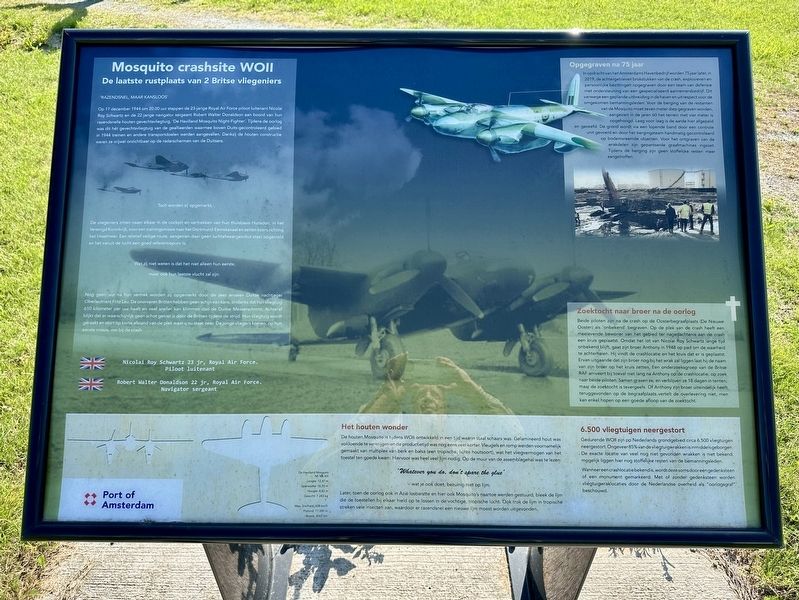
1. Mosquito crashsite WOII / Mosquito Crash Site WWII Marker

‘Razendsnel, maar kansloos’
Op 17 december 1944 om 20.00 uur stappen de 23-jarige Royal Air Force piloot luitenant Nicolai Roy Schwartz en de 22-jarige navigator sergeant Robert Walter Donaldson aan boord van hun razendsnelle houten gevechtsvliegtuig, 'De Havilland Mosquito Night-Fighter'. Tijdens de oorlog was dit het gevechtsvliegtuig van de geallieerden waarmee boven Duits-gecontroleerd gebied in 1944 treinen en andere transportdoelen werden aangevallen. Dankzij de houten constructie waren ze vrijwel onzichtbaar op de radarschermen van de Duitsers.
Toch worden zij opgemerkt...
De vliegeniers zitten naast elkaar in de cockpit en vertrekken van hun thuisbasis Hunsdon, in het Verenigd Koninkrijk, voor een trainingsmissie naar het Dortmund-Eemskanaal en zetten koers richting het Usselmeer. Een relatief veilige route, aangezien daar geen luchtafweergeschut staat opgesteld en het vanuit de lucht een goed referentiepunt is.
Wat zij niet weten is dat het niet alleen hun eerste, maar ook hun laatste vlucht zal zijn.
Nog geen uur na hun vertrek worden
this page online
Nicolai Roy Schwartz 23 jr, Royal Air Force.
Piloot luitenant
Robert Walter Donaldson 22 jr, Royal Air Force.
Navigator sergeant
Opgegraven na 75 jaar
In opdracht van het Amsterdams Havenbedrijf worden 75 jaar later, in 2019, de achtergebleven brokstukken van de crash, explosieven en persoonlijke bezittingen opgegraven door een team van defensie met ondersteuning van een gespecialiseerd aannemersbedrijf. Dit vanwege een geplande uitbreiding in de haven en uit respect voor de omgekomen bemanningsleden. Voor de berging van de restanten van de Mosquito moet zeven meter diep gegraven worden, aangezien in de jaren 60 het terrein met vier meter
Photographed by Andrew Ruppenstein, June 20, 2025
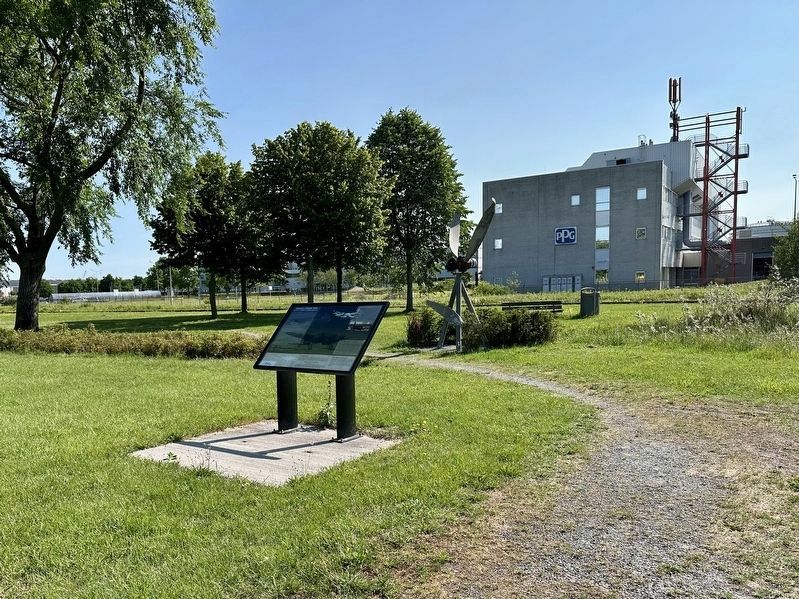
2. Mosquito crashsite WOII / Mosquito Crash Site WWII Marker - wide view
A memorial for the crashed plane is visible here a few steps beyond the marker.
Zoektocht naar broer na de oorlog
Beide piloten zijn na de crash op de Oosterbegraafplaats (De Nieuwe Ooster) als 'onbekend' begraven. Op de plek van de crash heeft een meelevende bewoner van het gebied ter nagedachtenis aan de crash een kruis geplaatst. Omdat het lot van Nicolai Roy Schwartz lange tijd onbekend blijft, gaat zijn broer Anthony in 1948 op pad om de waarheid te achterhalen. Hij vindt de crashlocatie en het kruis dat er is geplaatst. Ervan uitgaande dat zijn broer nog bij het wrak zal liggen laat hij de naam van zijn broer op het kruis zetten. Een onderzoeksgroep van de Britse RAF arriveert bij toeval niet lang na Anthony op de crashlocatie, op zoek naar beide piloten. Samen graven ze, en verblijven ze 18 dagen in tenten, maar de zoektocht is tevergeefs. Of Anthony zijn broer uiteindelijk heeft teruggevonden op de begraafplaats vertelt de overlevering niet, men kan enkel hopen op een goede afloop van de zoektocht.
Het houten wonder
De houten, Mosquito is tijdens Woll ontwikkeld in een tijd waarin staal schaars was. Gelamineerd hout was voldoende te verkrijgen en de productietijd was nog eens veel korter. Vleugels en romp werden voornamelijk gemaakt van multiplex van berk en balsa (een tropische, lichte houtsoort), wat het vliegvermogen van het toestel ten goede kwam. Hiervoor was heel veel lijm nodig. Op de muur van de assemblagehal was te lezen:
"Whatever you do, don't spare the glue'
- wat je ook doet, bezuinig niet op lijm.
Later, toen de oorlog ook in Azië losbarstte en hier ook Mosquito's naartoe werden gestuurd, bleek de lijm die de toestellen bij elkaar hield op te lossen in de vochtige, tropische lucht. Ook trok de lijm in tropische streken vele insecten aan, waardoor er razendsnel een nieuwe lijm moest worden uitgevonden.
6.500 vliegtuigen neergestort
Gedurende Woll zijn op Nederlands grondgebied circa 6.500 vliegtuigen neergestort. Ongeveer 85% van de vliegtuigwrakken is inmiddels geborgen. De exacte locatie van veel nog niet gevonden wrakken is niet bekend, mogelijk liggen hier nog stoffelijke resten van de bemanningsleden.
Wanneer een crashlocatie bekend is, wordt deze soms door een gedenksteen of een monument gemarkeerd. Met of zonder gedenksteen worden vliegtuigwraklocaties door de Nederlandse overheid als "oorlogsgraf" beschouwd.
The final resting place of two British airmen
"Fast, but hopeless"
On December 17, 1944, at 8:00 PM, 23-year-old Royal Air Force pilot Lieutenant Nicolai Roy Schwartz and 22-year-old navigator Sergeant Robert Walter Donaldson boarded their lightning-fast wooden fighter plane, the De Havilland Mosquito Night-Fighter. During the war, this was the Allied fighter plane used to attack trains and other transport targets over German-controlled territory in 1944. Thanks to its wooden construction, they were virtually invisible on German radar screens. Yet, they were noticed...
The pilots sat side by side in the cockpit and departed from their home base in Hunsdon, United Kingdom, for a training mission to the Dortmund-Ems Canal, heading towards the Ijsselmeer. A relatively safe route, as there are no anti-aircraft guns there and it's a good reference point from the air.
What they didn't know is that this would be not only their first flight, but also their last.
Less than an hour after their departure, they were spotted by the highly experienced German night fighter, Oberleutnant Fritz Lau. The inexperienced British didn't stand a chance, despite their aircraft reaching 610 kilometers per hour and climbing much faster than the German Messerschmitt. It later turned out that the British likely didn't fire a shot during the battle. Their plane was hit and crashed a short distance from where you are standing. The young pilots, on their first mission, perished in the crash.
Nicolai Roy Schwartz 23 Jr, Royal Air Force.
Pilot, lieutenant
Robert Walter Donaldson 22 Jr, Royal Air Force.
Navigator, sergeant
Excavated after 75 years
Commissioned by the Port of Amsterdam, 75 years later, in 2019, the remaining debris from the crash, explosives, and personal belongings were excavated by a team from the Ministry of Defence, supported by a specialized contractor. This was due to a planned expansion of the port and out of respect for the fallen crew members. To recover the remains of the Mosquito, seven meters of excavation was required, as the site was raised by four meters in the 1960s. The soil was peeled away and sieved layer by layer. The soil was fed via a conveyor belt through a control unit and inspected by the salvage team for foreign objects. Armored excavators were deployed to remove parts of the wreckage. No remains were found during the salvage operation.
The search for a brother after the war
Both pilots were buried as "unknown" at the Oosterbegraafplaats (The New Eastern Cemetery) after the crash. A sympathetic resident of the area placed a cross at the crash site in memory of the crash. Because the fate of Nicolai Roy Schwartz remained unknown for a long time, his brother Anthony set out in 1948 to uncover the truth. He found the crash site and the cross that had been placed there. Assuming his brother was still buried near the wreckage, he had his brother's name inscribed on the cross. A British RAF search party arrived at the crash site by chance not long after Anthony, searching for both pilots. Together they dug and stayed in tents for 18 days, but the search was in vain. Whether Anthony ultimately found his brother at the cemetery is unknown; one could only hope for a successful outcome.
The wooden wonder
The wooden Mosquito was developed during Woll's time, at a time when steel was scarce. Laminated wood was readily available, and production time was significantly shorter. The wings and fuselage were made primarily of birch plywood and balsa (a tropical, light wood), which enhanced the aircraft's flying ability. This required a great deal of glue. The following was written on the assembly hall wall:
“Whatever you do, don't spare the glue”
Later, when war broke out in Asia and Mosquitos were sent there as well, the glue holding the aircraft together dissolved in the humid, tropical air. The glue also attracted many insects in tropical climates, forcing the rapid development of a new adhesive.
6,500 aircraft crashed
During Woll, approximately 6,500 aircraft crashed on Dutch soil. Approximately 85% of the wreckage has now been recovered. The exact location of many of the wrecks that have not yet been found is unknown; the remains of the crew members may still be present.
When a crash site is known, it is sometimes marked with a memorial stone or monument. With or without a memorial stone, aircraft wreckage sites are considered "war graves" by the Dutch government.
Erected by Port of Amsterdam.
Topics. This historical marker is listed in these topic lists: Air & Space • War, World II. A significant historical date for this entry is December 17, 1944.
Location. 52° 24.397′ N, 4° 45.509′ E. Marker is in Amsterdam, Noord-Holland (North Holland). It is in Westpoort. It is at the intersection of Ruijgoordweg and Westpoortweg, on the left when traveling south on Ruijgoordweg. Touch for map. Marker is in this post office area: Amsterdam, Noord-Holland 1047, Netherlands. Touch for directions.

Regionally, it is in Europe, the European Union, Atlantic Europe, the Benelux Low Countries, the Schengen Area, Western Europe, and the Western World. Historically, it finds itself in what was once the Holy Roman Empire.
Other nearby markers. At least 8 other markers are within 3 kilometers of this marker, measured as the crow flies: RAF Mosquito HK529 Crash Memorial (a few steps from this marker); 19th Century Section of the Sugar Factory (approx. 2.5 kilometers away); Sluizen, Sluiseiland en Spoorbrug / Sluices and Railway Bridge (approx. 2.5 kilometers away); Haarlemmerstraatweg 15-31 (approx. 2.5 kilometers away); IJsteeg / Ij Alley (approx. 2.5 kilometers away); Huis ter Hart (approx. 2.5 kilometers away); Vaart / Haarlem canal and towpath (approx. 2.5 kilometers away); Raadhuis / Town Hall (approx. 2.6 kilometers away).
Credits. This page was last revised on August 23, 2025. It was originally submitted on August 23, 2025, by Andrew Ruppenstein of Lamorinda, California. This page has been viewed 92 times since then and 24 times this year. Photos: 1, 2. submitted on August 23, 2025, by Andrew Ruppenstein of Lamorinda, California.
