Downtown in Pueblo in Pueblo County, Colorado — The American Mountains (Southwest)
Evocation
Photographed by Mark Hilton, August 11, 2025
1. Evocation Marker
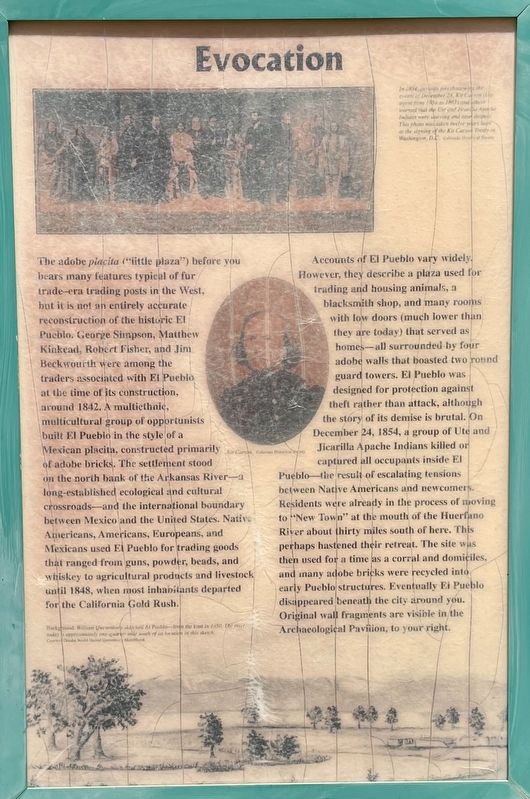
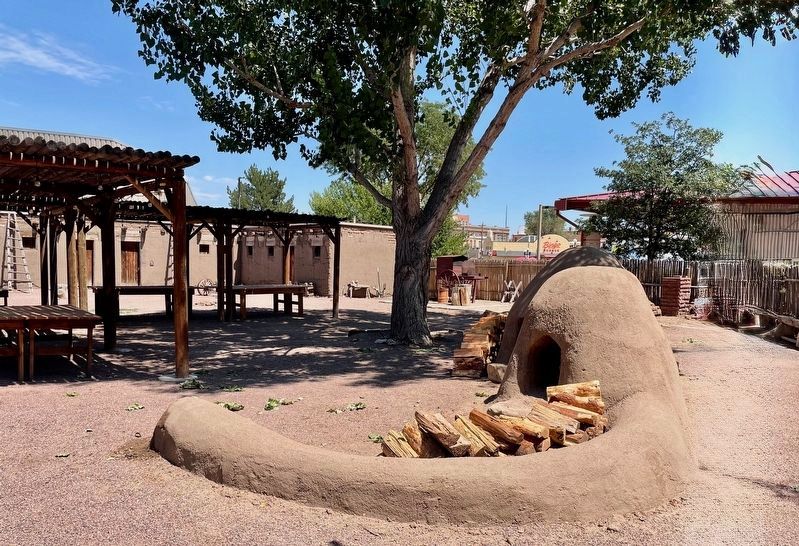
The adobe placita ("little plaza") before you bears many features typical of fur trade-era trading posts in the West, but it is not an entirely accurate reconstruction of the historic El Pueblo. George Simpson, Matthew Kinkead, Robert Fisher, and Jim Beckwourth were among the traders associated with El Pueblo at the time of its construction, around 1842. A multiethnic, multicultural group of opportunists built El Pueblo in the style of a Mexican placita, constructed primarily of adobe bricks. The settlement stood on the north bank of the Arkansas River—a long-established ecological and cultural crossroads—and the international boundary between Mexico and the United States. Native Americans, Americans, Europeans, and Mexicans used El Pueblo for trading goods that ranged from guns, powder, beads, and whiskey to agricultural products and livestock until 1848, when most inhabitants departed for the California Gold Rush.
Accounts of El Pueblo vary widely. However, they describe a plaza used for trading and housing animals, a blacksmith shop, and many rooms with low doors (much lower than they are today) that served as homes—all surrounded by four adobe walls that boasted two round guard towers. El Pueblo was designed for protection against theft rather than attack, although the story of its demise is brutal. On December 24, 1854, a group of Ute and Jicarilla Apache Indians killed or captured all occupants inside EI Pueblo—the result of escalating tensions between Native Americans and newcomers. Residents were already in the process of moving to New Town" at the mouth of the Huerfano River about thirty miles south of here. This perhaps hastened their retreat. The site was then used for a time as a corral and domiciles, and many adobe bricks were recycled into early
this page online
[Captions:]
[Top:] In 1854, perhaps foreshadowing the events of December 24, Kit Carson (Ute agent from 1854 to 1861) and others warned that the Ute and Jicarilla Apache Indians were starving and near despair. This photo was taken twelve years later at the signing of the Kit Carson Treaty in Washington, D.C. Colorado Historical Society
[Background:] William Quesenbury sketched At Pueblo—from the East in 1850. The river today approximately one-quarter mile south of its location in this sketch. Courtesy Omaha World Herald Quesenbury Sketchbook
Topics. This historical marker is listed in this topic list: Settlements & Settlers. A significant historical date for this entry is December 24, 1854.
Location. 38° 16.048′ N, 104° 36.639′ W. Marker is in Pueblo, Colorado, in Pueblo County. It is in Downtown. It is on North Victoria Avenue west of North Union Avenue, on the right when traveling west. Located to right of the El Pueblo History Museum. Touch for map. Marker is at or
Photographed by Mark Hilton, August 11, 2025
2. The adobe placita ("little plaza")

Regionally, this marker is in the Arkansas River Valley and in the Front Range. It is also in the American Mountain West. Globally, it is in North America, the Rocky Mountains, the Western Hemisphere, the Western World, and the Anglosphere. Historically, it finds itself in what was once the Comanchería and also the Republic of Texas.
Other nearby markers. At least 8 other markers are within walking distance of this marker: Matthew Kinkead (within shouting distance of this marker); Teresita Sandoval (within shouting distance of this marker); Fort Pueblo (within shouting distance of this marker); Pueblo Trading Post (within shouting distance of this marker); The Artist for Teresita Sandoval & Deon Duncan (about 300 feet away, measured in a direct line); The Artist for Charles Autobees - Dustin Payne C/A (about 400 feet away); The Artist for Marcelino Baca - Huberto Maestas (about 500 feet away); Borderland / Pueblo / Railroads / Pueblo Country (about 700 feet away). Touch for a list and map of all markers in Pueblo.
Photographed by Mark Hilton, August 11, 2025
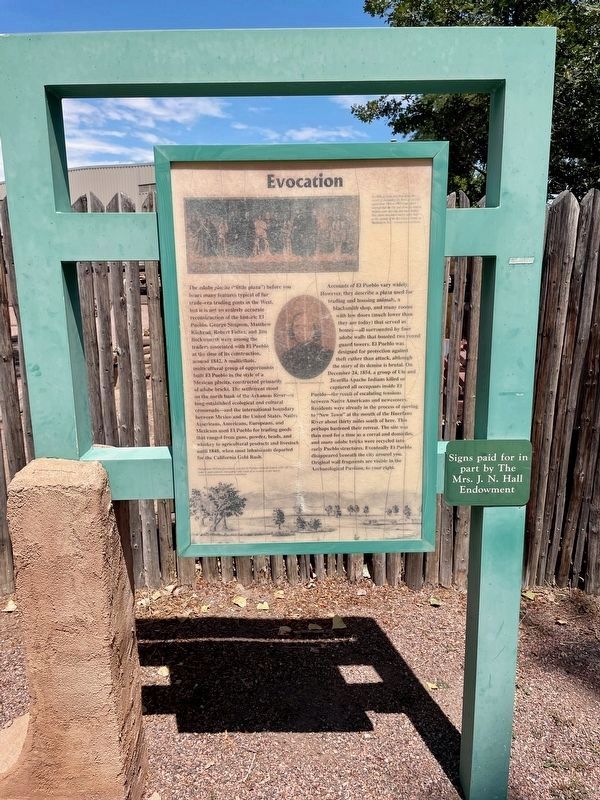
3. The "Little Plaza" is behind & tp the left of the marker.
Photographed by Mark Hilton, August 11, 2025
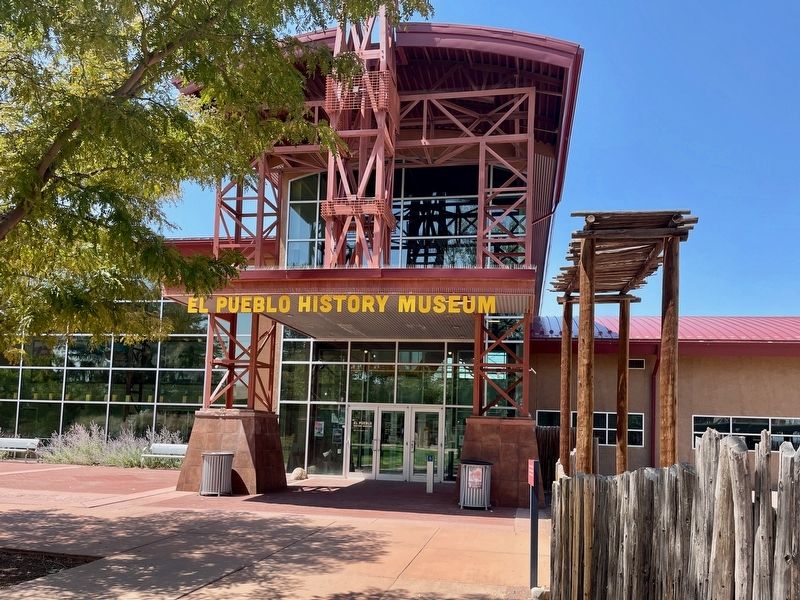
4. Area is part of the El Pueblo History Museum.
Credits. This page was last revised on August 23, 2025. It was originally submitted on August 23, 2025, by Mark Hilton of Montgomery, Alabama. This page has been viewed 100 times since then and 26 times this year. Photos: 1, 2, 3, 4. submitted on August 23, 2025, by Mark Hilton of Montgomery, Alabama.
