Bremen-Mitte in Mitte, Germany — Central Europe
Haus der Sieben Faulen
⎯⎯⎯
House of the Seven Lazy Brothers
| — | Böttcherstraße | — |
Photographed by Andrew Ruppenstein, May 19, 2025
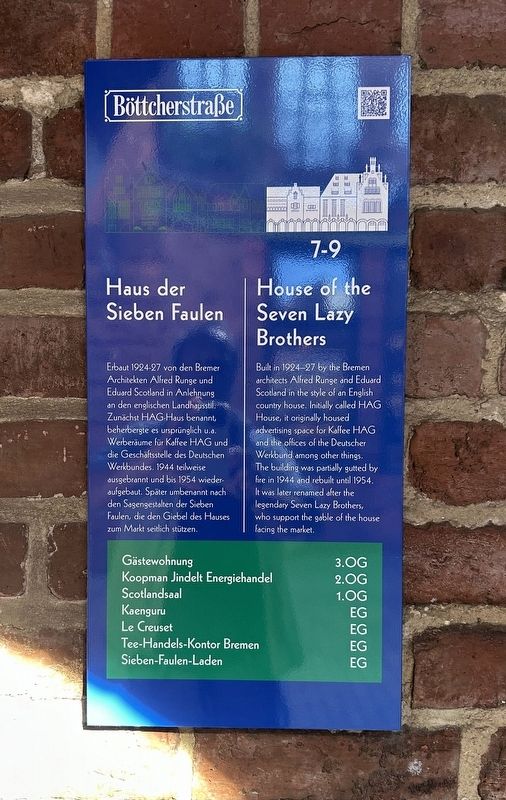
1. Haus der Sieben Faulen / House of the Seven Lazy Brothers Marker

Erbaut 1924-27 von den Bremer Architekten Alfred Runge und Eduard Scotland in Anlehnung an den englischen Landhausstil. Zunächst HAG-Haus benannt, beherbergte es ursprünglich u.a. Werberäume für Kaffee HAG und die Geschäftsstelle des Deutschen Werkbundes. 1944 teilweise ausgebrannt und bis 1954 wieder- aufgebaut. Später umbenannt nach den Sagengestalten der Sieben Faulen, die den Giebel des Hauses zum Markt seitlich stützen.
Built in 1924-27 by the Bremen architects Alfred Runge and Eduard Scotland in the style of an English country house. Initially called HAG House, it originally housed advertising space for Kaffee HAG and the offices of the Deutscher Werkbund among other things. The building was partially gutted by fire in 1944 and rebuilt until 1954. It was later renamed after the legendary Seven Lazy Brothers, who support the gable of the house facing the market.
Topics. This historical marker is listed in these topic lists: Architecture • Industry & Commerce. A significant historical year for this entry is 1944.
Location. 53° 4.509′ N, 8° 48.358′ E. Marker is in Bremen, in Mitte. It is in Bremen-Mitte. It is on Böttcherstraße, on the right when traveling south. Touch for map. Marker is at or near this postal address: Böttcherstraße 7-9, Bremen 28195, Germany. Touch for directions.

Regionally, it is in Europe, the European Union, Atlantic Europe, Central Europe, the Schengen Area, Western Europe, and the Western World. Historically, it finds itself in what was once the Holy Roman Empire.
Other nearby markers. At least 8 other markers are within walking distance of this marker: Haus St. Petrus / St Petrus House (a few steps from this marker); Paula Becker-Modersohn Haus / Paula Becker-Modersohn House (a few steps from this marker); Roselius-Haus / Roselius House (a few steps from this marker); Die Gluckhenne / The Broody Hen
this page online
Also see . . . House of the Seven Lazy Brothers (Wikipedia). Excerpt:
The House of the Seven Lazy Brothers (German: Haus der Sieben Faulen) is a historic building in Bremen, Germany, completed in 1927. With a name based on a local legend, the building located in Böttcherstraße in the old town was built by the prosperous coffee merchant Ludwig Roselius to a design by Bremen architects Eduard Scotland and Alfred Runge. The first version of the house was home to the advertising department of Roselius's coffee company and the Deutscher Werkbund association of craftsmen. When it was rebuilt in 1954 the new design was based on a traditional local story.(Submitted on August 24, 2025.)
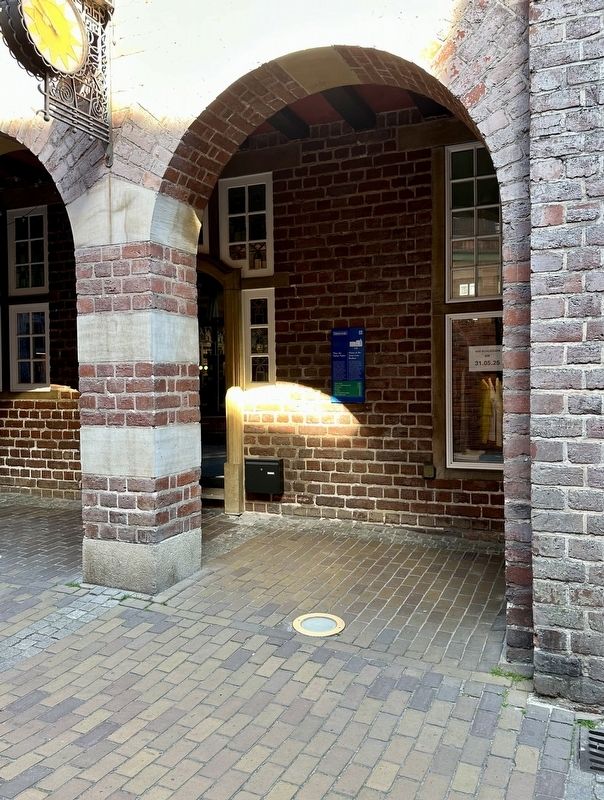
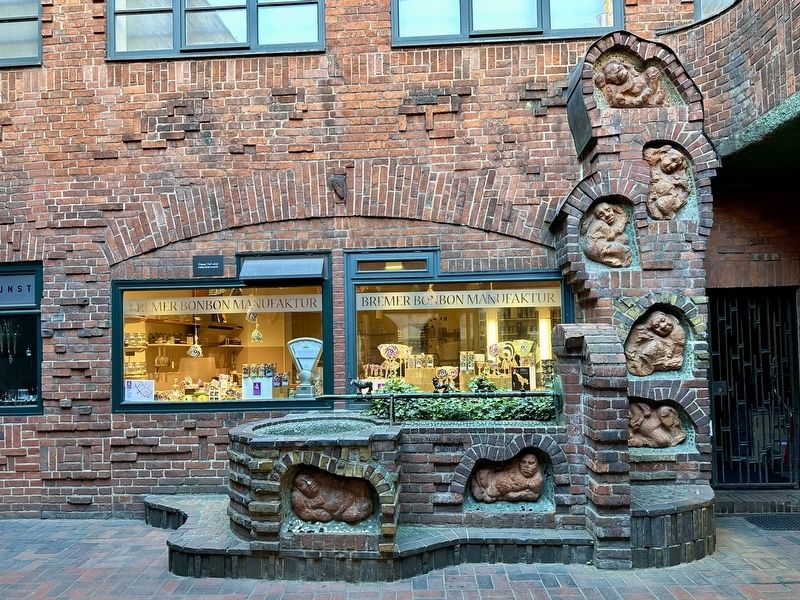
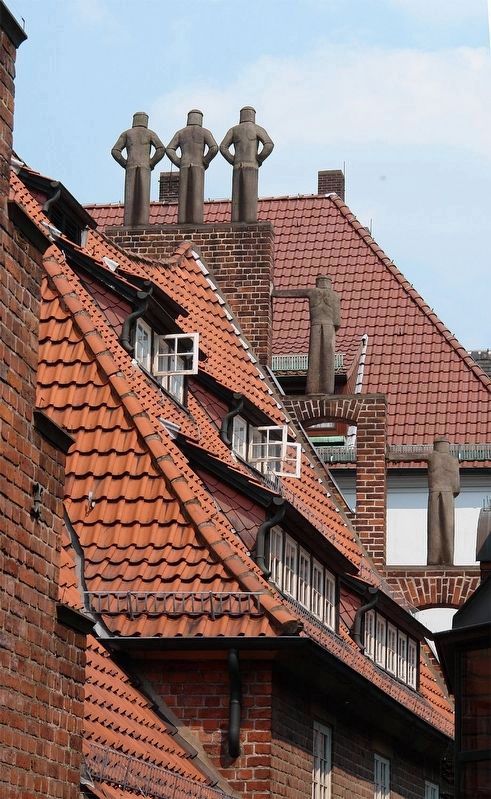
Crafted by Bernhard Hoetger, the Fountain of the Seven Lazy Brothers bordering the 1954 rebuild of the house was based on a legend about the sons of a local farmer who were considered lazy as theycould find no work in Bremen. After venturing into the wide world for a few years, they returned to the city. With the benefit of experience, they worked in their father's fields, dug drainage ditches and built a dyke next to the Weser which prevented it from flooding. The citizens finally realized how astute they had been. While the fountain still presents seven lazy figures, the proud, upright statues on the gable above show how hard-working they had been.Photographed by Andrew Ruppenstein, May 19, 20252. Haus der Sieben Faulen / House of the Seven Lazy Brothers Marker - wide view
Photographed by Andrew Ruppenstein, May 19, 2025
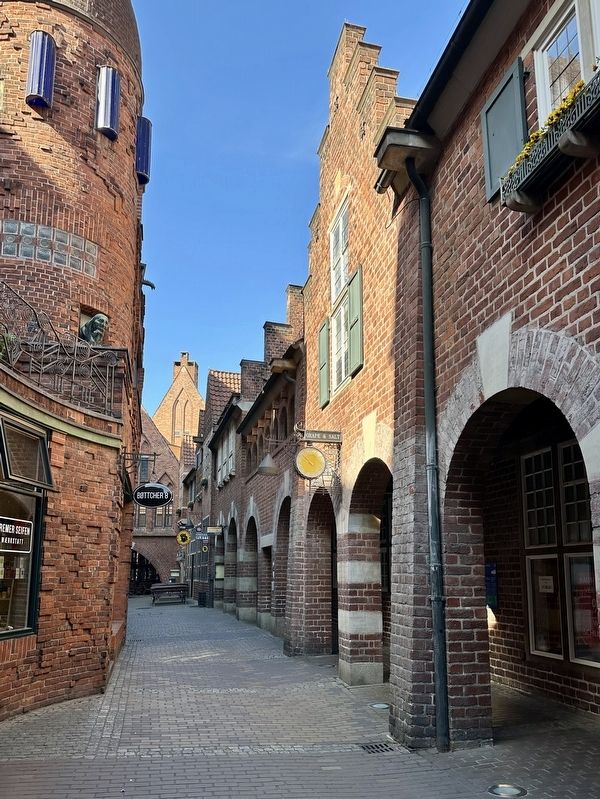
3. Haus der Sieben Faulen / House of the Seven Lazy Brothers Marker - wider view
The maker is (barely) visible here on the right, lurking in the shadows.
Photographed by Andrew Ruppenstein, May 19, 2025
4. Seven Lazy Brothers Fountain/Sculptures
Just a few steps away is…
Photographed by Jürgen Howaldt (via Wikimedia Commons under CC 2.0 license), May 6, 2006
5. The Seven Lazy Brothers, now not-so-lazy
And up on the roof…
Credits. This page was last revised on August 24, 2025. It was originally submitted on August 24, 2025, by Andrew Ruppenstein of Lamorinda, California. This page has been viewed 83 times since then and 10 times this year. Photos: 1, 2, 3, 4, 5. submitted on August 24, 2025, by Andrew Ruppenstein of Lamorinda, California.
