Fort Smith in Sebastian County, Arkansas — The American South (West South Central)
First Evangelical Lutheran Church
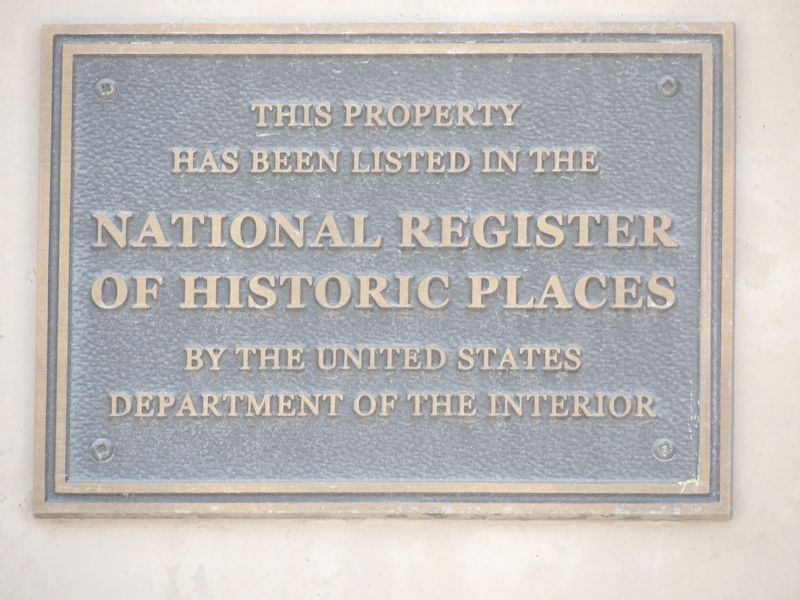
Photographed by Duane and Tracy Marsteller, June 22, 2025
1. First Evangelical Lutheran Church Marker
Topics and series. This historical marker is listed in these topic lists: Architecture • Religion & Religious Structures. In addition, it is included in the National Register of Historic Places (NRHP) series list. A significant historical year for this entry is 1904.
Location. 35° 23.209′ N, 94° 25.011′ W. Marker is in Fort Smith, Arkansas, in Sebastian County. It is at the intersection of North D Street and North 12th Street, on the right when traveling west on North D Street. Touch for map. Marker is at or near this postal address: 1115 N D St, Fort Smith AR 72901, United States of America. Touch for directions.

Regionally, this marker is in the Arkansas River Valley, in the Cherokee Heritage Region, and in Osage Territory. It is also in the American South and specifically in the Upper South. Globally, it is in North America, the Western Hemisphere, the Western World, and the Anglosphere. Historically, it finds itself in what was once the territory of the Mississippian Culture,
this page online
Other nearby markers. At least 8 other markers are within walking distance of this marker: Immaculate Conception Church in 1906 (approx. ¼ mile away); Texas Corner in 1958 (approx. 0.3 miles away); Fort Towson Trail (approx. 0.3 miles away); Great Cyclone at Fort Smith (approx. 0.3 miles away); The New Theatre in 1911 (approx. 0.3 miles away); William J. Murphy House (approx. 0.4 miles away); The House That Began as a Secret (approx. 0.4 miles away); First National Bank (approx. half a mile away). Touch for a list and map of all markers in Fort Smith.
Regarding First Evangelical Lutheran Church. Excerpts from the National Register nomination:
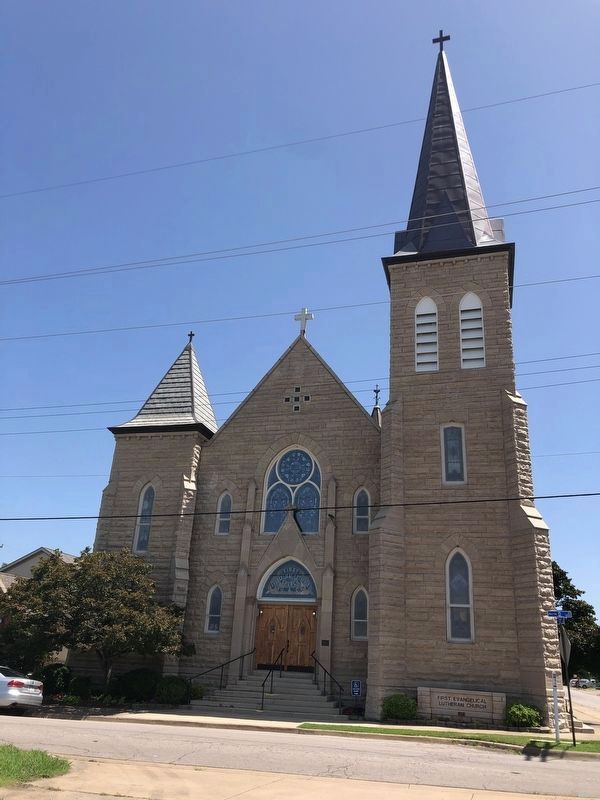
The First Evangelical Lutheran Church is an excellent example of a masonry Gothic Revival style church in Fort Smith, Arkansas. The design of the church includes many of the typical Gothic Revival characteristics, including the use of heavy, substantial materials such as stone, steeply pitched cross gables, pointed arch windows, detailed ornamentation, and wall surfaces that extend in the gableends without a break.…Photographed by Duane and Tracy Marsteller, June 22, 20252. First Evangelical Lutheran Church MarkerMarker is to the right of the doors.
As early as 1869, the congregation began planning for a new building to accommodate the continued growth in membership. The leaders of the congregation called for the design of a new stone structure that would not cost over $20,000.00 to construct. Sometime in late 1900 or early 1901, William Hornor Blakely was approached to create a design for the new church building. In May of 1901, plans for a new church structure were accepted by the church leadership. The Heilmann Construction Company of Joplin, Missouri, was soon hired to manage the construction of the church. On October 12, 1902, the cornerstone of the new structure was laid. …
The new First Evangelical Lutheran Church of Fort Smith was dedicated on May 15, 1904 with many local Lutheran dignitaries in attendance. The dedication service included morning services in German as well as afternoon services in English.
Also see . . .
1. First Evangelical Lutheran Church (PDF). National Register nomination for the church, which was listed in 2017. (Prepared by Callie Williams, Arkansas Historic Preservation Program; via Arkansas Heritage) (Submitted on August 24, 2025, by Duane and Tracy Marsteller of Murfreesboro, Tennessee.)
2. Church History. In the year 1843, a small party of German Lutherans (six families) immigrated from Saxony and settled in what is now called Long Prairie, about twelve miles south of Fort Smith. During the next seven years other families arrived from Saxony and settled in Long Prairie also. To be sure they were not without services, as early as 1848, it is reported that Lutheran sermons were read on Sundays in the house of Mr. Gottlieb Ellig. (First Lutheran Church) (Submitted on August 24, 2025, by Duane and Tracy Marsteller of Murfreesboro, Tennessee.)
Credits. This page was last revised on August 24, 2025. It was originally submitted on August 24, 2025, by Duane and Tracy Marsteller of Murfreesboro, Tennessee. This page has been viewed 68 times since then and 22 times this year. Photos: 1, 2. submitted on August 24, 2025, by Duane and Tracy Marsteller of Murfreesboro, Tennessee.
