
Three Forks in Gallatin County, Montana — The American West (Mountains)
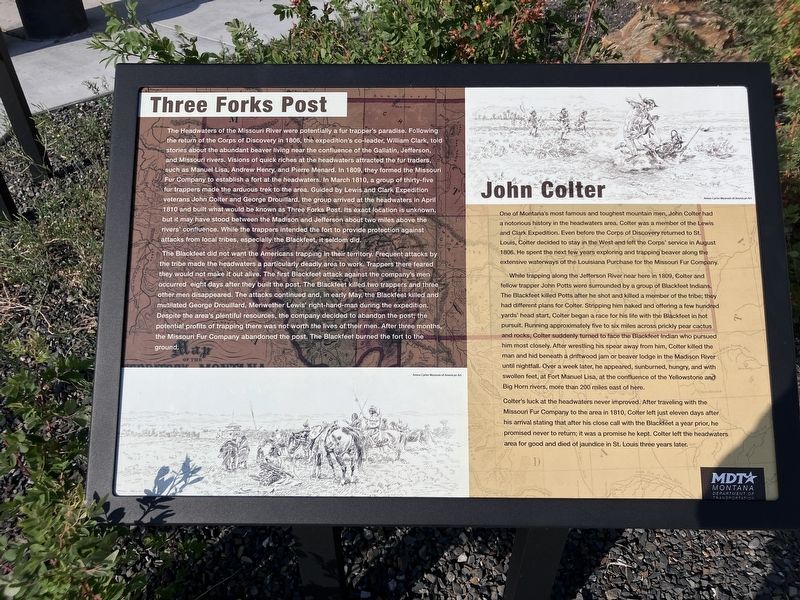
Three Forks Post
⎯⎯⎯
John Colter
Photographed by Barry Swackhamer, July 27, 2025
1. Three Forks Post / John Colter Marker
The Headwaters of the Missouri River were potentially a fur trapper's paradise. Following the return of the Corps of Discovery in 1806, the expeditions's co-leader, William Clark told stories about the abundant beaver living near the confluence of the Gallatin, Jefferson, and Missouri rivers. Visions of quick riches at the headwaters attracted the fur traders such as Manuel Lisa, Andrew Henry and Pierre Menard. In 1809, they formed the Missouri Fur Company to establish a fort at the headwaters. In March 1810, a group of thirty-five fur trappers made the arduous trek to the area. Guided by Lewis and Clark Expedition veterans John Colter and George Drouillard, the group arrived at the headwaters in April 1810 and built what would be known as Three Forks Post. Its exact location is unknown , but it may have stood between the Madison and Jefferson about two miles above the rivers' confluence. While the trappers intended the fort to provide protection against attacks from local tribes, especially the Blackfeet, it seldom did.
The Blackfeet did not want the Americans trapping in their territory. Frequent
this page online
John Colter
One of Montana's most famous and toughest mountain men, John Colter had a notorious history in the headwaters area. Colter was a member of the Lewis and Clark Expedition. Even before the Corps of Discovery returned to St. Louis, Colter decided to stay in the West and left the Corps' service in August 1806. He spent the next few years exploring and trapping beaver along the extensive waterways of the Louisiana
Photographed by Barry Swackhamer, July 27, 2025
2. Three Forks Post / John Colter Marker
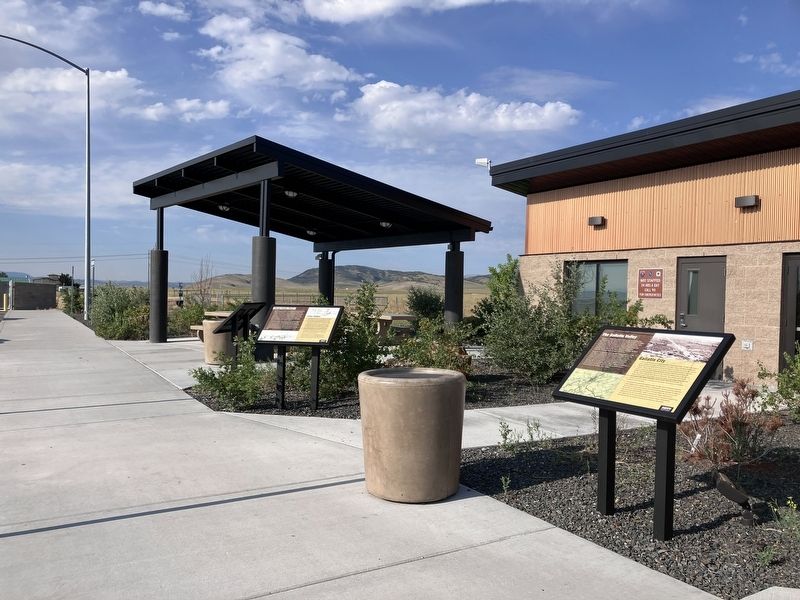
The marker is located at the right, front post of the sun shelter. Only the backside of the marker is visible.
While trapping along the Jefferson River hear here in 1809, Colter and fellow trapper John Potts were surrounded by a group of Blackfeet Indians. The Blackfeet killed Potts after he shot and killed a member of the tribe; they had different plans for Colter. Stripping him naked and offering few hundred yards' head start, Colter began to race for his life with the Blackfeet in hot pursuit. Running approximately five to six miles across prickly pear cactus and rocks, Colter suddenly turned to face the Blackfeet Indian who pursued him most closely. After wrestling his spear away from him, Colter killed the man and hid beneath a driftwood dam or beaver lodge in the Madison River until nightfall. Over a week later, he appeared, sunburned, hungry, and with swollen, at Fort Manuel Lisa, at the confluence of the Yellowstone and Big Horn rivers more than 200 miles east of here.
Colter's luck at the headwaters never improved. After traveling with the Missouri Fur Company to the area in 1810, Colter left just eleven days after his arrival stating that after his close call the the Blackfeet a year prior, he promised never to return; it was a promise he kept. Colter left the headwaters area for good and died of jaundice in St. Louis three years later.
Erected by Montana Department of Transportation.
Topics and series. This historical marker is listed in these topic lists: Exploration • Industry & Commerce • Settlements & Settlers. In addition, it is included in the Lewis & Clark Expedition series list. A significant historical month for this entry is March 1810.
Location. 45° 55.531′ N, 111° 35.974′ W. Marker is in Three Forks, Montana, in Gallatin County. It is on U.S. 287 near Interstate 90, on the left when traveling north. The marker is located at the Three Forks Rest Area. Touch for map. Marker is at or near this postal address: 10778 U.S Highway 287, Three Forks MT 59752, United States of America. Touch for directions.

Regionally, this marker is in Yellowstone Country and in Greater Bozeman. It is also in the American Mountain West and in the Lewis & Clark Corridor. Globally, it is in North America, the Rocky Mountains, the Western Hemisphere, the Western World, and the Anglosphere. Historically, it finds itself in what was once Rupert’s Land and also the Louisiana Purchase.
Other nearby markers. At least 8 other markers are within 3 miles of this marker, measured as the crow flies: Thunder Horses (here, next to this marker); The Gallatin Valley / Gallatin City (here, next to this marker); A Trail Through History / When Montana's Roads Had Names (within shouting distance of this marker); George Drouillard (1773-1810) (approx. 2 miles away); Colter’s Run (approx. 3.1 miles away); Native Americans (approx. 3.1 miles away); European Interest in the Missouri (approx. 3.1 miles away); Fur Trade (approx. 3.1 miles away). Touch for a list and map of all markers in Three Forks.
Also see . . .
1. Missouri Fur Company -- Wikipedia. (Pierre) Menard wrote presciently to a friend, "It is said that one cannot imagine the quantity of beaver that there is, but there is the difficulty of the savage Black Feet who plunder often." Besides the danger from the Blackfeet of which Menard wrote, infighting threatened to tear apart the company... (Submitted on August 24, 2025, by Barry Swackhamer of Brentwood, California.)
2. John Colter -- Wikipedia. The stereotypes of reclusive frontier mountain men may be thanks to Nicholas Biddle's written characterizations of Colter, which paint him a man easily beguiled by the trapping prospects of the wilderness and intimidated by the possibility of returning to regular society.[2] Because no written materials attributed to Colter have ever been discovered (besides his signature,) Biddle's characterizations cannot be directly contested. (Submitted on August 24, 2025, by Barry Swackhamer of Brentwood, California.)
Credits. This page was last revised on August 24, 2025. It was originally submitted on August 24, 2025, by Barry Swackhamer of Brentwood, California. This page has been viewed 157 times since then and 55 times this year. Photos: 1, 2. submitted on August 24, 2025, by Barry Swackhamer of Brentwood, California.
