San Gimignano in Provincia di Siena, Tuscany, Italy — Southern and Western Europe (Mediterranean)
Porta San Giovanni
⎯⎯⎯
Gate of Saint John
La demolizione della chiesa della Madonna dei Lumi e il restauro della Porta San Giovanni
| — | La Gimignano di Dante | — |
Photographed by Sean P. Flynn, July 27, 2025
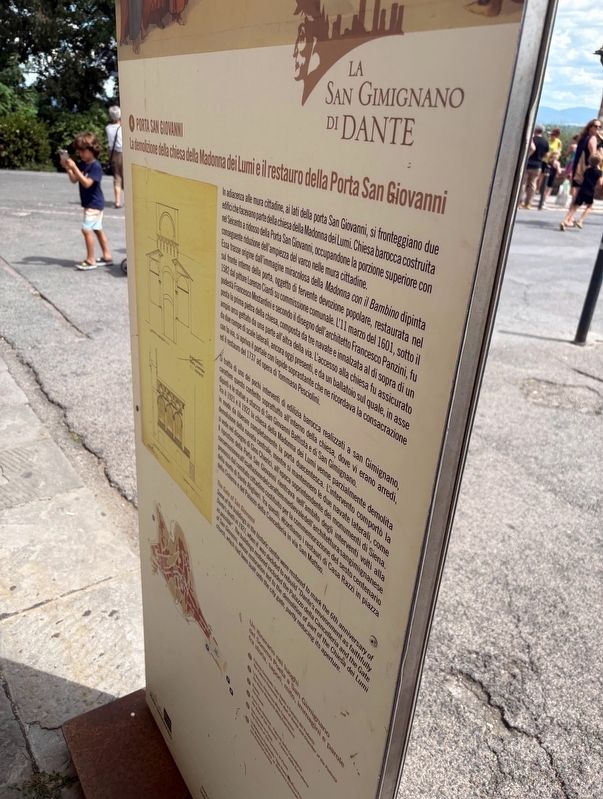
1. Porta San Giovanni Marker
In adiacenza alle mura cittadine, ai lati della porta San Giovanni, si fronteggiano due edifici che facevano parte della chiesa della Madonna dei Lumi. Chiesa barocca costruita nel Seicento a ridosso della Porta San Giovanni, occupandone la porzione superiore con conseguente riduzione dell'ampiezza del varco nelle mura cittadine.
Essa trasse origine dall'immagine miracolosa della Madonna con il Bambino dipinta sul fronte interno della porta, oggetto di fervente devozione popolare, restaurata nel 1582 dal pittore Lorenzo Ciardi su commissione comunale. L'11 marzo del 1601, sotto il podestà Francesco Mostardini e secondo il disegno dell'architetto Francesco Panzini, fu posta la prima pietra della chiesa, composta da tre navate e innalzata al di sopra di un ampio arco gettato da una parte all'altra della via. L'accesso alla chiesa fu assicurato da due rampe di scale laterali, ancora oggi presenti, e da un ballatoio sul quale, in asse con la via, si apriva il portale con lapide soprastante che ne ricordava la consacrazione ed il restauro del 1737 ad opera di Tommaso Pesciolini.
Si tratta di uno dei pochi interventi
this page online
Tra il 1921 e il 1922 la chiesa della Madonna dei Lumi venne parzialmente demolita in modo da liberare completamente la porta duecentesca. L'intervento comportò la demolizione della navata centrale, mentre si mantennero le due navate laterali, come si vede nel disegno di Gino Chierici, all'epoca soprintendente dei monumenti di Siena. Il ripristino della Porta San Giovanni rientrava nell'ambito degli interventi volti alla conservazione e all'esaltazione del carattere medievale dell'architettura sangimignanese promossi dal comitato cittadino costituito per la commemorazione del sesto centenario della morte di Dante Alighieri. Tra questi, ricordiamo i restauri di Casa Razzi in piazza della Cisterna e del Palazzo della Cancelleria in via San Matteo.
The Gate of San Giovanni
Some of the buildings in the historic centre were restored to mark the 6th anniversary of Dante's death in 1921, when it was dedided to rebuild "Dante's environment as faithfully as possible". The buildings restored included the Palazzo della Cancelleria and the Gate of San Giovanni, whose restoration led to the demolition of part of the Chiesa dei Lumi church, which had been built onto the city gate, partly reducing its aperture.
[Full
Photographed by Sean P. Flynn, July 27, 2025
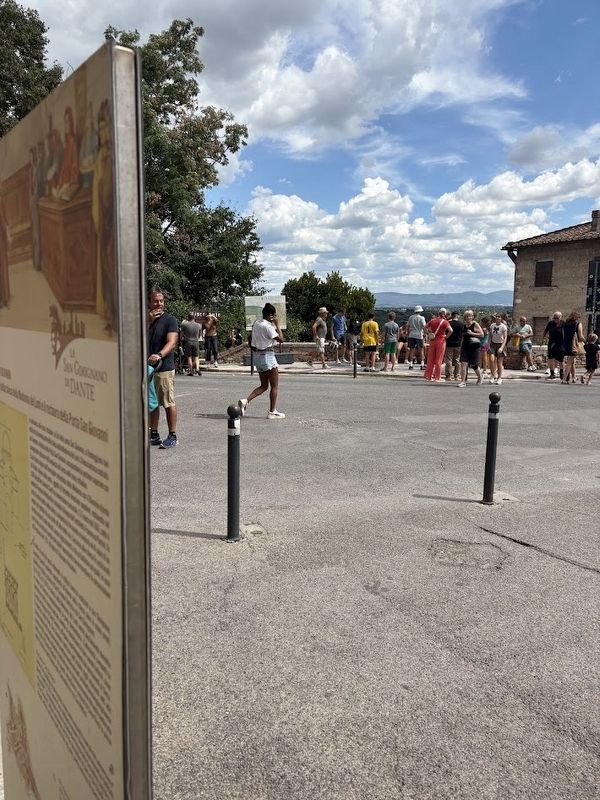
2. Porta San Giovanni / Gate of Saint John Marker
Adjacent to the city walls, on either side of the Gate of Saint John, stand two buildings that were once part of the Church of the Madonna dei Lumi. This Baroque church was built in the 17th century adjacent to the Porta San Giovanni, occupying its upper portion, thus reducing the width of the gap in the city walls.
It originated from the miraculous image of the Madonna and Child painted on the inside of the gate, an object of fervent popular devotion. Commissioned by the city, it was restored in 1582 by the painter Lorenzo Ciardi. On March 11, 1601, under the mayor Francesco Mostardini and according to the design of the architect Francesco Panzini, the first stone of the church was laid. It consists of three naves and is erected above a large arch spanning the street. Access to the church was provided by two flights of lateral stairs, still present today, and by a gallery leading to the portal, aligned with the street, with a plaque above it commemorating its consecration and restoration in 1737 by Tommaso Pesciolini.
This is one of the few Baroque architectural projects completed in
Photographed by Sean P. Flynn, July 27, 2025
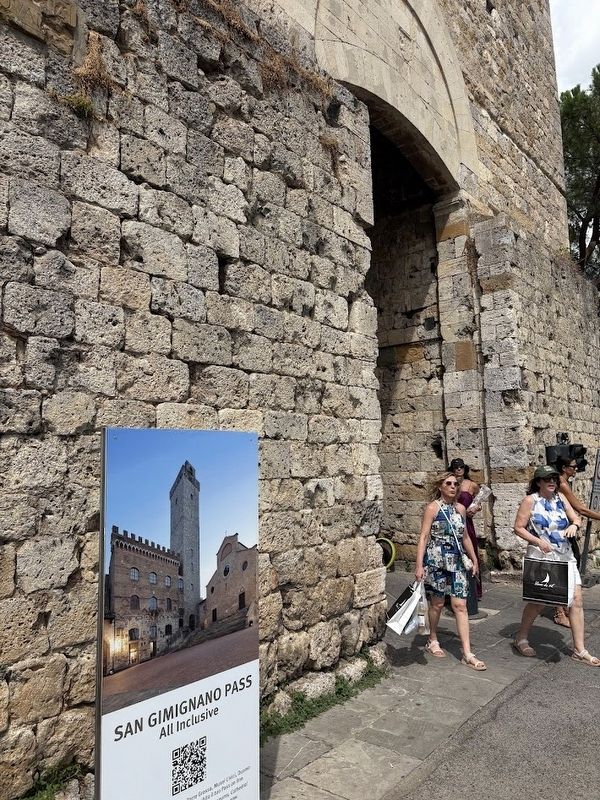
3. Front of the marker at Porta San Giovanni
Between 1921 and 1922, the church of the Madonna dei Lumi was partially demolished to completely free the 13th-century doorway. The project involved demolishing the central nave, while the two side naves were preserved, as seen in the drawing by Gino Chierici, Siena's superintendent of monuments at the time. The restoration of the Gate of Saint John was part of the project to preserve and enhance the medieval character of San Gimignano's architecture, promoted by the citizens' committee formed to commemorate the sixth centenary of Dante Alighieri's death. Among these projects were the restoration of Casa Razzi in Piazza della Cisterna and the Palazzo della Cancelleria on Via San Matteo.
Topics. This historical marker is listed in these topic lists: Arts, Letters, Music • Religion & Religious Structures. A significant historical year for this entry is 1921.
Location. 43° 27.886′ N, 11° 2.554′ E. Marker is in San Gimignano, Toscana (Tuscany), in Provincia
Photographed by Sean P. Flynn, July 27, 2025
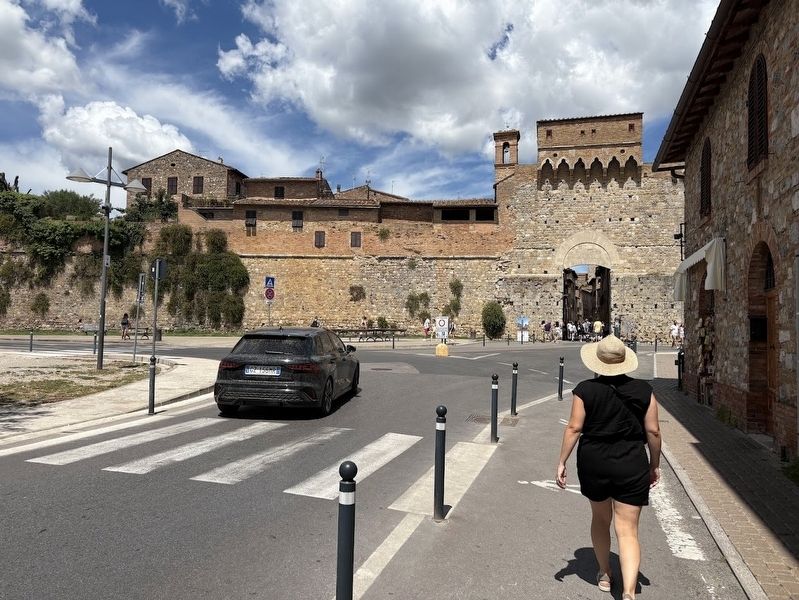
4. Porta San Giovanni

Regionally, it is in Europe, the European Union, the Schengen Area, a coastal Mediterranean country, and the Western World. Historically, it finds itself in what was once the Roman Empire and specifically also the Holy Roman Empire.
Other nearby markers. At least 8 other markers are within walking distance of this marker: Via Francigena (a few steps from this marker); Leone Chellini (within shouting distance of this marker); San Gimignano War Memorial (about 90 meters away, measured in a direct line); Garibaldo Cepparelli (about 90 meters away); Chiesa di San Francesco / Church of Saint Francis (about 120 meters away); Olinto Ceccarelli (about 210 meters away); Adamo Borri (approx. 0.4 kilometers away); Leopold II (approx. 0.4 kilometers away). Touch for a list and map of all markers in San Gimignano.
More about this marker. The subtitle of the gate translates to "The Demolition of the Church of the Madonna dei Lumi and the Restoration of the Porta San Giovanni."
The historical text is on the rear of a sign promoting a San Gimignano all-inclusive pass. Backing up against the city's ancient walls, it's easy to miss and not easy to read.
Regarding Porta San Giovanni / Gate of Saint John. Dante is known to have stayed in San Gimignano in 1300 while serving as a representative of the Guelph League, which was seeking to obtain a political alliance.
Also see . . . Porta San Giovanni.
Excerpt: "Completed in 1262, it has a Sienese arch, with a sentry at the top that sticks out and rests on the lower wall with its series of small arches. In 1601 the sentry was in the doorway to the small church of Madonna dei Lumi, which was demolished in 1922 to clear the road. Today, all that remains of the church is a small bell tower that can be seen beyond the walls."(Submitted on August 26, 2025, by Sean P. Flynn of Oak Park, Illinois.)
Credits. This page was last revised on August 26, 2025. It was originally submitted on August 26, 2025, by Sean P. Flynn of Oak Park, Illinois. This page has been viewed 80 times since then and 27 times this year. Photos: 1, 2, 3, 4. submitted on August 26, 2025, by Sean P. Flynn of Oak Park, Illinois.
