Greenville in Hunt County, Texas — The American South (West South Central)
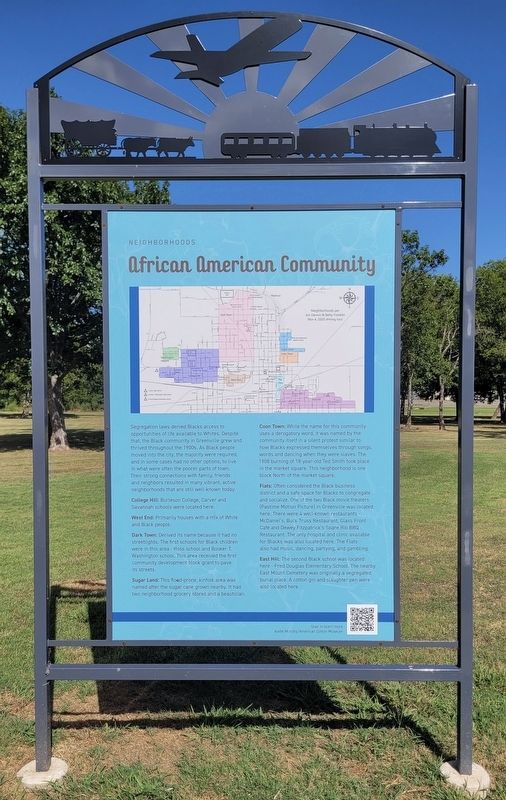
African American Community
Neighborhoods
⎯⎯⎯
People
Photographed by James Hulse, July 28, 2025
1. African American Community Marker
College Hill: Burleson College, Carver and Savannah schools were located here.
West End: Primarily houses with a mix of White and Black people.
Dark Town: Derived its name because it had no streetlights. The first schools for Black children were in this area - Ross school and Booker T. Washington school. This area received the first community development block grant to pave its streets.
Sugar Land: This floed-prone, kinfolk area was named after the sugar cane grown nearby. It had two neighborhood grocery stores and a beautician.
Coon Town: While the name for this community uses a derogatory word, it was named by the community itself in a silent protest similar to how Blacks expressed themselves through songs, words and dancing when they were slaves. The 1908 burning of 18-year-old Ted Smith took place in the market square. This neighborhood is one block North of the market square.
Flats: Often considered the Black business district and a safe space for Blacks to congregate and socialize. One of the two Black movie theaters (Pastime Motion Picture) in Greenville was located here. There were 4 well-known restaurants - McDaniel's, Buck Truss Restaurant, Glass Front Café and Dewey Fitzpatrick's Spare Rib BBQ Restaurant. The only hospital and clinic available for Blacks was also located here. The Flats also had music, dancing, partying,
this page online
East Hill: The second Black school was located here - Fred Douglas Elementary School. The nearby East Mount Cemetery was originally a segregated burial place. A cotton gin and slaughter pen were also located here.
Reverse Side
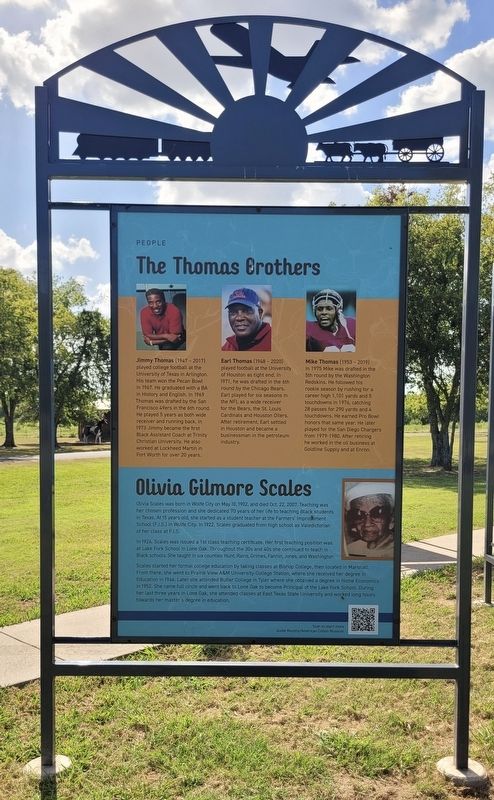
The Thomas Brothers
Jimmy Thomas (1947-2017) played college football at the University of Texas in Arlington. His team won the Pecan Bowl in 1967. He graduated with a BA in History and English. In 1969 Thomas was drafted by the San Francisco 49ers in the 6th round. He played 5 years as both wide receiver and running back. In 1973 Jimmy became the first Black Assistant Coach at Trinity Christian University. He also worked at Lockheed Martin in Fort Worth for over 20 years.
Earl Thomas (1948-2020) played football at the University of Houston as tight end. In 1971, he was drafted in the 6th round by the Chicago Bears. Earl played for six seasons in the NFL as a wide receiver for the Bears, the St. Louis Cardinals and Houston Oilers. After retirement, Earl settled in Houston and became a businessman in the petroleum industry.
Mike Thomas (1953-2019) In 1975 Mike was drafted in the 5th
Photographed by James Hulse, July 28, 2025
2. African American Community Marker - Reverse Side
Olivia Gilmore Scales
Olivia Scales was born in Wolfe City on May 10, 1902, and died Oct. 22, 2007. Teaching was her chosen profession and she dedicated 70 years of her life to teaching Black students in Texas. At 15 years old, she started as a student teacher at the Farmers' Improvement School (F.I.S.) in Wolfe City. In 1922, Scales graduated from high school as Valedictorian of her class at F.I.S.
In 1924, Scales was issued a 1st class teaching certificate. Her first teaching position was at Lake Fork School in Lone Oak. Throughout the 30s and 40s she continued to teach in Black schools. She taught in six counties: Hunt, Rains, Grimes, Fannin, Jones, and Washington.
Scales started her formal college education by taking classes at Bishop College, then located in Marshall. From
Photographed by James Hulse, July 28, 2025
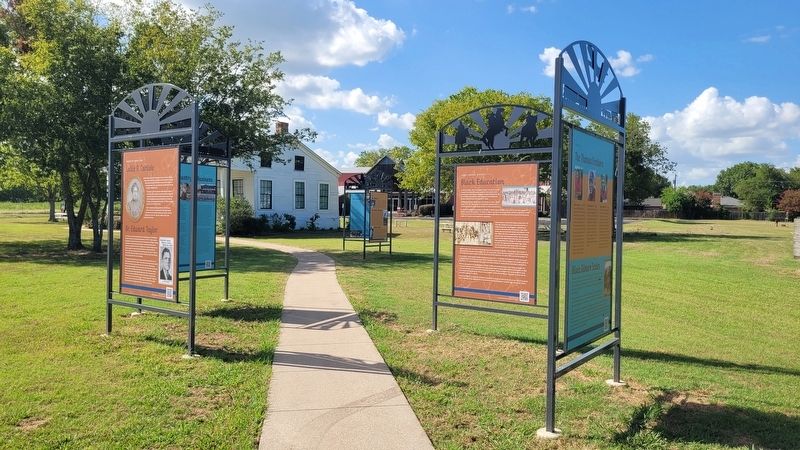
3. The view of the markers along along the trail
The marker is the first marker on the right side
Erected by Audie Murphy / American Cotton Museum.
Topics. This historical marker is listed in this topic list: African Americans. A significant historical date for this entry is May 10, 1902.
Location. 33° 7.509′ N, 96° 5.346′ W. Marker is in Greenville, Texas, in Hunt County. It is on Interstate 30 Frontage Road ¼ mile west of Division Street, on the right when traveling west. The marker is located on the grounds of the Audie Murphy / American Cotton Museum. Touch for map. Marker is at or near this postal address: 600 I-30 Frontage Rd, Greenville TX 75401, United States of America. Touch for directions.

Regionally, this marker is in the Prairies & Lakes Region and in the Dallas-Fort Worth Metropolitan Area. It is also in the American South. Globally, it is in North America, a Gulf of Mexico state, the Western Hemisphere, the Western World, and the Anglosphere. Historically, it finds itself in what was once New Spain, the Republic of Texas, one of the Confederate States of America, and the Antebellum South.
Other nearby markers. At least 8 other markers are within walking distance of this marker: Black Education (here, next to this marker); Early Industry & Business (a few steps from this marker); a different marker also named Early Industry & Business (a few steps from this marker); Aztec Eagles (a few steps from this marker); Early Twentieth Century (a few steps from this marker); Sports (a few steps from this marker); Reconstruction Era (a few steps from this marker); The Sixties (a few steps from this marker). Touch for a list and map of all markers in Greenville.
Also see . . .
1. African American Community. Audie Murphy / American Cotton Museum (Submitted on August 26, 2025, by James Hulse of Medina, Texas.)
2. Thomas Brothers and Scales. Audie Murphy / American Cotton Museum (Submitted on August 26, 2025, by James Hulse of Medina, Texas.)
Credits. This page was last revised on August 27, 2025. It was originally submitted on August 26, 2025, by James Hulse of Medina, Texas. This page has been viewed 245 times since then and 83 times this year. Photos: 1, 2, 3. submitted on August 27, 2025, by James Hulse of Medina, Texas.
