Greenville in Hunt County, Texas — The American South (West South Central)
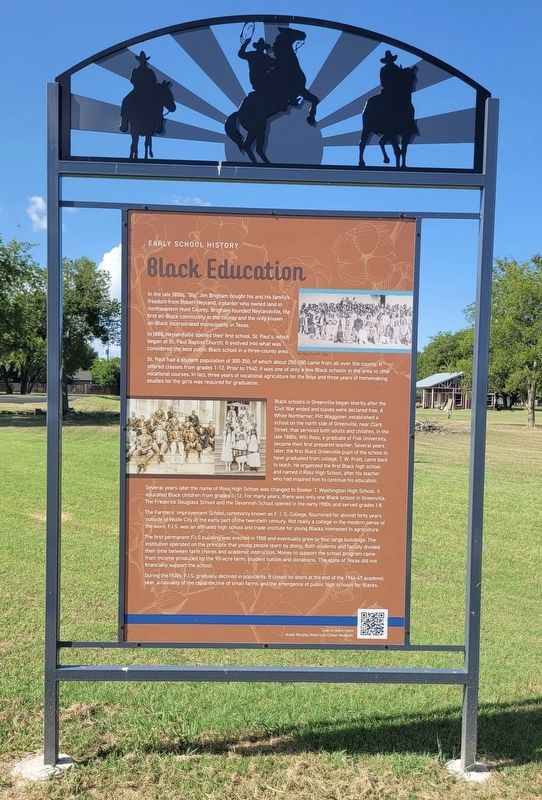
Black Education
Early School History
⎯⎯⎯
People
Photographed by James Hulse, July 28, 2025
1. Black Education Marker
In 1888, Neylandville opened their first school, St. Paul's, which began at St. Paul Baptist Church. It evolved into what was considered the best public Black school in a three-county area.
St. Paul had a student population of 300-350, of which about 250-280 came from all over the county. It offered classes from grades 1-12. Prior to 1940, it was one of only a few Black schools in the area to offer vocational courses. In fact, three years of vocational agriculture for the boys and three years of homemaking studies for the girls was required for graduation.
Black schools in Greenville began shortly after the Civil War ended and slaves were declared free. A White Northerner, Pitt Waggoner, established a school on the north side of Greenville, near Clark Street, that serviced both adults and children. In the late 1880s, Will Ross, a graduate of Fisk University, became their first prepared teacher. Several years later, the first Black Greenville pupil of the school to have graduated from college, T. W. Pratt, came back to teach. He organized the first Black high school and named it Ross High School, after his teacher who had inspired him to continue his education.
Several years later the name of Ross High School was changed to Booker T. Washington High School. It educated Black children from grades 1-12. For many years, there was only one Black school in Greenville. The Frederick Douglass School and the Savannah School opened in the early 1900s and served grades 1-8.
The Farmers' Improvement School, commonly known
this page online
The first permanent F.I.S building was erected in 1908 and eventually grew to four large buildings. The institution operated on the principle that young people learn by doing. Both students and faculty divided their time between farm chores and academic instruction. Money to support the school program came from income produced by the 90-acre farm, student tuition and donations. The state of Texas did not financially support the school.
During the 1930s, F.I.S. gradually declined in popularity. It closed its doors at the end of the 1946-47 academic year, a casualty of the rapid decline of small farms and the emergence of public high schools for Blacks.
Captions
(Photo #1) St. Paul School, 1926
Reverse Side
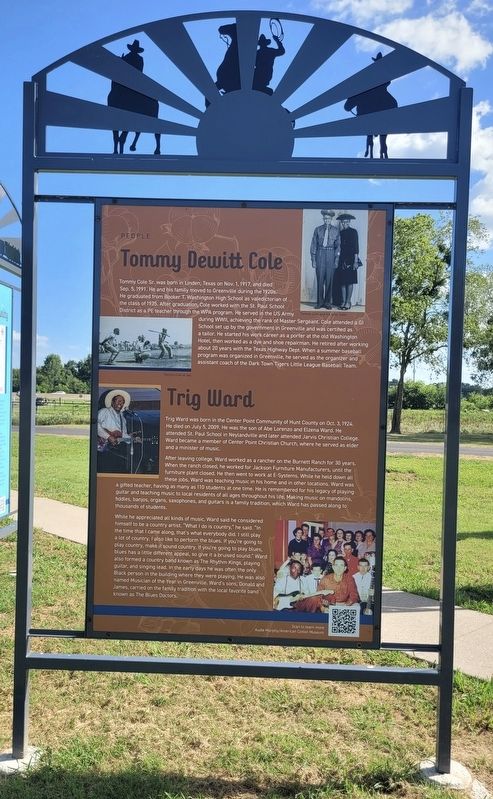
Tommy Dewitt Cole
Tommy Cole Sr. was born in Linden, Texas on Nov. 1, 1917, and died Sep. 5, 1991. He and his family moved to Greenville during
Photographed by James Hulse, July 28, 2025
2. Black Education Marker - Reverse Side
Trig Ward
Trig Ward was born in the Center Point Community of Hunt County on Oct. 3, 1924. He died on July 5, 2009. He was the son of Abe Lorenzo and Elzena Ward. He attended St. Paul School in Neylandville and later attended Jarvis Christian College. Ward became a member of Center Point Christian Church, where he served as elder and a minister of music.
After leaving college, Ward worked as a rancher on the Burnett Ranch
Photographed by James Hulse, July 28, 2025
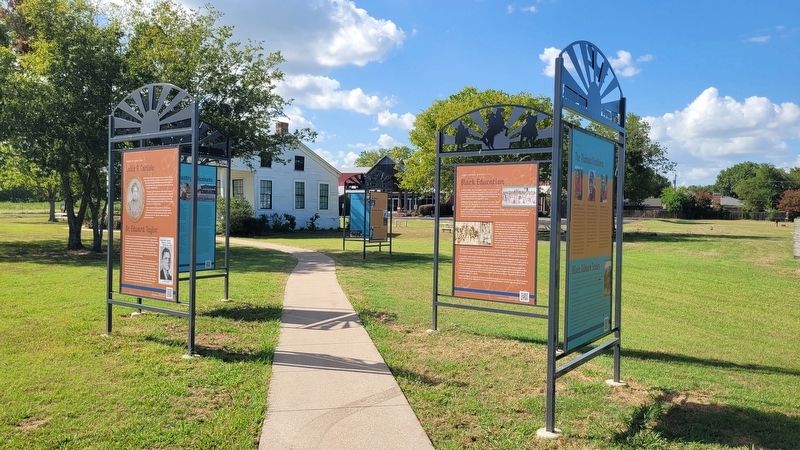
3. The Black Education Marker is the second marker on the right
While he appreciated all kinds of music, Ward said he considered himself to be a country artist. "What I do is country," he said. "In the time that I came along, that's what everybody did. I still play a lot of country. I also like to perform the blues. If you're going to play country, make it sound country. If you're going to play blues, blues has a little different appeal, so give it a bruised sound." Ward also formed a country band known as The Rhythm Kings, playing guitar, and singing lead. In the early days he was often the only Black person in the building where they were playing. He was also named Musician of the Year in Greenville. Ward's sons, Donald and James, carried on the family tradition with the local favorite band known as The Blues Doctors.
Captions
(Photo #1) Tommy Cole and his wife, Edith
(Photo #2) Tommy Cole at bat
Erected by Audie Murphy / American Cotton Museum.
Topics. This historical marker is listed in these topic lists: African Americans • Arts, Letters, Music • Education • Sports. A significant historical date for this entry is July 5, 2009.
Location. 33° 7.51′ N, 96° 5.347′ W. Marker is in Greenville, Texas, in Hunt County. It is on Interstate 30 Frontage Road ¼ mile west of Division Street, on the right when traveling west. The marker is located on the grounds of the Audie Murphy / American Cotton Museum. Touch for map. Marker is at or near this postal address: 600 I-30 Frontage Rd, Greenville TX 75401, United States of America. Touch for directions.

Regionally, this marker is in the Prairies & Lakes Region and in the Dallas-Fort Worth Metropolitan Area. It is also in the American South. Globally, it is in North America, a Gulf of Mexico state, the Western Hemisphere, the Western World, and the Anglosphere. Historically, it finds itself in what was once New Spain, the Republic of Texas, one of the Confederate States of America, and the Antebellum South.
Other nearby markers. At least 8 other markers are within walking distance of this marker: African American Community (here, next to this marker); Early Industry & Business (here, next to this marker); a different marker also named Early Industry & Business (here, next to this marker); Sports (a few steps from this marker); The Sixties (a few steps from this marker); Aztec Eagles (a few steps from this marker); Early Twentieth Century (a few steps from this marker); Reconstruction Era (a few steps from this marker). Touch for a list and map of all markers in Greenville.
Also see . . .
1. Black Education. Audie Murphy / American Cotton Museum (Submitted on August 26, 2025, by James Hulse of Medina, Texas.)
2. Tommy Cole And Trig Ward. Audie Murphy / American Cotton Museum (Submitted on August 26, 2025, by James Hulse of Medina, Texas.)
Credits. This page was last revised on August 28, 2025. It was originally submitted on August 26, 2025, by James Hulse of Medina, Texas. This page has been viewed 141 times since then and 33 times this year. Photos: 1. submitted on August 27, 2025, by James Hulse of Medina, Texas. 2, 3. submitted on August 28, 2025, by James Hulse of Medina, Texas.
