Greenville in Hunt County, Texas — The American South (West South Central)
Early Industry & Business
Emerging Industry
⎯⎯⎯
People
Photographed by James Hulse, July 28, 2025
1. Early Industry & Business Marker
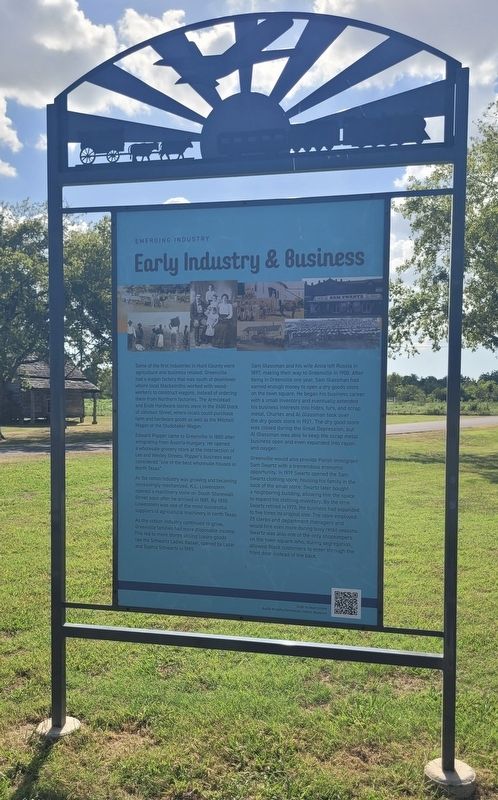
Edward Popper came to Greenville in 1880 after emigrating from Austria-Hungary. He opened a wholesale grocery store at the intersection of Lee and Wesley Streets. Popper's business was considered "one of the best wholesale houses in North Texas."
As the cotton industry was growing and becoming increasingly mechanized, K.L. Lowenstein opened a machinery store on South Stonewall Street soon after he arrived in 1881. By 1890 Lowenstein was one of the most successful suppliers of agricultural machinery in north Texas.
As the cotton industry continued to grow, Greenville families had more disposable income. This led to more stores selling luxury goods like the Schwartz Ladies Bazaar, opened by Lazar and Sophia Schwartz in 1895.
Sam Glassman and his wife Anna left Russia in 1897, making their way to Greenville in 1900. After being in Greenville one year, Sam Glassman had earned enough money to open a dry goods store on the town square. He began his business career with a small inventory and eventually extended his business interests into hides, furs, and scrap metal. Charles and Al Glassman took over the dry goods store in 1921. The dry good store was closed during the Great Depression, but Al Glassman was able to keep the scrap metal business open and even expanded into rayon and oxygen.
Greenville would also provide Polish immigrant Sam Swartz with a tremendous
this page online
Reverse Side
Alexander Bryan
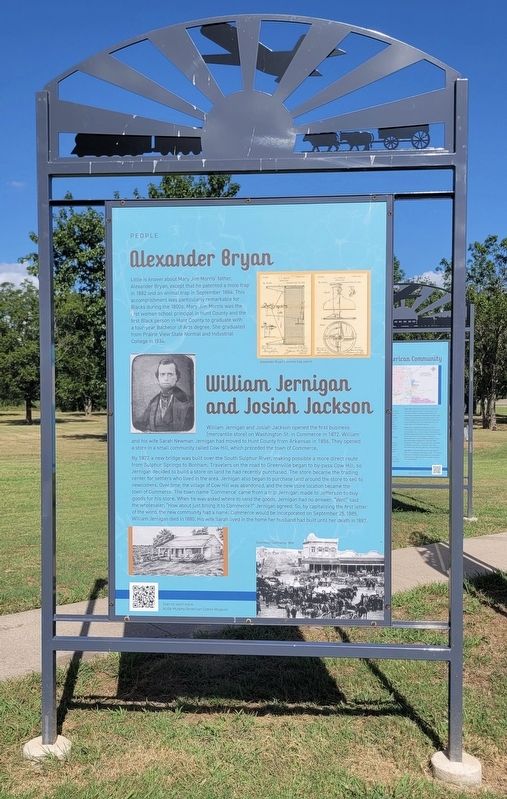
Little is known about Mary Jim Morris' father, Alexander Bryan, except that he patented a mole trap in 1882 and an animal trap in September 1884. This accomplishment was particularly remarkable for Blacks during the 1800s. Mary Jim Morris was the first woman school principal in Hunt County and the first Black person in Hunt County to graduate with a four-year Bachelor of Arts degree. She graduated from Prairie View State Normal and Industrial College in 1934.
William Jernigan and Josiah Jackson
William Jernigan and
Photographed by James Hulse, July 28, 2025
2. Early Industry & Business Marker - Reverse Side
By 1872 a new bridge was built over the South Sulphur River, making possible a more direct route from Sulphur Springs to Bonham. Travelers on the road to Greenville began to by-pass Cow Hill, so Jernigan decided to build a store on land he had recently purchased. The store became the trading center for settlers who lived in the area. Jernigan also began to purchase land around the store to sell to newcomers. Over time, the village of Cow Hill was abandoned, and the new store location became the town of Commerce. The town name 'Commerce' came from a trip Jernigan made to Jefferson to buy goods for his store. When he was asked where to send the goods, Jernigan had no answer. "Well" said the wholesaler, "How about just billing it to Commerce?" Jernigan agreed. So, by capitalizing the first letter of the word, the new community had a name. Commerce would
Photographed by James Hulse, July 28, 2025
3. Early Industry & Business Marker (right side)
Captions
(Photo #1) Alexander Bryan's Animal trap patent
(Photo #2) Downtown Commerce, 1896
Erected by Audie Murphy / American Cotton Museum.
Topics. This historical marker is listed in these topic lists: African Americans • Industry & Commerce • Settlements & Settlers. A significant historical month for this entry is September 1884.
Location. 33° 7.511′ N, 96° 5.352′ W. Marker is in Greenville, Texas, in Hunt County. It is on Interstate 30 Frontage Road ¼ mile west of Division Street, on the right when traveling west. The marker is located on the grounds of the Audie Murphy / American Cotton Museum. Touch for map. Marker is at or near this postal address: 600 I-30 Frontage Rd, Greenville TX 75401, United States of America. Touch for directions.

Regionally, this marker is in the Prairies & Lakes Region and in the Dallas-Fort Worth Metropolitan Area. It is also in the American South. Globally, it is in North America, a Gulf of Mexico state, the Western Hemisphere, the
Photographed by James Hulse, July 28, 2025
4. The view of the Early Industry & Business Marker along the trail
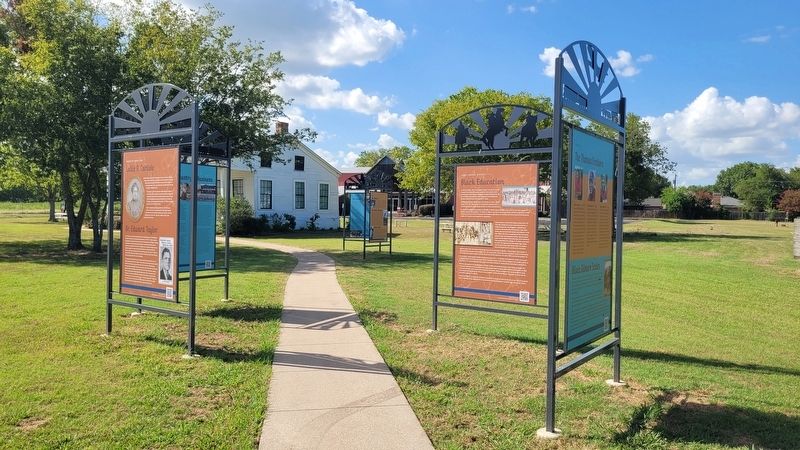
The marker is the second marker from the left side.
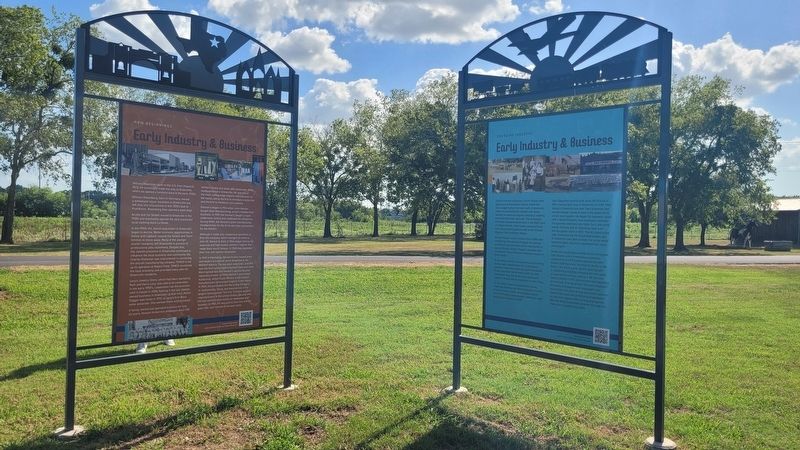
Other nearby markers. At least 8 other markers are within walking distance of this marker: A different marker also named Early Industry & Business (here, next to this marker); Black Education (here, next to this marker); African American Community (a few steps from this marker); Sports (a few steps from this marker); The Sixties (a few steps from this marker); Aztec Eagles (within shouting distance of this marker); Early Twentieth Century (within shouting distance of this marker); Reconstruction Era (within shouting distance of this marker). Touch for a list and map of all markers in Greenville.
Credits. This page was last revised on August 28, 2025. It was originally submitted on August 26, 2025, by James Hulse of Medina, Texas. This page has been viewed 159 times since then and 43 times this year. Photos: 1, 2, 3, 4. submitted on August 28, 2025, by James Hulse of Medina, Texas.
