
Staunton, Virginia — The American South (Mid-Atlantic)
A Mansion in the New Republic:
John Howe Peyton & Montgomery Hall
| — | The Long Road To Freedom | — |
Photographed by Bradley Owen, July 21, 2025
1. A Mansion in the New Republic: Marker
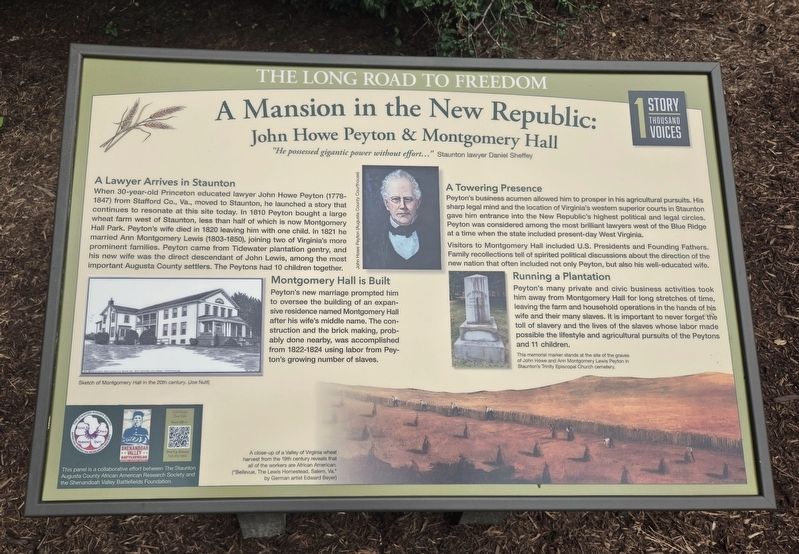
"He possessed gigantic power without effort..." Staunton lawyer Daniel Sheffey
A Lawyer Arrives in Staunton
When 30-year-old Princeton educated lawyer John Howe Peyton (1778-1847) from Stafford Co., Va., moved to Staunton, he launched a story that continues to resonate at this site today. In 1810 Peyton bought a large wheat farm west of Staunton, less than half of which is now Montgomery Hall Park. Peyton's wife died in 1820 leaving him with one child. In 1821 he married Ann Montgomery Lewis (1803-1850), joining two of Virginia's more prominent families. Peyton came from Tidewater plantation gentry, and his new wife was the direct descendant of John Lewis, among the most important Augusta County settlers. The Peytons had 10 children together.
Montgomery Hall is Built
Peyton's new marriage prompted him to oversee the building of an expansive residence named Montgomery Hall after his wife's middle name. The construction and the brick making, probably done nearby, was accomplished from 1822-1824 using labor from Peyton's growing number of slaves.
A Towering Presence
Peyton's business acumen allowed him
this page online
Visitors to Montgomery Hall included U.S. Presidents and Founding Fathers. Family recollections tell of spirited political discussions about the direction of the new nation that often included not only Peyton, but also his well-educated wife.
Running a Plantation
Peyton's many private and civic business activities took him away from Montgomery Hall for long stretches of time, leaving the farm and household operations in the hands of his wife and their many slaves. It is important to never forget the toll of slavery and the lives of the slaves whose labor made possible the lifestyle and agricultural pursuits of the Peytons and 11 children.
(Captions):
Sketch of Montgomery Hall in the 20th century. (Joe Nutt)
A close-up of a Valley of Virginia wheat harvest from the 19th century reveals that all of the workers are African American. ("Bellevue, The Lewis Homestead, Salem, Va." by German artist Edward Beyer)
John Howe Peyton (Augusta County Courthouse)
This memorial marker stands at the site of the graves of John Howe and Ann Montgomery Lewis Peyton in Staunton's Trinity Episcopal Church cemetery.
Erected 2025
Photographed by Bradley Owen, July 21, 2025
2. A Mansion in the New Republic: Marker
Marker is on the left.
Topics. This historical marker is listed in these topic lists: African Americans • Notable Places. A significant historical year for this entry is 1810.
Location. 38° 8.729′ N, 79° 5.52′ W. Marker is in Staunton, Virginia. It is on Kenneth Jones Drive 0.2 miles west of Montgomery Avenue, on the left when traveling west. Marker is located in Montgomery Hall Park. Touch for map. Marker is at or near this postal address: 1100 Montgomery Avenue, Staunton VA 24401, United States of America. Touch for directions.

Regionally, this marker is in Virginia’s Shenandoah Valley. It is also in the American South and specifically in the Upper South. Globally, it is in North America, the Western Hemisphere, the Western World, and the Anglosphere. Historically, it finds itself in what was once the territory of the Mississippian Culture, one of the original Thirteen Colonies, one of the Confederate States of America, and the Antebellum South.
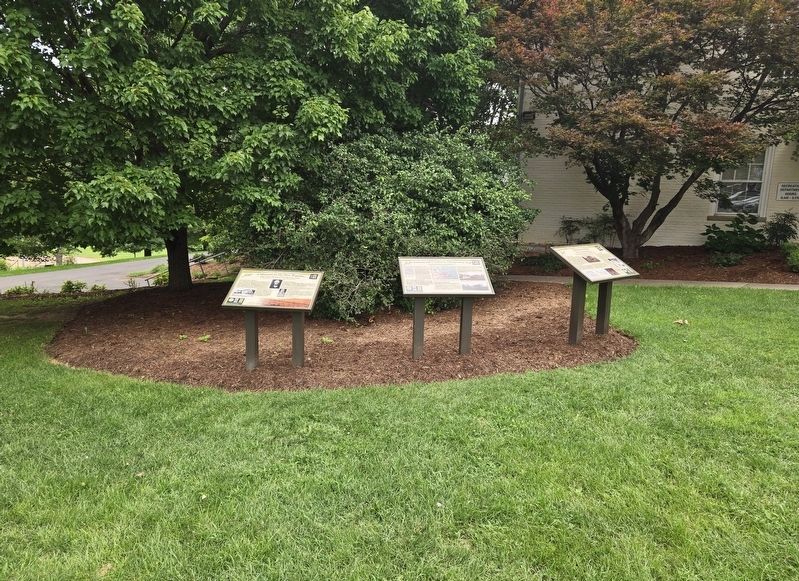
Other nearby markers. At least 8 other markers are within walking distance of this marker: Farming and Freedom at Montgomery Hall (here, next to this marker); Montgomery Hall (here, next to this marker); The Long Road to Freedom (here, next to this marker); Held in Bondage (a few steps from this marker); Shining Light on Their Humanity (a few steps from this marker); An African American Haven Becomes Reality (a few steps from this marker); The Montgomery Hall Park Recreation Committee (within shouting distance of this marker); A Beacon of Light Across Virginia (within shouting distance of this marker). Touch for a list and map of all markers in Staunton.
Credits. This page was last revised on August 30, 2025. It was originally submitted on August 27, 2025, by Bradley Owen of Morgantown, West Virginia. This page has been viewed 106 times since then and 24 times this year. Photos: 1, 2. submitted on August 30, 2025, by Bradley Owen of Morgantown, West Virginia.
