Leadville in Lake County, Colorado — The American Mountains (Southwest)
Tabor Opera House
Historic Landmark
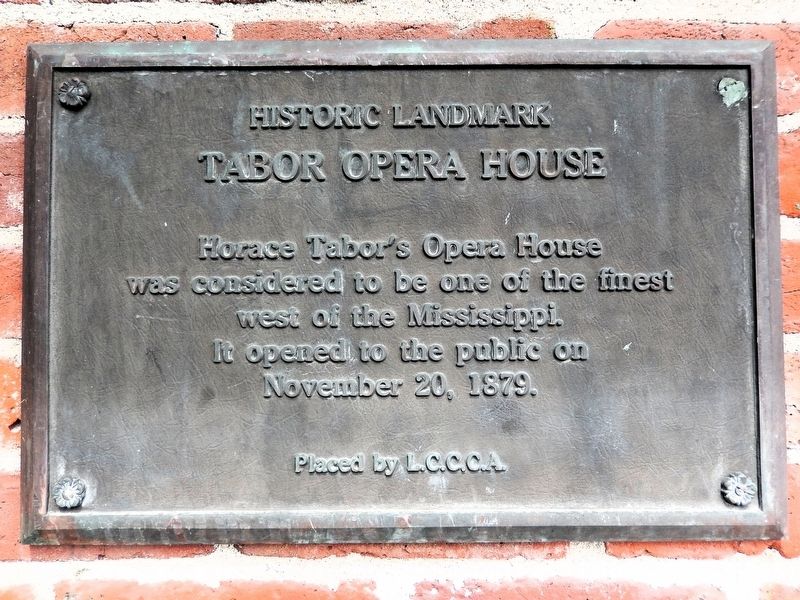
Photographed by Cosmos Mariner, July 27, 2025
1. Tabor Opera House Marker
Horace Tabor’s Opera House was considered to be one of the finest west of the Mississippi. It opened to the public on November 20, 1879.
Erected by Lake County Civic Center Association.
Topics and series. This historical marker is listed in these topic lists: Architecture • Arts, Letters, Music • Entertainment • Notable Buildings. In addition, it is included in the National Register of Historic Places (NRHP) series list. A significant historical date for this entry is November 20, 1879.
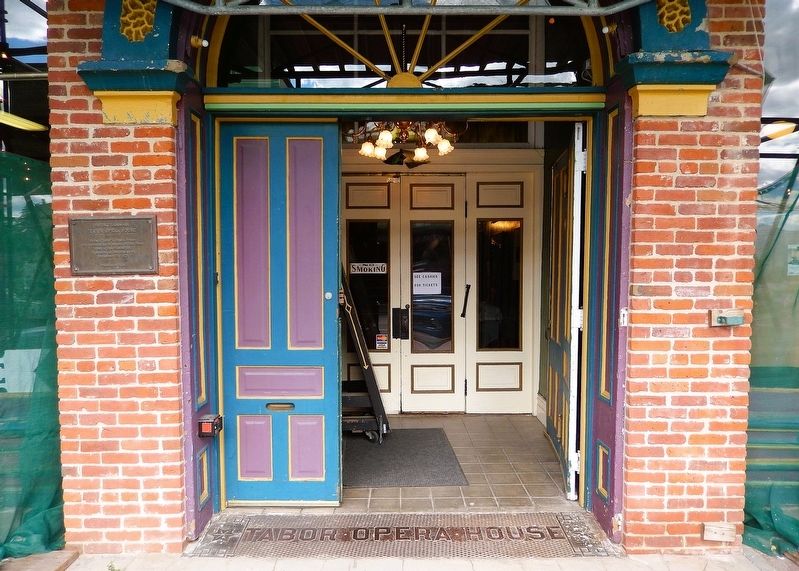
Location. 39° 14.803′ N, 106° 17.458′ W. Marker is in Leadville, Colorado, in Lake County. It is on Harrison Avenue (U.S. 24) just north of East 3rd Street, on the right when traveling north. The marker is mounted at eye-level, directly on the subject building, on the left side of the front/west entrance. Touch for map. Marker is at or near this postal address: 308 Harrison Avenue, Leadville CO 80461, United States of America. Touch for directions.

Regionally, this marker is in the Arkansas River Valley, in the Colorado High Rockies and on the Continental Divide. It is also in the American Mountain West. Globally, it is in North
this page online
Other nearby markers. At least 8 other markers are within walking distance of this marker: David May (a few steps from this marker); 10th Mountain Division (about 300 feet away, measured in a direct line); Temple Israel: A Frontier Synagogue and Museum (about 700 feet away); Welcome to Leadville, CO! / ¡Bienvenido a Leadville, CO! (approx. 0.2 miles away); Tabor Grand Hotel (approx. 0.2 miles away); Annunciation Church (approx. ¼ mile away); Golden Burro Cafe (approx. ¼ mile away); Leadville City Hall (approx. 0.3 miles away). Touch for a list and map of all markers in Leadville.
Regarding Tabor Opera House. Contributing property, Leadville Historic District, National Register of Historic Places № 66000248.
From the National Register Nomination prepared by Joseph Scott Mendinghall, 12/18/1975:
The Leadville Historic District encompasses a scattered group of distinctive and important historic buildings that harmonize well with the central architectural theme associated with late 19th century mining towns of the West. The TaborOpera House is a three-story brick structure erected by H.A.W. Tabor in 1879.Photographed by Cosmos Mariner, July 27, 20252. Tabor Opera House MarkerThe marker is mounted on the left/north side of the front entrance.
The first Leadville boom took place in the early 1860's with the discovery of rich placer gold diggings, but the surface deposits were quickly exhausted. The second boom in the 1870s ushered in the silver era. One of the most spectacular strikes in Colorado mining annals, it began with a series of incredibly rich discoveries along California Gulch. Almost overnight the desolate pine flat just below timberline sprouted into a rowdy, rugged mining camp with the usual assortment of pine bough shelters, tent hotels, banks, grocery stores, and beer gardens.
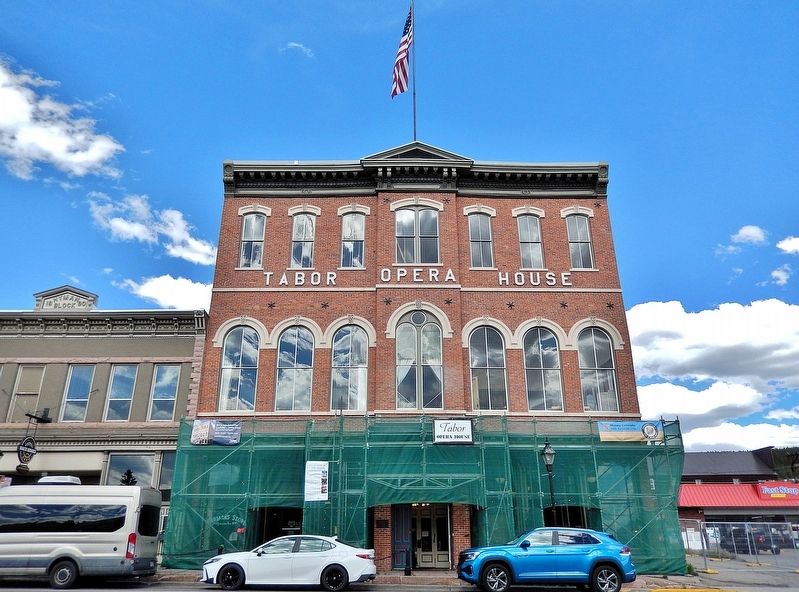
Perhaps the best known of Leadville's silver kings was H.A.W. Tabor. This Vermont born stonecutter, with his wife and small son, came to the Pike’s Peak Gold Rush early in 1859 and endured several years of hardship and privation. About the time of the silver strike, Tabor grubstaked two prospectors, August Rische, and George T. Hook, for a small amount. As a result of their labor the Little Pittsburgh mine was discovered and ultimately paid Tabor a fortune. He then embarked upon a public career. He was electedLieutenant Governor of the State and took an active part in the campaigns of the Republican party and gave generously to many civic enterprises in both Leadville and Denver. However, Tabor’s fortunes were to fall as rapidly as they rose. When silver prices collapsed his financial empire quickly crumbled. He became virtually penniless and was postmaster of Denver at his death in 1899.Photographed by Cosmos Mariner, July 27, 20253. Tabor Opera House (west/front elevation)
Also see . . .
1. Tabor Opera House History (TaborOperaHouse.org).
Excerpt: Mining magnate Horace (H.A.W.) Tabor built the opera house in 1879 in just 100 days, to bring arts and culture to a cold, remote mining town. Now the highest-elevation city in North America, at 10,152’, Leadville, Colorado, was then one of the West’s rowdiest silver boomtowns.(Submitted on August 31, 2025, by Cosmos Mariner of Cape Canaveral, Florida.)
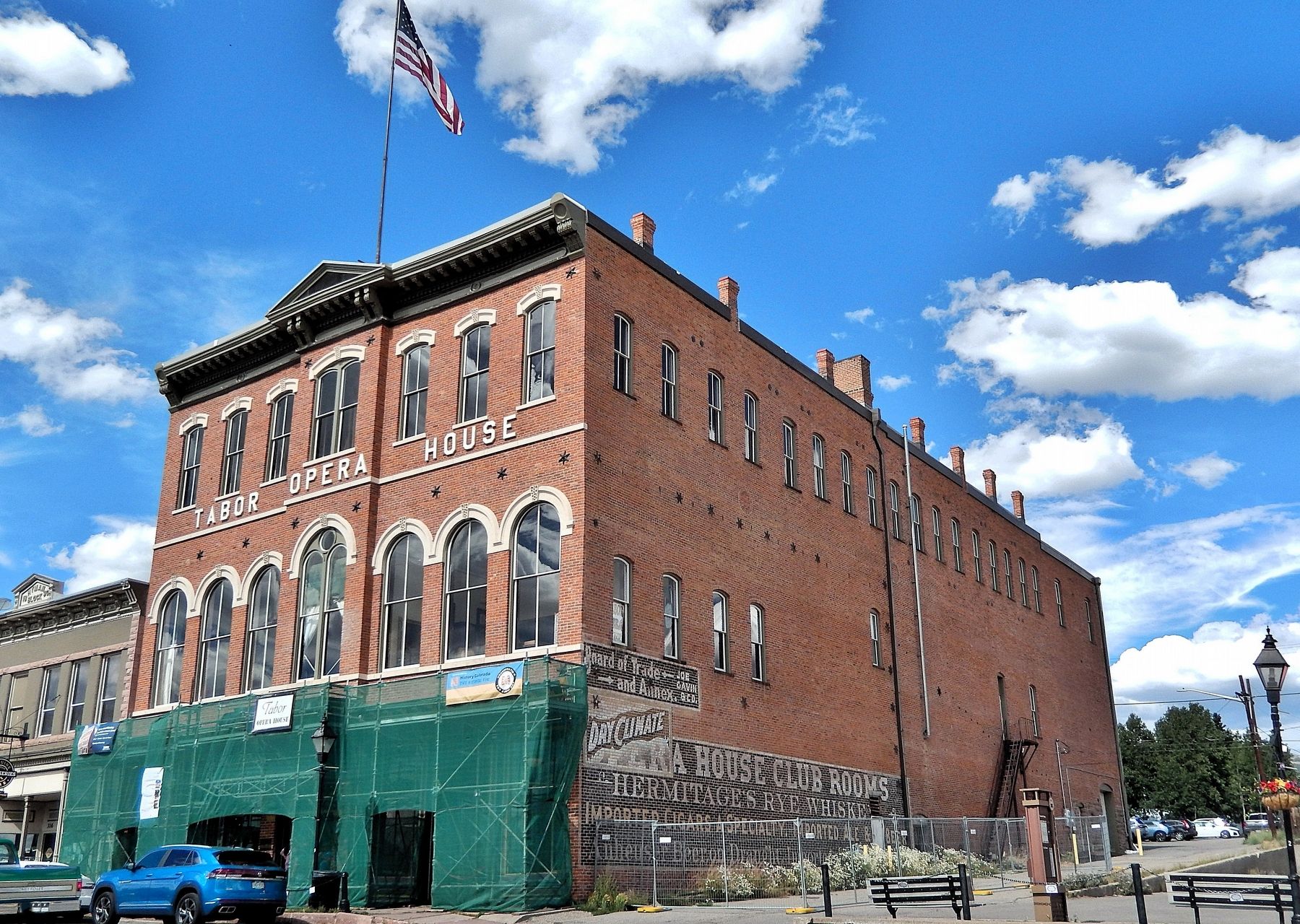
Tabor had a big job. The building materials he wanted weren’t available in Leadville, so he had them brought by wagon over Colorado’s highest, roughest passes. He built a massive three-story opera house made of stone, brick, and iron, trimmed with Portland cement. Its solid brick walls stand 16 inches thick!
In 1879, the building included two retail stores on the first floor, an elegant theateron the second floor, and a third floor with an enclosed skywalk to the Clarendon Hotel. The hotel, now gone, stood directly to the south. The Tabor’s ornate interior boasted richly painted walls and ceiling frescoes, custom carpets, and hand-painted stage curtains. The red, gold, white, and sky-blue colors glowed. The first gas lights to illuminate Leadville — flowing from 72 jets — revealed the opera house’s beauty.Photographed by Cosmos Mariner, July 27, 20254. Tabor Opera House (southwest elevation)
Despite building an impressive opera house at breakneck speed, Tabor did not pack the house on opening night — more people attended a hanging across the street. Eventually, the Tabor became known as the finest opera house west of the Mississippi. Luminaries such as Oscar Wilde, John Philip Sousa, and Buffalo Bill appeared at the Tabor. So did live tigers, when a circus act came to town.
2. Tabor Opera House (Wikipedia).
Excerpt: Built in 1879, it was the most costly structure in Colorado at the time, with materials being brought by wagons from Denver. The massive three-story opera house, constructed of stone, brick, and iron, was called "Leadville's finest brick structure". A 1935 newspaper article stated its cost to be "something under $75,000". Following the 1893 collapse in the price of silver, after the repeal of the Sherman Silver Purchase Act, Tabor was forced to sell the Leadville opera house for $32,000 USD. The new owner, Algernon Weston, owned the opera house until his death in 1897. In 1901 the building was sold to the local Elks society, who reopened it in 1902 as the Elks Opera House. In 1955 the building was sold for $20,000 USD to Evelyn Furman, a resident of Leadville. Furman maintained the building, opening it occasionally for tours and performances, until her death in 2011. In 2016 the city of Leadville purchased the building for $600,000 USD. Today, the renovation of the building is overseen by a private non-profit society, the Tabor Opera House Preservation Foundation. The building has been designated a national treasure by the National Trust for Historic Preservation.(Submitted on August 31, 2025, by Cosmos Mariner of Cape Canaveral, Florida.)
3. Leadville Historic District (Wikipedia).
Excerpt: The Leadville Historic District includes 67 mines in the mining district east of the city up to the 12,000-foot level, and a defined portion of the village area. It was designated in 1961. Then, when the National Register of Historic Places (NRHP) program was started in 1966, Leadville's National Historic District was included in its first day's listings. The NRHP district was later expanded, adding a number of structures along the Harrison Avenue corridor.(Submitted on August 31, 2025, by Cosmos Mariner of Cape Canaveral, Florida.)
The Tabor Opera House, built by Horace Tabor, was one of the most costly and substantially-built structures in Colorado history. The construction materials were not available in Leadville, so Tabor ordered that they be brought up by wagons. Its solid brick walls stand 16 inches thick.
Credits. This page was last revised on August 31, 2025. It was originally submitted on August 28, 2025, by Cosmos Mariner of Cape Canaveral, Florida. This page has been viewed 76 times since then and 14 times this year. Photos: 1, 2, 3, 4. submitted on August 31, 2025, by Cosmos Mariner of Cape Canaveral, Florida.
