Schönefeld in Dahme-Spreewald, Brandenburg, Germany — Central Europe
Die Glocken der Dorfkirche Schönefeld
⎯⎯⎯
The Bells of the Schönefeld Village Church
Photographed by Andrew Ruppenstein, August 28, 2025
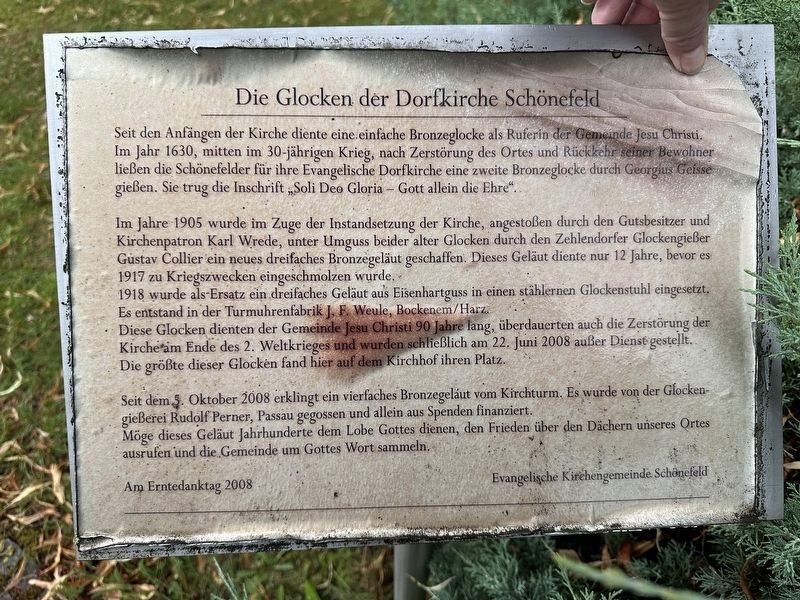
1. Die Glocken der Dorfkirche Schönefeld / The Bells of the Schönefeld Village Church Marker
The marker is on its last legs, as its adhesive backing has started to fail.

Im Jahre 1905 wurde im Zuge der Instandsetzung der Kirche, angestoßen durch den Gutsbesitzer und Kirchenpatron Karl Wrede, unter Umguss beider alter Glocken durch den Zehlendorfer Glockengießer Gustav Collier ein neues dreifaches Bronzegeläut geschaffen. Dieses Geläut diente nur 12 Jahre, bevor es 1917 zu Kriegszwecken eingeschmolzen wurde.
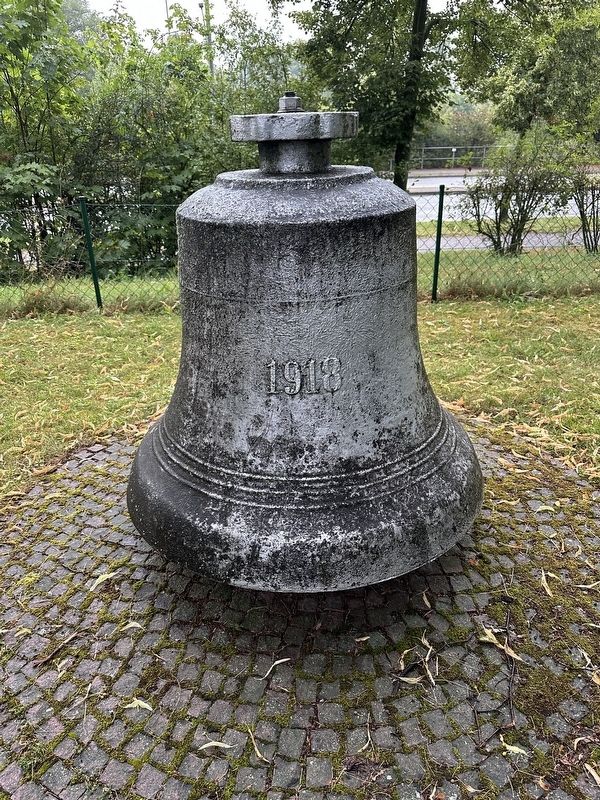
1918 wurde als Ersatz ein dreifaches Geläut aus Eisenhartguss in einen stählernen Glockenstuhl eingesetzt. Es entstand in der Turmuhrenfabrik J. F. Weule, Bockenem/Harz.
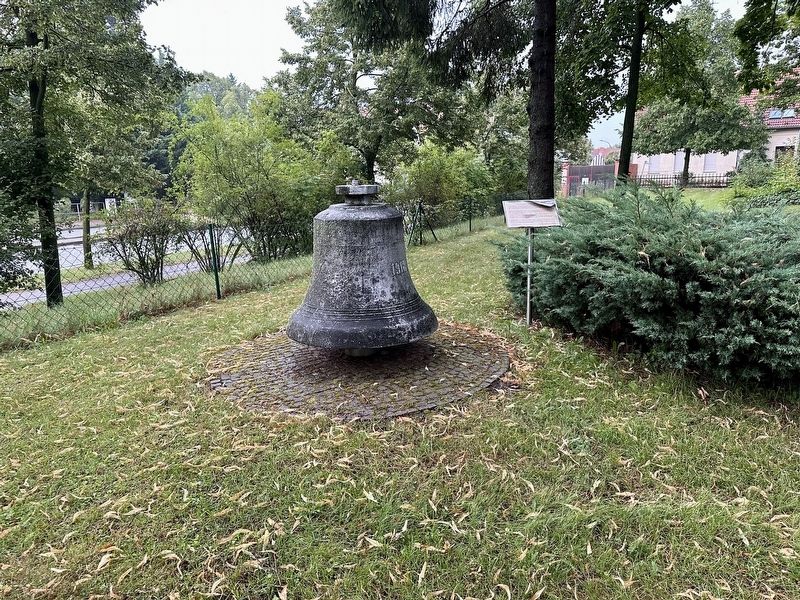
Diese Glocken dienten der Gemeinde Jesu Christi 90 Jahre lang, überdauerten auch die Zerstörung der Kirche am Ende des 2. Weltkrieges und wurden schließlich am 22. Juni 2008 außer Dienst gestellt. Die größte dieser Glocken fand hier
this page online
Seit dem 5. Oktober 2008 erklingt ein vierfaches Bronzegeláut vom Kirchturm. Es wurde von der Glockengießerei Rudolf Perner, Passau gegossen und allein aus Spenden finanziert. Möge dieses Geläut Jahrhunderte dem Lobe Gottes dienen, den Frieden über den Dächern unseres Ortes ausrufen und die Gemeinde um Gottes Wort sammeln.
Since the church's beginnings, a simple bronze bell served as the bell ringer for the congregation of Jesus Christ. In 1630, in the midst of the Thirty Years' War, after the village had been destroyed and its inhabitants returned, the people of Schönefeld had a second bronze bell cast for their Protestant village church by Georgius Geisse. It bore the inscription "Soli Deo Gloria - To God alone be the glory."
In 1905, during the restoration of the church, initiated by the landowner and patron Karl Wrede, a new triple bronze chime was created by the Zehlendorf bell founder Gustav Collier, recasting both old bells. This chime served only 12 years before being melted down for wartime purposes in 1917. In 1918, a replacement triple chime made of chilled cast
Photographed by Andrew Ruppenstein, August 28, 2025
2. Bell and Marker
Since October 5, 2008, a four-tone bronze bell has rung from the church tower. It was cast by the Rudolf Perner bell foundry in Passau and financed entirely through donations. May this ringing serve to praise God for centuries, proclaim peace over the rooftops of our town, and gather the congregation around God's Word.
Erected 2008 by Evangelische Kirchengemeinde Schönefeld.
Topics and series. This historical marker is listed in this topic list: Religion & Religious Structures. In addition, it is included in the Historic Bells series list. A significant historical year for this entry is 1630.
Location. 52° 23.238′ N, 13° 30.365′ E. Marker has been damaged. Marker is in Schönefeld, Brandenburg, in Dahme-Spreewald. It can be reached from the intersection of Kirchstraße
Photographed by Andrew Ruppenstein, August 28, 2025
3. Bell

Regionally, this marker is in German Lusatia. Globally, it is in Europe, the European Union, Atlantic Europe, Central Europe, the Schengen Area, Western Europe, and the Western World. Historically, it finds itself in what was once the Holy Roman Empire, the former East Germany, and at the Berlin Wall.
Other nearby markers. At least 8 other markers are within 14 kilometers of this location, measured as the crow flies: Die Geschichte dahinter / The history behind (approx. 0.7 kilometers away); Berliner Mauer / Berlin Wall (approx. 1.6 kilometers away in Berlin); Tagelöhnerhaus / Day Laborers House (approx. 4.2 kilometers away); NS Zwangsarbeit in Adlerhof / Nazi Forced Labour in Adlerhof (approx. 5.9 kilometers away in Berlin); Rudolf Wagner Régeny (approx. 5.9 kilometers away in Berlin); Anna Seghers (approx. 6.1 kilometers
Photographed by Andrew Ruppenstein, August 28, 2025
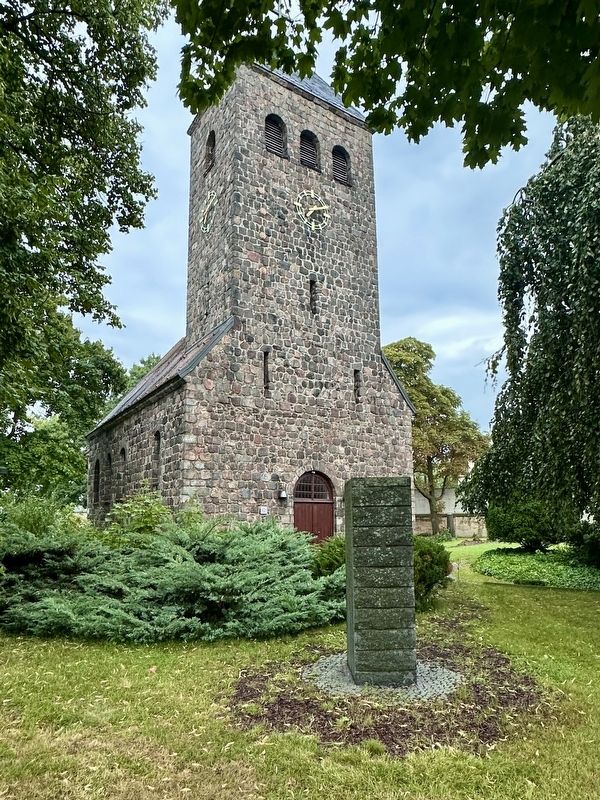
4. Dorfkirche Schönefeld / Schönefeld Village Church
The marker are just out of the camera‘s view, on the left.
Credits. This page was last revised on August 28, 2025. It was originally submitted on August 28, 2025, by Andrew Ruppenstein of Lamorinda, California. This page has been viewed 90 times since then and 18 times this year. Photos: 1, 2, 3, 4. submitted on August 28, 2025, by Andrew Ruppenstein of Lamorinda, California.
