
Vinci in Città Metropolitana di Firenze, Tuscany, Italy — Southern and Western Europe (Mediterranean)
Bruno Domenichini
Photographed by Sean P. Flynn, July 29, 2025
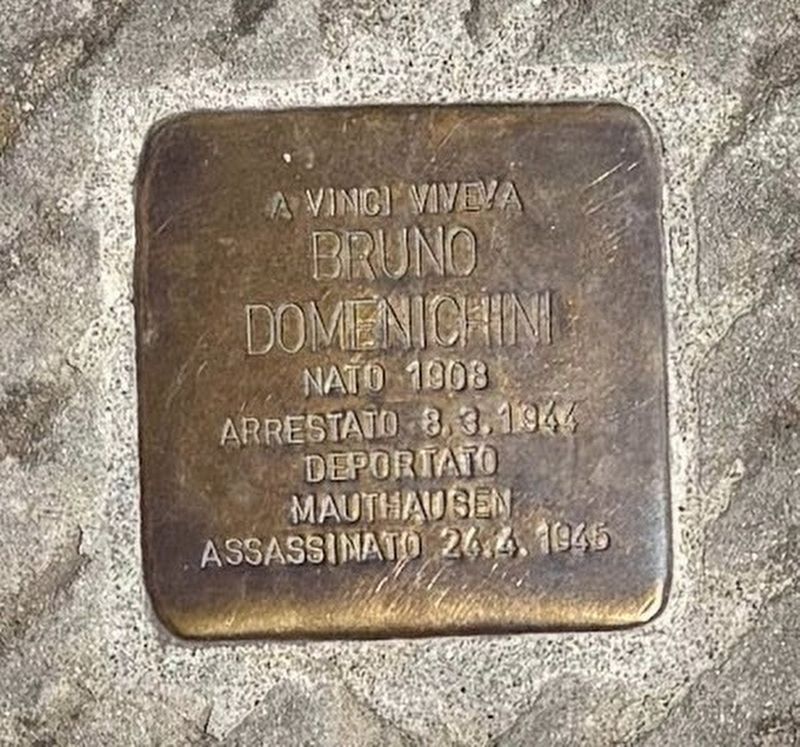
1. Bruno Domenichini Marker
Bruno Domenichini
Nato 1908
Arrestato 8.3.1944
Deportato
Mauthausen
Assassinato 24.4.1945
[English translation:]
Bruno Domenichini
Born in 1908
Arrested March 8, 1944
Deported to Mauthausen
Assassinato April 24, 1945
Topics and series. This historical marker is listed in these topic lists: Disasters • War, World II. In addition, it is included in the Stolpersteine series list. A significant historical date for this entry is March 8, 1944.
Location. 43° 47.214′ N, 10° 55.587′ E. Marker is in Vinci, Toscana (Tuscany), in Città Metropolitana di Firenze. It is on Piazza Leonardo da Vinci near Via Montalbano. Touch for map. Marker is at or near this postal address: Piazza Leonardo da Vinci 1, Vinci, Toscana 50059, Italy. Touch for directions.

Regionally, it is in Europe, the European Union, the Schengen Area, a coastal Mediterranean country, and the Western World. Historically, it finds itself in what was once the Byzantine Empire, the Roman Empire, and specifically the Holy Roman Empire.
Other nearby markers. At least 8 other markers are within walking distance of this marker: Francesco Domenichini (here, next to this marker); Spartaco Fedi (here, next to this marker); Gino Giacomelli (here, next to this marker); Vittorio Emanuele II / Victor Emmanuel II (here, next to this marker); Renzo Gemignani (here, next to this marker); Vinicio Lorenzini (here, next to this marker); Angiolo Masi
this page online
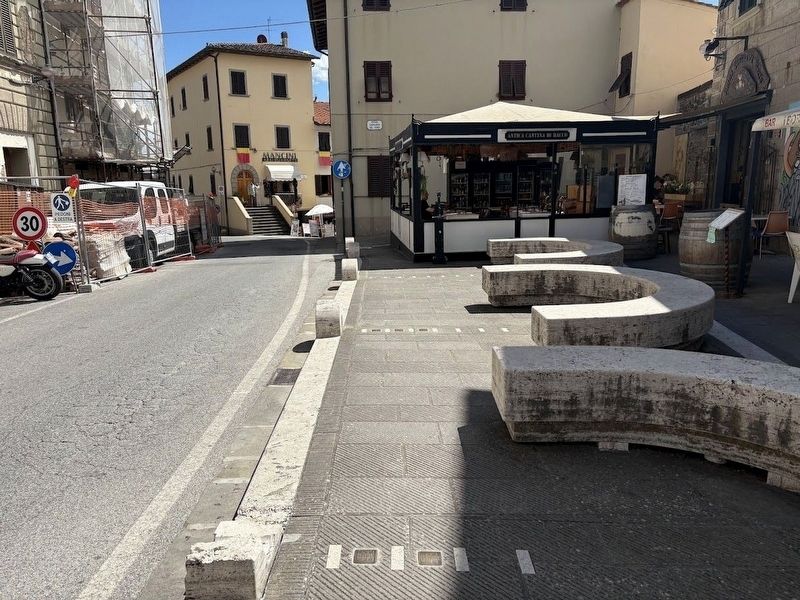
More about this marker. The marker is one of eight "Stumbling Stones" (German: Stolpersteine) that are embedded into the sidewalk across the street from Vinci's municipal building. The Stolpersteine are a multi-city project in Europe to remember local Holocaust victims. The eight men honored here were arrested together on March 8, 1944.
About 7,500 Italian Jews are believed to have died during the Holocaust.
Regarding Bruno Domenichini. Little additional information about Bruno Domenichini's life and death could be found, including his relation to Francesco Domenichini, whose stumbling stone is immediately next to Bruno’s. The Domenichinis were two of eight men arrested in Vinci on March 8, 1944, and sent to Mauthausen concentration camp in Austria. A 2025 article about a commemoration of their arrest said the Domenichinis were from Livorno, a coastal city about 65 kilometers west of Vinci, but that could not be further verified.
Mauthausen was open from 1938 until 1945 and is considered one of the most brutal of Germany's camps, home to a quarry that required

Photographed by Sean P. Flynn, July 29, 2025
2. Two "Stumbling Stones" in Vinci
Mauthausen was the final German concentration camp to be liberated by Allied troops. However, the final months at this camp had been particularly brutal as camp leaders and SS guards prepared to defend it against attack. Sick or exhausted inmates were exterminated to make room for new inmates, while food rations dwindled to minuscule numbers. Bruno Domenichini died on April 24, 1945, only 11 days before the camp was liberated by the U.S. Army's 11th Armored Division on May 5.
Also see . . . Where Murder Was a Way of Life: The Mauthausen Concentration Camp. An article about Mauthausen from the National World War II Museum in New Orleans.
Excerpt: “Mauthausen was one of the worst of the concentration camps in this system. 'One of the worst,' a phrase of comparison, is not used lightly here. Established in 1938 near the city of Linz in Upper Austria, it was founded, along with Flossenbürg and Ravensbrück, on orders from Reichsführer SS Heinrich Himmler, as part of an expansion of the concentration-camp network. Quickly Mauthausen acquired(Submitted on August 29, 2025, by Sean P. Flynn of Oak Park, Illinois.)a reputation for lethality, even among its peer camps. With its subcamps at Gusen, Ebensee, and Melk, Mauthausen sat at the center of a web of systematic violence.”Photographed by Sean P. Flynn, July 29, 20253. 8 Stolpersteine in Vinci

United States Holocaust Memorial Museum, courtesy of Archiv der KZ-Gedenkstaette Mauthausen, circa 1941
4. Prisoners in the Wiener Graben quarry at Mauthausen
Credits. This page was last revised on August 29, 2025. It was originally submitted on August 29, 2025, by Sean P. Flynn of Oak Park, Illinois. This page has been viewed 71 times since then and 12 times this year. Photos: 1, 2. submitted on August 29, 2025, by Sean P. Flynn of Oak Park, Illinois. 3. submitted on August 28, 2025, by Sean P. Flynn of Oak Park, Illinois. 4. submitted on August 29, 2025, by Sean P. Flynn of Oak Park, Illinois.
