
Vinci in Città Metropolitana di Firenze, Tuscany, Italy — Southern and Western Europe (Mediterranean)
Angiolo Masi
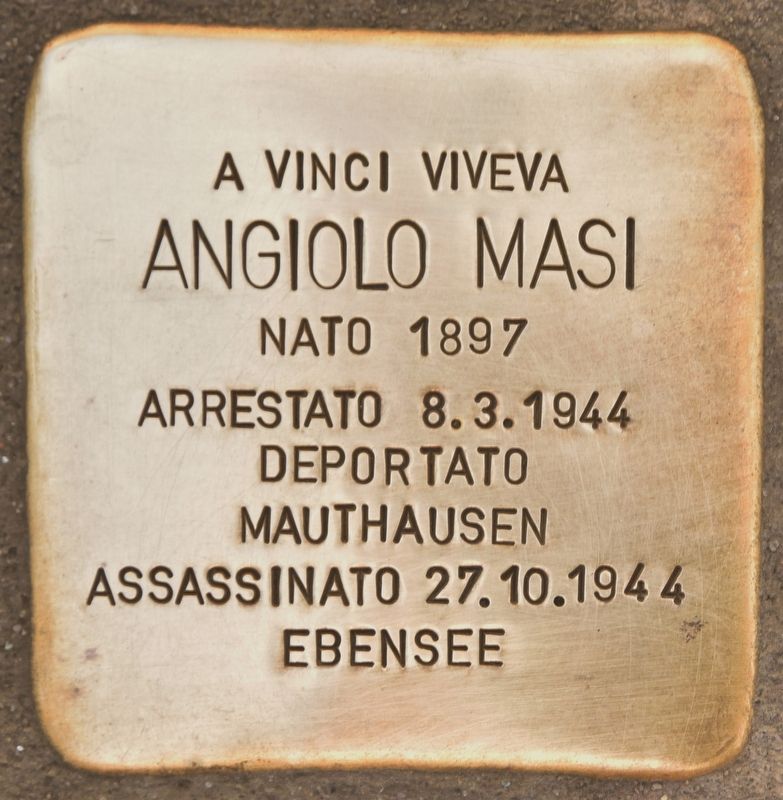
Angiolo Masi
Nato 1897
Arrestato 8.3.1944
Deportato
Mauthausen
Assassinato 27.10.1944
Ebensee
[English translation:]
Angiolo Masi
Born 1897
Arrested March 8, 1944
Deported to Mauthausen
Murdered November 27, 1944
Ebensee
Topics and series. This historical marker is listed in these topic lists: Disasters • War, World II. In addition, it is included in the Stolpersteine series list. A significant historical date for this entry is March 8, 1944.
Location. 43° 47.211′ N, 10° 55.592′ E. Marker is in Vinci, Toscana (Tuscany), in Città Metropolitana di Firenze. It is at the intersection of Piazza Leonardo da Vinci and Via Montalbano, on the right when traveling south on Piazza Leonardo da Vinci. Touch for map. Marker is at or near this postal address: Piazza Leonardo da Vinci 1, Vinci, Toscana 50059, Italy. Touch for directions.

Regionally, it is in Europe, the European Union, the Schengen Area, a coastal Mediterranean country, and the Western World. Historically, it finds itself in what was once the Byzantine Empire, the Roman Empire, and specifically the Holy Roman Empire.
Other nearby markers. At least 8 other markers are within walking distance of this marker: Piero Bastiani (here, next to this marker); The Liberation of Vinci, Italy (here, next to this marker); Renzo Gemignani (here, next to this marker); Vittorio Emanuele II / Victor Emmanuel II (here, next to this marker); Spartaco Fedi (here,
this page online
More about this marker. The marker is one of eight "Stumbling Stones" (German: Stolpersteine) that are embedded into the sidewalk across the street from Vinci's municipal building. The Stolpersteine are a multi-city project in Europe to remember local Holocaust victims. The eight men honored here were arrested together on March 8, 1944.
About 7,500 Italian Jews are believed to have died during the Holocaust.
Regarding Angiolo Masi. Information about neither Masi's life nor his death at a Nazi concentration camp could be found, but details about Mauthausen concentration camp and its Ebensee sub-camp offer a little bit of insight. Mauthausen was open from 1938 until 1945 and is considered one of the most brutal of Germany's camps, home to a quarry that required the back-breaking work of slave labor. Originally a camp for political prisoners, it also held Jews and POWs, and in its later years had a gas chamber for murdering inmates.
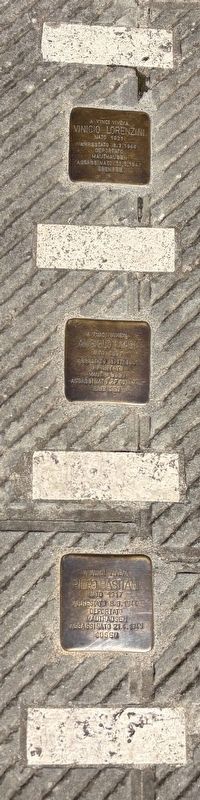
Photographed by Sean P. Flynn, July 29, 2025
2. Angiolo Masi Marker
Also see . . .
1. Stolpersteine official site. (Submitted on August 31, 2025, by Sean P. Flynn of Oak Park, Illinois.)
2. Ebensee concentration camp.
Excerpt: "The Ebensee concentration camp was erected as a labour camp subordinate to the Mauthausen concentration camp. The first inmates arrived in Ebensee on 18 November 1943. Until the time when the construction of the first barracks was finished, the prisoners had to stay in a storehouse of the weaving mill. To cover up the existence of the camp, SS officers used the code names Kalk (limestone), Kalksteinbergwerk (limestone mine), Solvay and Zement (cement). The main purpose of Ebensee was to provide slave labour for the construction of the enormous underground tunnels which were to be used for research purposes and the development of the A9/A10 Interkontinentalrakete (intercontinental rocket)."(Submitted on August 31, 2025, by Sean P. Flynn of Oak Park, Illinois.)
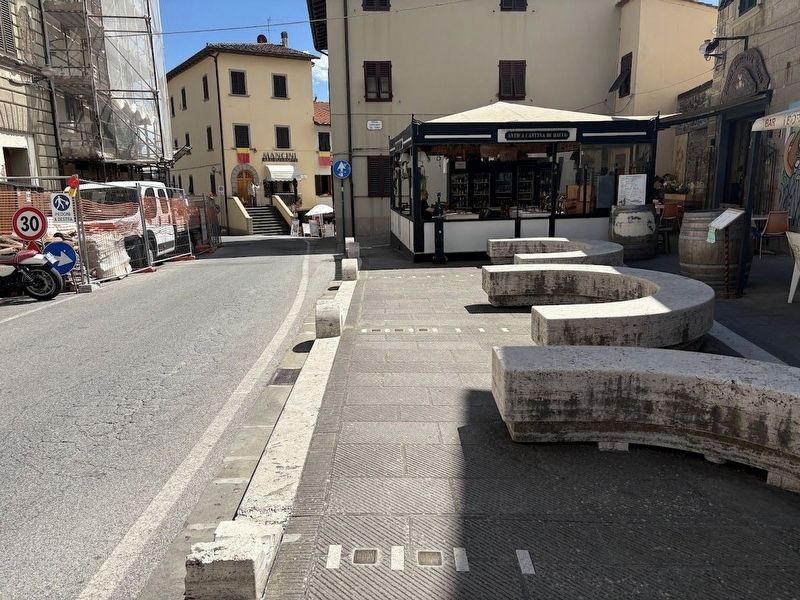
Photographed by Sean P. Flynn, July 29, 2025
3. 8 Stolpersteine in Vinci

United States Holocaust Memorial Museum, courtesy of Lillian Pressman, May 1945
4. View of the crematorium at Ebensee
The photo was taken soon after Ebensee was liberated on May 6, 1945.
Credits. This page was last revised on August 31, 2025. It was originally submitted on August 29, 2025, by Sean P. Flynn of Oak Park, Illinois. This page has been viewed 67 times since then and 9 times this year. Photos: 1, 2. submitted on August 29, 2025, by Sean P. Flynn of Oak Park, Illinois. 3. submitted on August 28, 2025, by Sean P. Flynn of Oak Park, Illinois. 4. submitted on August 29, 2025, by Sean P. Flynn of Oak Park, Illinois.
