
Vinci in Città Metropolitana di Firenze, Tuscany, Italy — Southern and Western Europe (Mediterranean)
Piero Bastiani
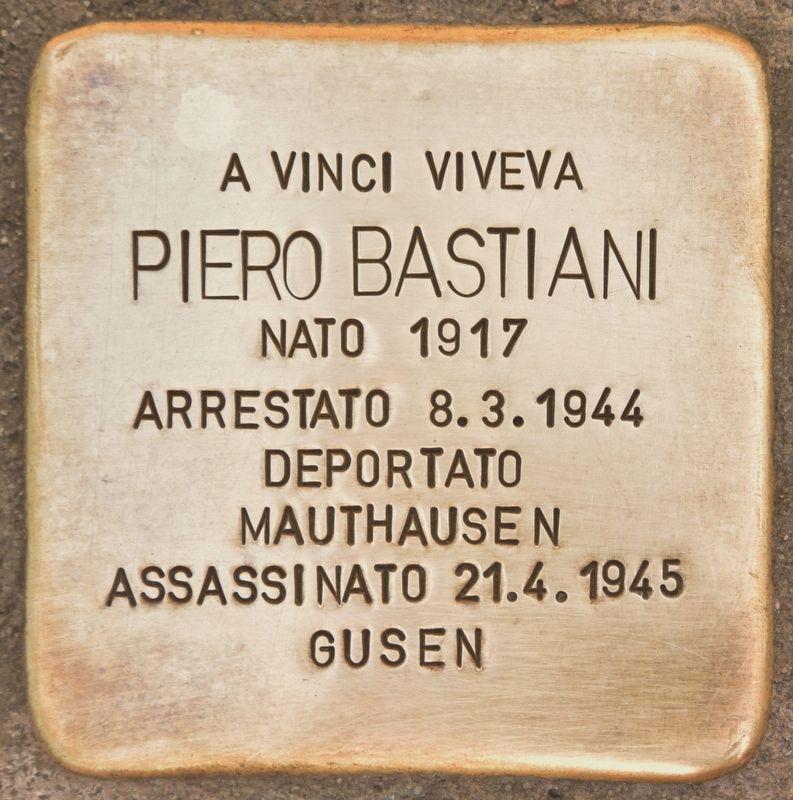
Piero Bastiani
Nato 1917
Arrestato 8.3.1944
Deportato
Mauthausen
Assassinato 21.4.1945
Gusen
[English translation:]
Piero Bastiani
Born 1917
Arrested March 8, 1944
Deported to Mauthausen
Murdered April 4, 1945
Gusen
Topics and series. This historical marker is listed in these topic lists: Disasters • War, World II. In addition, it is included in the Stolpersteine series list. A significant historical date for this entry is March 8, 1944.
Location. 43° 47.211′ N, 10° 55.592′ E. Marker is in Vinci, Toscana (Tuscany), in Città Metropolitana di Firenze. It is at the intersection of Piazza Leonardo da Vinci and Via Montalbano, on the right when traveling south on Piazza Leonardo da Vinci. Touch for map. Marker is at or near this postal address: Piazza Leonardo da Vinci 1, Vinci, Toscana 50059, Italy. Touch for directions.

Regionally, it is in Europe, the European Union, the Schengen Area, a coastal Mediterranean country, and the Western World. Historically, it finds itself in what was once the Byzantine Empire, the Roman Empire, and specifically the Holy Roman Empire.
Other nearby markers. At least 8 other markers are within walking distance of this marker: Angiolo Masi (here, next to this marker); The Liberation of Vinci, Italy (here, next to this marker); Renzo Gemignani (here, next to this marker); Vittorio Emanuele II / Victor Emmanuel II (here, next to this marker); Spartaco Fedi (here, next
this page online
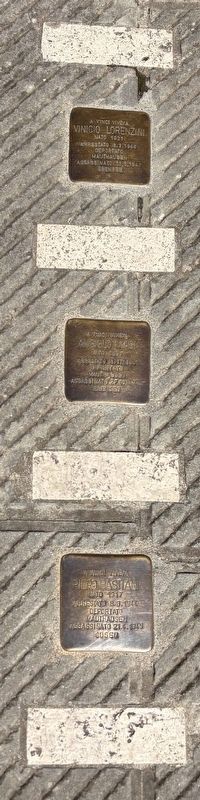
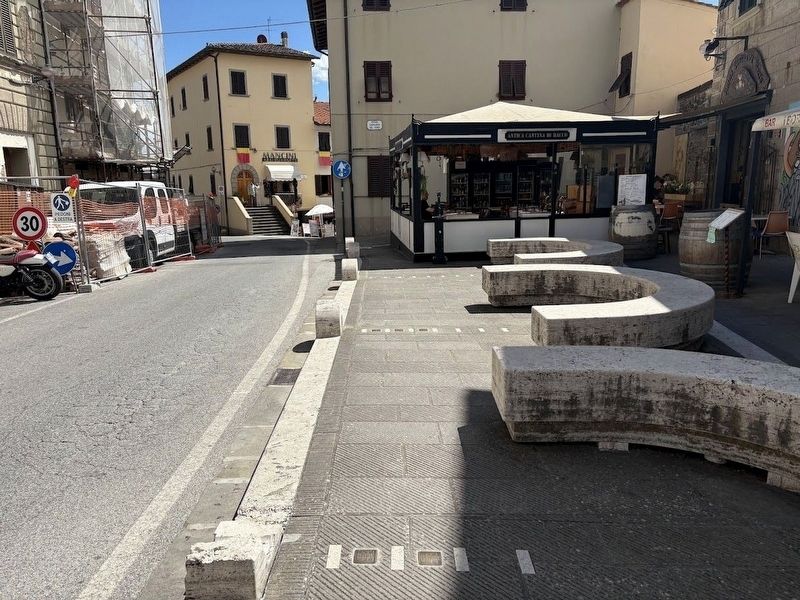
More about this marker. The marker is one of eight "Stumbling Stones" (German: Stolpersteine) that are embedded into the sidewalk across the street from Vinci's municipal building. The Stolpersteine are a multi-city project in Europe to remember local Holocaust victims. The eight men honored here were arrested together on March 8, 1944.
About 7,500 Italian Jews are believed to have died during the Holocaust.
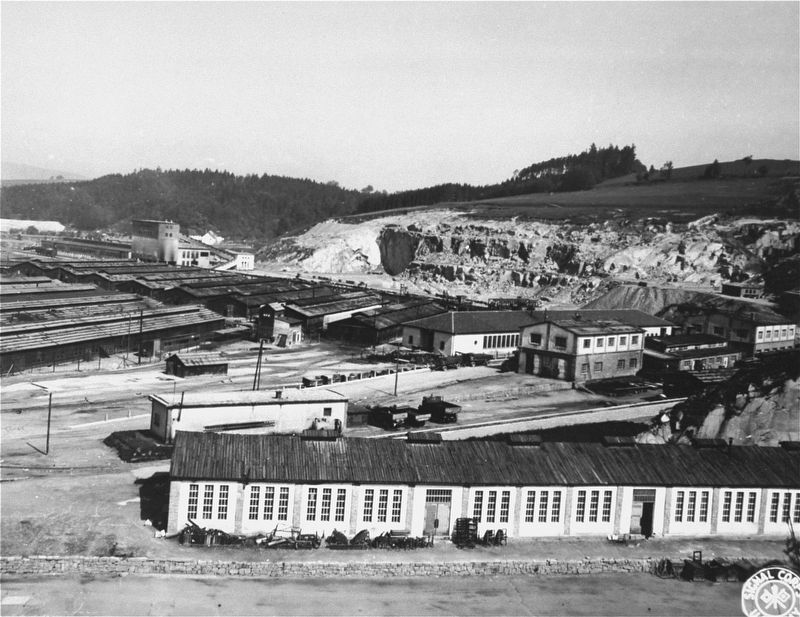
Regarding Piero Bastiani. Further details about Piero Bastiani's life and death could be found, but details about Mauthuasen concentration camp and its Gusen sub-camp do offer some clues.
Mauthausen was open from 1938 until 1945 and is considered one of the most brutal of Germany's concentration camps, home to a quarry that required the back-breaking work of slave labor. About 190,000 prisoners were held at Mauthausen, of which about 90,000 are believed to have died.
Prisoners at the Gusen sub-camp, where
Photographed by Sean P. Flynn, July 29, 2025
2. Piero Bastiani Marker
Also see . . . The Gusen Branch Camp. From KZ-Gedenkstätte Mauthausen.
Excerpt: "At first the SS transferred mainly Polish and Spanish concentration camp prisoners from Mauthausen to Gusen. As in Mauthausen, initially most were used as forced labourers in the quarries. In particular in the years 1940 to 1942, the prisoners were killed systematically in their thousands, or they died as a result of the murderous conditions. In 1941 the number of deaths in the Gusen branch camp was several times as high as in Mauthausen.(Submitted on August 31, 2025, by Sean P. Flynn of Oak Park, Illinois.)
"As part of the growing use of concentration camp prisoners as forced labourers in the arms industry, in 1943 two large arms companies moved parts of their production to the Gusen concentration camp. Steyr-Daimler-Puch AG, the largest arms company in the ‘Ostmark’, now produced guns here and the Messerschmitt GmbH company, a major aeroplane manufacturer in the German Reich, made aeroplane parts. For prisoners assigned directly to arms production, conditions now improved and for a time mortality in the camp sank."
Photographed by Sean P. Flynn, July 29, 2025
3. 8 Stolpersteine in Vinci
United States Holocaust Memorial Museum, courtesy of Eugene S. Cohen, circa May 1945
4. A view of the Gusen concentration camp after liberation
Credits. This page was last revised on August 31, 2025. It was originally submitted on August 29, 2025, by Sean P. Flynn of Oak Park, Illinois. This page has been viewed 71 times since then and 13 times this year. Photos: 1, 2. submitted on August 29, 2025, by Sean P. Flynn of Oak Park, Illinois. 3. submitted on August 28, 2025, by Sean P. Flynn of Oak Park, Illinois. 4. submitted on August 30, 2025, by Sean P. Flynn of Oak Park, Illinois.
