Rico in Dolores County, Colorado — The American Mountains (Southwest)
Rico Town Hall
(formerly the Dolores County Courthouse)
Photographed by Cosmos Mariner, July 18, 2025
1. Rico Town Hall Marker
National Register of Historic Places
National Register of Historic Places
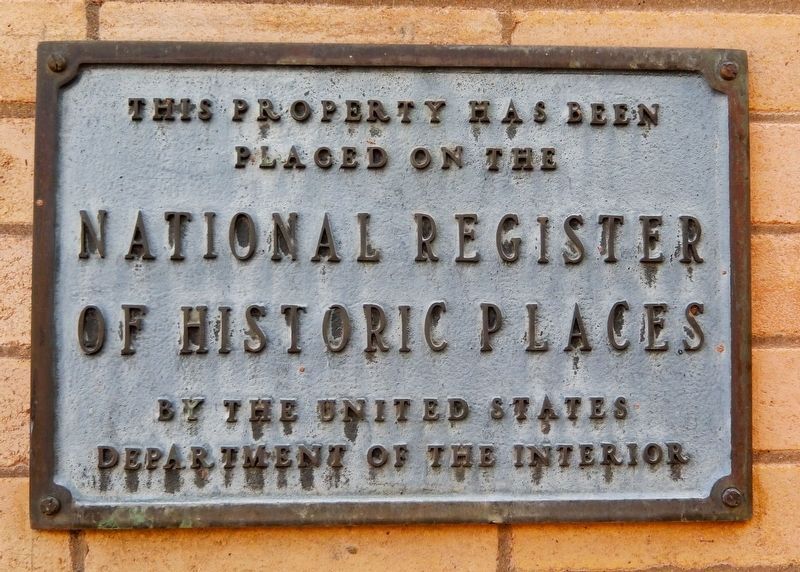
This property has been placed on the
National Register of Historic Places
by the United States Department of the Interior
Topics and series. This historical marker is listed in these topic lists: Architecture • Notable Buildings. In addition, it is included in the National Register of Historic Places (NRHP) series list. A significant historical year for this entry is 1892.
Location. 37° 41.571′ N, 108° 1.815′ W. Marker is in Rico, Colorado, in Dolores County. It is at the intersection of North Commercial Street and East Mantz Avenue, on the right when traveling north on North Commercial Street. The marker is mounted at eye-level, directly on the west/front facade of the subject building. Touch for map. Marker is at or near this postal address: 1 North Commercial Street, Rico CO 81332, United States of America. Touch for directions.

Regionally, this marker is in the Western Slope. It is also in the American Mountain West, on the Colorado Plateau, and at the Four Corners. Globally, it is in North America, the Rocky Mountains, the Western Hemisphere, the Western World, and the Anglosphere. Historically, it finds
this page online
Other nearby markers. At least 8 other markers are within 11 miles of this marker, measured as the crow flies: Colorado Centennial Project (here, next to this marker); The Atlantic Cable Mine (about 700 feet away, measured in a direct line); Rico, Colorado (about 700 feet away); Valley Rico Cemetery (approx. one mile away); Keeping the Trains Running (approx. 10½ miles away); Winter on a Mountain Pass (approx. 10.7 miles away); Sheep and Cattle Grazing in the High Country (approx. 10.7 miles away); Early History and Railroad Development (approx. 10.7 miles away). Touch for a list and map of all markers in Rico.
Regarding Rico Town Hall. National Register of Historic Places № 74000574 and Colorado State Register of Historic Places Site № 5DL.423.
From the National Register Nomination prepared by Jack P. Curran, Mayor of the Town of Rico, 10/1974:
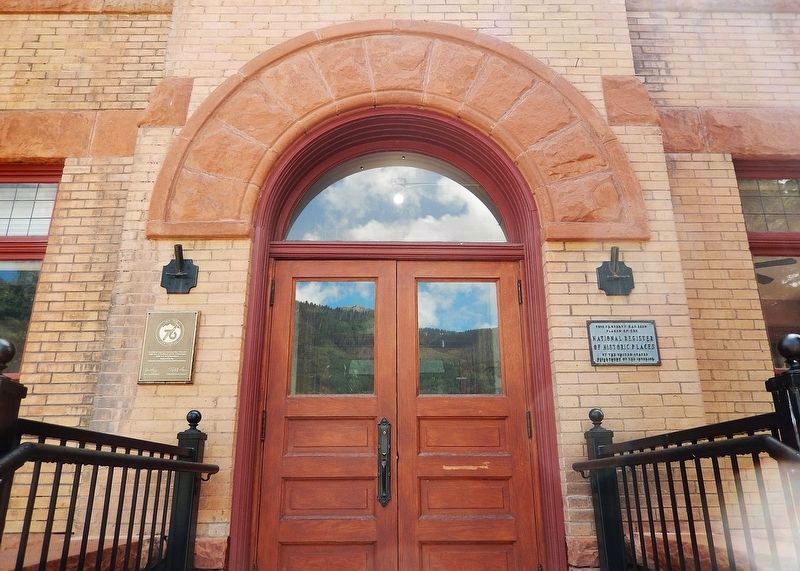
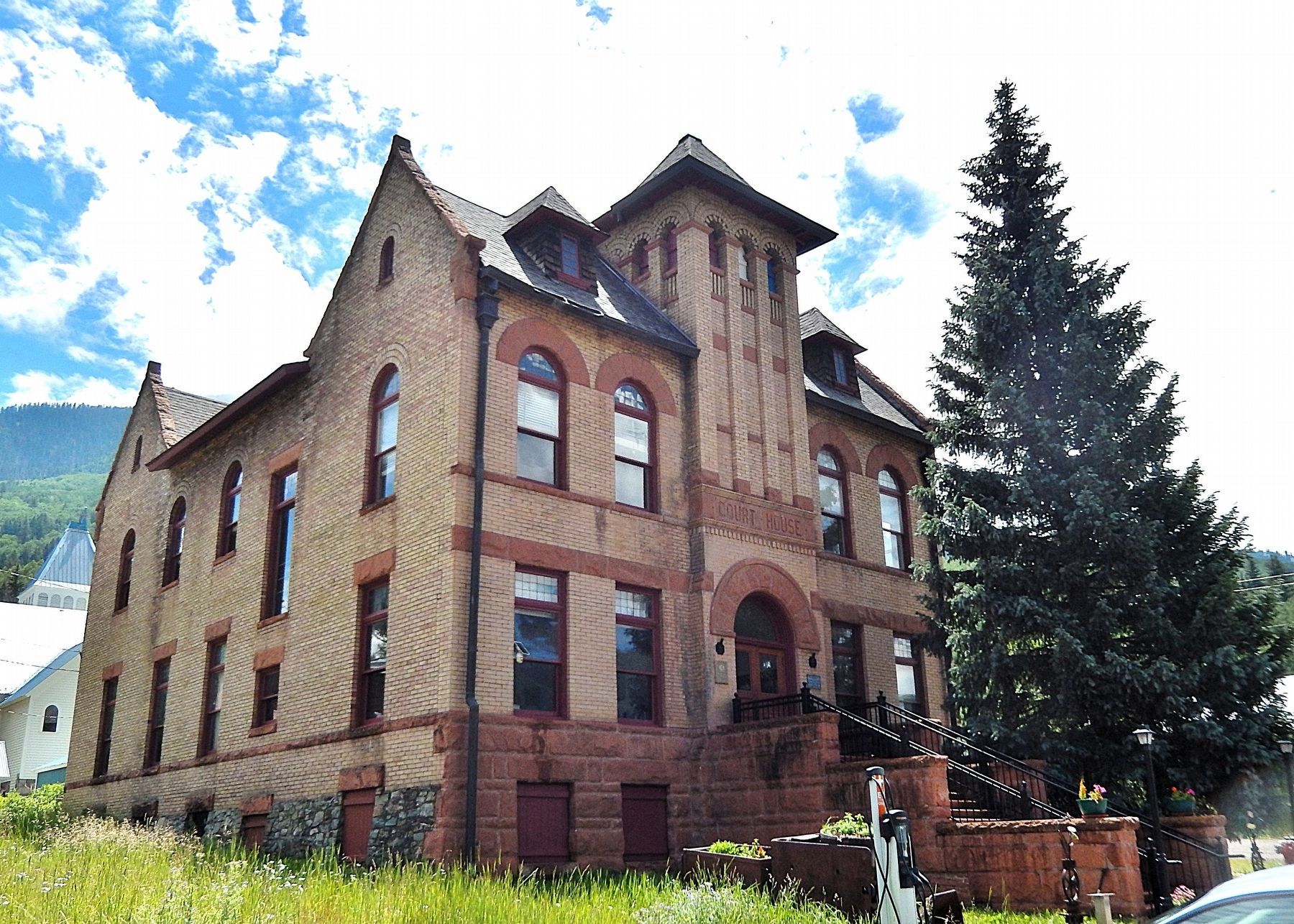
The courthouse was constructed by a Mr. Carpenter in 1892 and 1893. Since we have been unable to locate any design or plan for the building and the architecture varies fromthe first to the second floors it is suspected that the builder and the stone masons designed the building as they constructed it.Photographed by Cosmos Mariner, July 18, 20252. Rico Town Hall EntranceThe National Register of Historic Places marker is on the right side of the entrance.
It was built as the Courthouse and County Seat for Dolores County during the mining boom that resulted when Dave Swickheimer struck the Enterprise gold and silver contract in 1897.
Rico was incorporated on October 11, 1879, and became the second incorporated town in Ouray County, the first being the town of Ouray. Communications and transportation between the two towns were difficult and sometimes impossible. Rico, with a growing population estimated to be 4,000, sought and gained independence. Rico was named the county seat of Dolores County created for the purpose of facilitating government operations. Dolores County was carved from Ouray County by the passage of House Bill № 111, February 10, 1881. Dolores county derived its name from the Dolores River, “The River of Sorrow,” which headwaters within its borders.
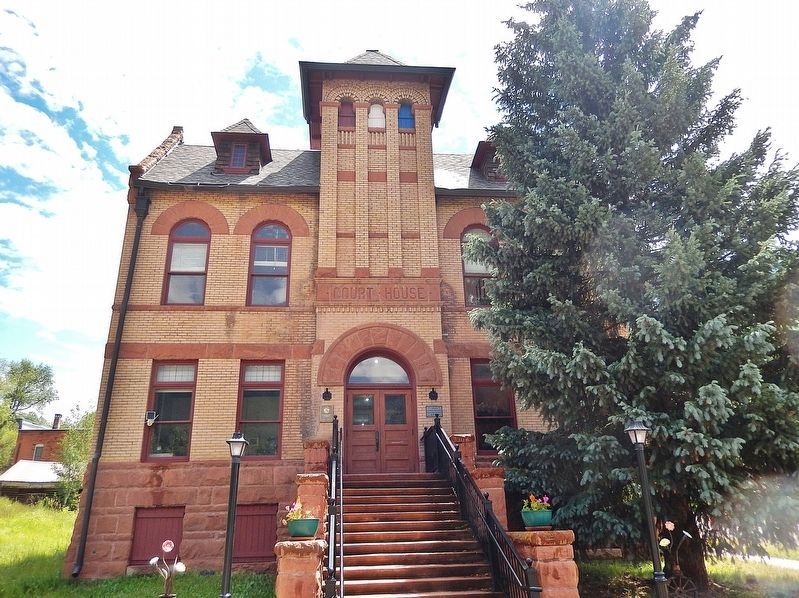
The rails of the narrow-gauge Rio Grande Southern Railroad were laid into Rico in 1891, and many old problems were solved. The Iron Horse would replace hundreds of pack animals and oxenteams that for more than a decade had been the only means of transportation. Materials and supplies were made readily available, and construction of new buildings developed into a building boom when many log and frame structures were replaced with brick and stone.Photographed by Cosmos Mariner, July 18, 20253. Rico Town Hall (west/front elevation)
A two-story log courthouse, cramped for space, was obsolete and a new courthouse was planned. Native granite, plentiful in the area would be used for the foundation and basement walls. Redstone would be cut and shipped from Quarry, Colorado, 18 miles south of Rico on a spur of the Rio Grande Southern. Combined with the redstone, pressed brick from the Durango Brick Yard at Lightner Creek would be used in the exterior walls. Other materials used in construction would come from pueblo, Denver, and St. Louis, Missouri.
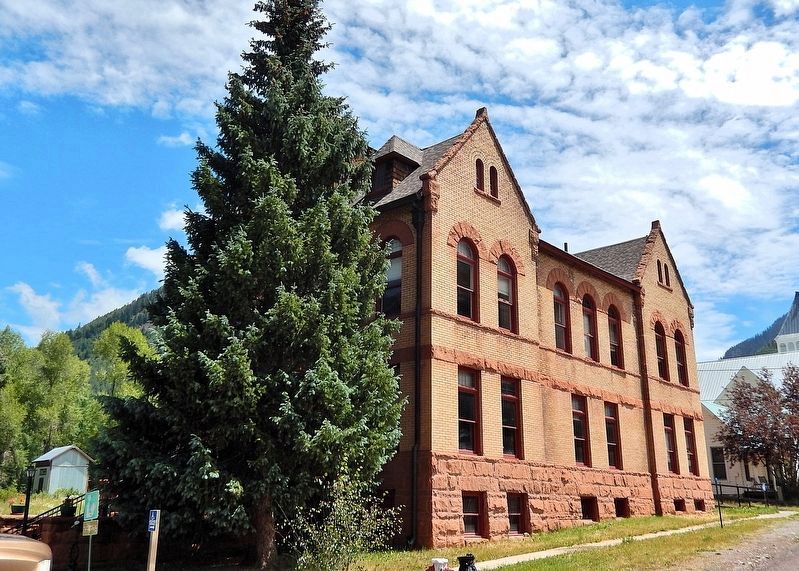
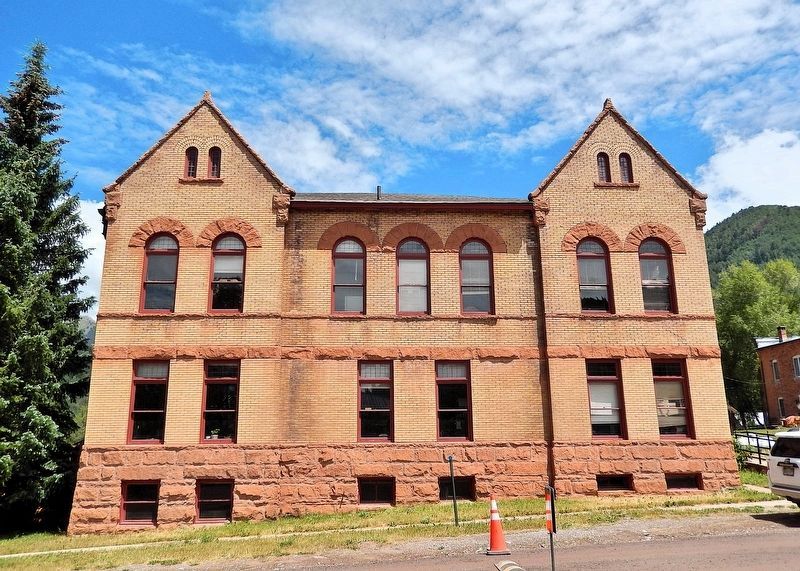
It was late 1893 before the majestic building was near completion and ready for occupancy. The courthouse served for 53 years. In the interim, mining was on the decline and homesteading lands were opened in the west of Dolores County. Transportation from Dove Creek was difficult, paralleling conditions that existed between Rico and Ouray before Dolores County wasestablished. Residents of Dove Creek had complained for some time about the location of the county seat in Rico. Dove Creek had become the center of population with more than twice the number of inhabitants of the mining areas of Rico and Dunton. They contended that Dove Creek should be the County Seat.Photographed by Cosmos Mariner, July 18, 20254. Rico Town Hall (southwest elevation)
The controversy became a major issue in the general election of 1944 and relocation of the county seat was widely publicized. Dove Creek won by a majority vote and records were removed from Rico in 1946 to the facilities in Dove Creek, the new county seat.
Unoccupied in the years that followed, time and lack of maintenance took their toll on the old courthouse. Sale of the premises was considered. Citizens of Rico concerned with the possibility of private ownership met the Board of County Commissioners in a desperate effort to resolve the problem. At a regular meeting of the Board of County Commissioners held in Dove Creek on the 3rd day of October, 1955, a resolution for the conveyance of the old courthouse was unanimously passed. A deed conveying the old courthouse to the Town of Rico was recorded in the county Clerk's office in DoveCreek, Colorado, April 2, 1956.Photographed by Cosmos Mariner, July 18, 20255. Rico Town Hall (south elevation)
A new roof was installed by volunteer labor, rooms on the main floor were renovated and the hallway textured. The building was partially rewired at a cost of $900 and the obsolete coal fired steam boiler replaced with a new propane furnace. The building is used for offices of the Town Board, Rico volunteer firemen, Chamber of Commerce and is available for public meetings. A polling place is provided for all elections. The Old Courthouse in Rico stands as a monumental edifice to the determination of the pioneers of Rico and Dolores County.
Related markers. Click here for a list of markers that are related to this marker. Rico Town Hall, Colorado
Also see . . .
1. Rico Town Hall (Wikipedia).
Excerpt: Rico was formerly the county seat of Dolores County, and the city hall was built as the Dolores County Courthouse in 1892. At the time Rico was in the middle of a gold boom and had a population of 4,000. The new courthouse replaced a log courthouse. It is built of dense red sandstone from the Cutler Formation in Ouray on a local granite foundation. Brick came from the Durango Brick Yard(Submitted on September 3, 2025, by Cosmos Mariner of Cape Canaveral, Florida.)at Lightner Creek. The 2½-story structure features arched windows and parapeted end gables, with a central tower that projects slightly above the steep main roof over the entrance. Over time the county's population shifted to Dove Creek, and after 53 years the county seat moved in 1946. The courthouse remained vacant until 1955, when it was transferred to Rico for town offices and meeting space. The Rico Town Hall was placed on the National Register of Historic Places on December 31, 1974.Photographed by Cosmos Mariner, July 18, 20256. Rico Town Hall (northwest elevation)From the National Register Nomination: The building is rectangular in shape and has two stories plus a full basement that is one-half above and one-half below the ground level. The outer walls of the building were constructed of red sandstone from below the ground level to the beginning of the main floor. The two stories above were constructed of light common red brick set in stretcher bond. The bricks were hauled in from Durango via railroad.
2. Dolores County Courthouse (Rico Town Hall) (History Colorado).
Excerpt: This two-story light red brick building, with a raised basement, was constructed in 1892. Red sandstone was used at the basement level and for window detailing. It is listed on the Colorado State Register of Historic Places, Site Number 5DL.423.(Submitted on September 3, 2025, by Cosmos Mariner of Cape Canaveral, Florida.)
Credits. This page was last revised on September 3, 2025. It was originally submitted on August 29, 2025, by Cosmos Mariner of Cape Canaveral, Florida. This page has been viewed 82 times since then and 30 times this year. Photos: 1, 2, 3, 4, 5, 6. submitted on September 3, 2025, by Cosmos Mariner of Cape Canaveral, Florida.
