Downtown in Asheville in Buncombe County, North Carolina — The American South (South Atlantic)
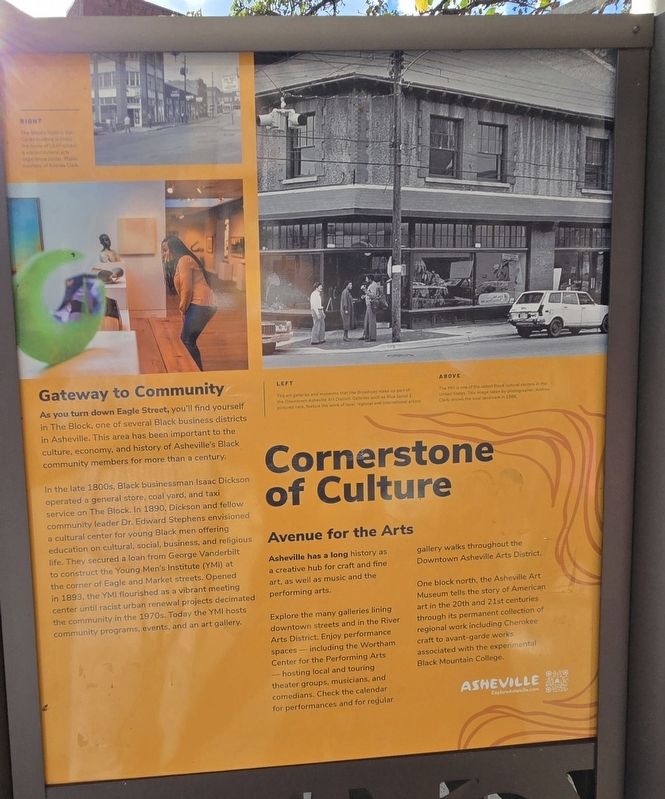
Cornerstone of Culture
Photographed by Mark Parker, August 29, 2025
1. Cornerstone of Culture Marker
Gateway to Community
As you turn down Eagle Street, you'll find yourself in The Block, one of several Black business districts in Asheville. This area has been important to the culture, economy, and history of Asheville's Black community members for more than a century.
In the late 1800s, Black businessman Isaac Dickson operated a general store, coal yard, and taxi service on The Block. In 1890, Dickson and fellow community leader Dr. Edward Stephens envisioned a cultural center for young Black men offering education on cultural, social, business, and religious life. They secured a loan from George Vanderbilt to construct the Young Men's Institute (YMI) at the corner of Eagle and Market streets. Opened in 1893, the YMI flourished as a vibrant meeting center until racist urban renewal projects decimated the community in the 1970s. Today the YMI hosts community programs, events, and an art gallery.
Avenue for the Arts
Asheville has a long history as a creative hub for craft and fine art, as well as music and the performing arts.
Explore the many galleries lining downtown streets and in the River Arts District.
this page online
One block north, the Asheville Art Museum tells the story of American art in the 20th and 21st centuries through its permanent collection of regional work including Cherokee craft to avant-garde works associated with the experimental Black Mountain College.
(captions)
Right The Block's Del Carde building is today the home of LEAF Local, a vibrant cultural arts experience center. Photo courtesy of Andrea Clark.
Left The art galleries and museums that line Broadway make up part of the Downtown Asheville Art District. Galleries such as Blue Spiral 1, pictured here, feature the work of local, regional and international artists.
Above The YMI is one of the oldest Black cultural centers in the United States. This image taken by photographer, Andrea Clark, shows the local landmark in 1988.
Erected by Explore Asheville.
Topics. This historical marker is listed
Photographed by Mark Parker, August 29, 2025
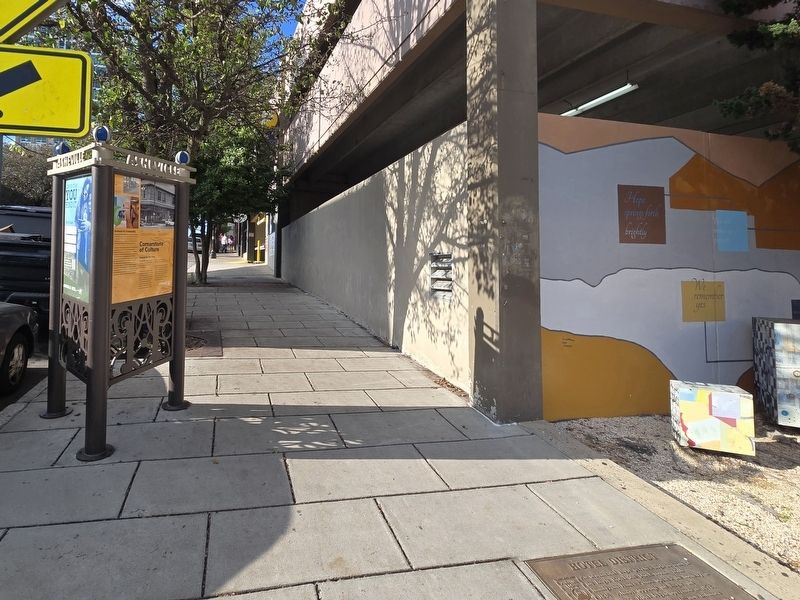
2. Cornerstone of Culture Marker looking north on Biltmore Ave at Eagle St.
Hotel District marker is at bottom right corner of photo
Location. 35° 35.633′ N, 82° 33.077′ W. Marker is in Asheville, North Carolina, in Buncombe County. It is in Downtown. It is at the intersection of Biltmore Avenue (U.S. 25) and Eagle Street, on the right when traveling north on Biltmore Avenue. Touch for map. Marker is at or near this postal address: 2 Eagle St, Asheville NC 28801, United States of America. Touch for directions.

Regionally, this marker is in the Mountains. It is also in the American South, specifically in the Upper South, in Appalachia, and specifically in Southern Appalachia. Globally, it is in North America, the Western Hemisphere, the Western World, and the Anglosphere. Historically, it finds itself in what was once the original Cherokee Nation, the territory of the Mississippian Culture, one of the original Thirteen Colonies, one of the Confederate States of America, and the Antebellum South.
Other nearby markers. At least 8 other markers are within walking distance of this marker: Hotel District (here, next to this marker); Oscar Wong (within shouting distance of this marker); The YMI & William and Georgia Roland (about 300 feet away, measured in a direct line); "The Block" (about 300 feet away); The Early Years In Asheville's Historic Central Square (about 400 feet away); Walk Into History (about 400 feet away); Crossroads of Commerce (about 400 feet away); Crossroads (about 400 feet away). Touch for a list and map of all markers in Asheville.
Other markers no longer nearby. Asheville (was here, next to this marker but has been permanently removed); Crossroads of Culture (was about 400 feet away but has been confirmed missing); Robert E. Lee (was about 400 feet away but has been permanently removed).
Credits. This page was last revised on September 1, 2025. It was originally submitted on September 1, 2025, by Mark Parker of Hickory, North Carolina. This page has been viewed 81 times since then and 23 times this year. Photos: 1, 2. submitted on September 1, 2025, by Mark Parker of Hickory, North Carolina. • Bernard Fisher was the editor who published this page.
