Flat Rock in Henderson County, North Carolina — The American South (South Atlantic)
St. John in the Wilderness
Photographed by Mark Parker, July 28, 2025
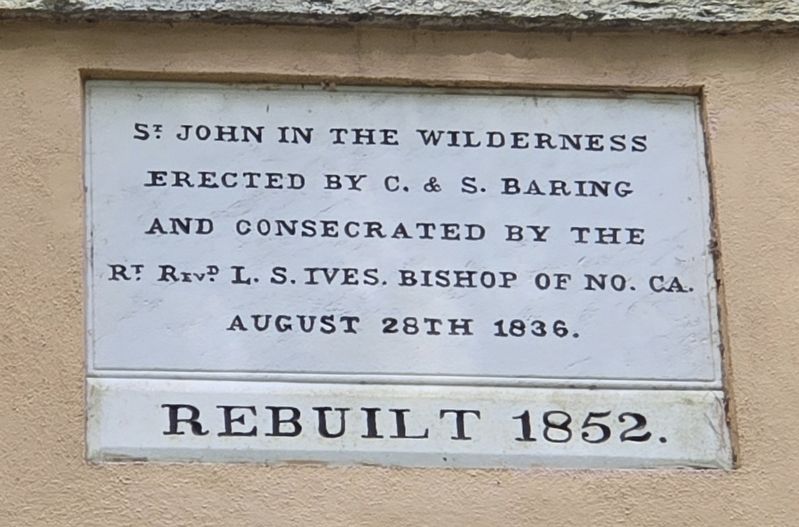
1. St. John in the Wilderness Marker
Erected by C. & S. Baring
And Consecrated by the
Rt. Revd. L. S. Ives. Bishop of No. Da.
August 28th 1836.
Rebuilt 1852.
Topics. This historical marker is listed in this topic list: Religion & Religious Structures. A significant historical date for this entry is August 28, 1836.
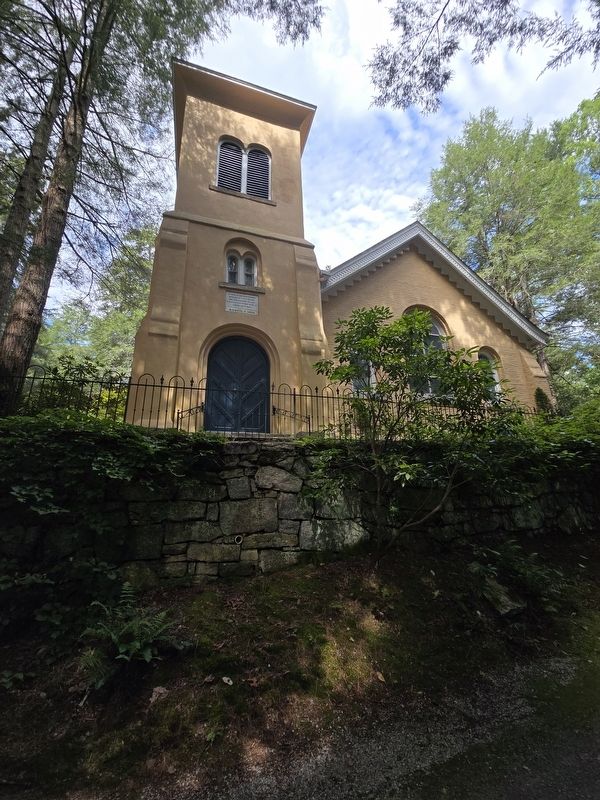
Location. 35° 16.948′ N, 82° 26.6′ W. Marker is in Flat Rock, North Carolina, in Henderson County. It can be reached from the intersection of Greenville Highway (North Carolina Route 225) and Rutledge Drive (County Route 1166), on the right when traveling south. The marker is above the sanctuary entrance. Touch for map. Marker is at or near this postal address: 1895 Greenville Hwy, Hendersonville NC 28739, United States of America. Touch for directions.

Regionally, this marker is in the Mountains and in Greater Asheville. It is also in the American South, specifically in the Upper South, in Appalachia, and specifically in Southern Appalachia. Globally, it is in North America, the Western Hemisphere, the Western World, and the Anglosphere. Historically, it finds itself in what was once the original Cherokee Nation,
this page online
Other nearby markers. At least 8 other markers are within walking distance of this marker: James Brown (a few steps from this marker); C.G. Memminger (within shouting distance of this marker); a different marker also named St. John in the Wilderness (within shouting distance of this marker); George A. Trenholm (about 600 feet away, measured in a direct line); Mountain Lodge (approx. 0.4 miles away); Hemlocks (approx. 0.4 miles away); Flat Rock (approx. 0.6 miles away); Connemara (approx. 0.6 miles away). Touch for a list and map of all markers in Flat Rock.
Also see . . . A Brief History of St. John in the Wilderness. Entry from St. John in the Wilderness Episcopal Church
The search for a milder climate for his Welsh-born wife Susan, brought Charles Baring, a member of the Baring banking family of England, to Flat Rock to find a summer place to escape the oppressive heat, humidity, and malaria of the South Carolina Lowcountry where they lived. In 1827 the Barings built(Submitted on September 1, 2025, by Mark Parker of Hickory, North Carolina.)a home here and named it Mountain Lodge, designed on the order of an English country estate. The house they built stands today about a quarter of a mile from the church.Photographed by Mark Parker, July 28, 20252. St. John in the Wilderness Marker above the sanctuary entrance
On the property of their newly constructed home, the Barings built a private chapel, a practice then prevalent among the English gentry. The small wooden structure burned in a woods fire, and in 1833, work began on a second church built of handmade brick.
In August of 1836 the Barings deeded their chapel to the Diocese of North Carolina and twenty members of the Flat Rock “summer colony” formed themselves into an Episcopal parish. In the 1890s when the Missionary District of Asheville (later Diocese of Western North Carolina) was formed, St. John in the Wilderness transferred its affiliation. It is the oldest parish in the diocese.
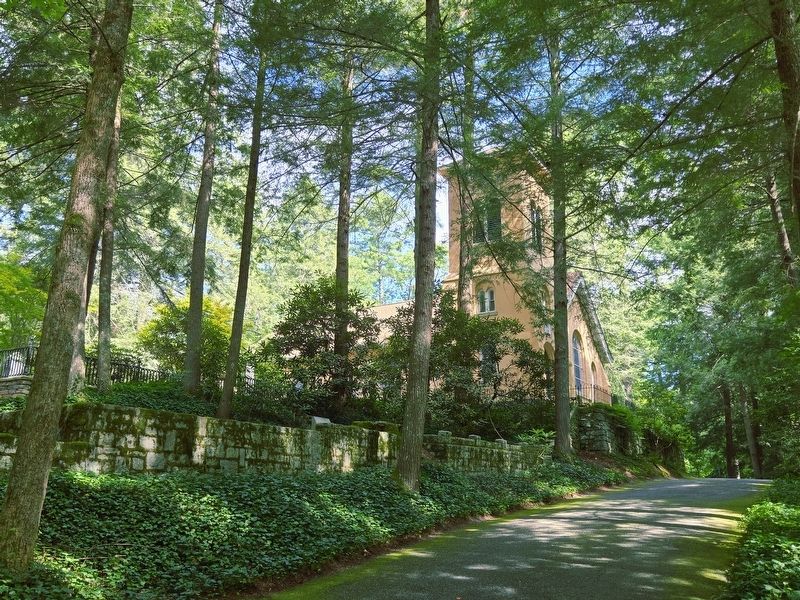
Although there is no written confirmation of how the Barings came to name their chapel “St. John in the Wilderness,” a couple of theories exist. The first is that the area of Flat Rock was part of the Blue Ridge Mountains that used to be known as “The Wilderness.” Some historians point to this geographic designation asbeing added to a name that honors John the Baptist. However, another likely explanation may be found in Charles’s ancestral home of Southwestern England. In the small town of Exmouth, near where the Baring family is from, there is a church that dates to the 14th century, and laid to rest in its cemetery are several members of the Baring family. The name of that church is St. John in the WildernessPhotographed by Mark Parker, July 28, 20253. St. John in the Wilderness driveway entrance from Rutledge Drive
Credits. This page was last revised on November 15, 2025. It was originally submitted on September 1, 2025, by Mark Parker of Hickory, North Carolina. This page has been viewed 62 times since then and 25 times this year. Photos: 1, 2, 3. submitted on September 1, 2025, by Mark Parker of Hickory, North Carolina. • Devry Becker Jones was the editor who published this page.
