
St. Augustine Beach in St. Johns County, Florida — The American South (South Atlantic)
Waves of Change
| — | St. Johns County Black Heritage Trail | — |
Photographed by Brandon D Cross, September 1, 2025
1. Waves of Change Marker
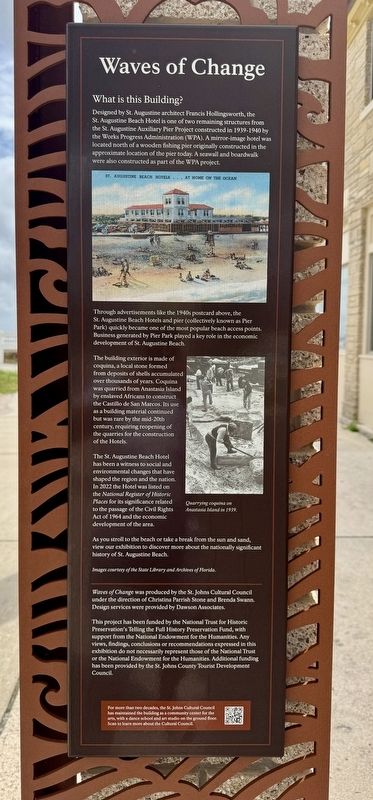
What is this Building?
Designed by St. Augustine architect Francis Hollingsworth, the St. Augustine Beach Hotel is one of two remaining structures from the St. Augustine Auxiliary Pier Project constructed in 1939-1940 by the Works Progress Administration (WPA). A mirror-image hotel was located north of a wooden fishing pier originally constructed in the approximate location of the pier today. A seawall and boardwalk were also constructed as part of the WPA project.
Through advertisements like the 1940s postcard above, the St. Augustine Beach Hotels and pier (collectively known as Pier Park) quickly became one of the most popular beach access points. Business generated by Pier Park played a key role in the economic development of St. Augustine Beach.
The building exterior is made of coquina, a local stone formed from deposits of shells accumulated over thousands of years. Coquina was quarried from Anastasia Island by enslaved Africans to construct the Castillo de San Marcos. Its use as a building material continued but was rare by the mid-20th century, requiring reopening of the quarries for the construction of the Hotels.
The St. Augustine Beach Hotel has been a witness to social and environmental changes that have shaped the region and the nation. In 2022 the Hotel was listed on the National Register of Historic Places for its significance related to the passage of the Civil Rights Act of 1964 and the economic development of the area.
As you stroll to the beach or take a break from the sun and sand, view our exhibition to discover more about the nationally significant history of St. Augustine Beach.
(insert)
For more than two decades, the St. Johns Cultural Council has maintained the building as a community center for the arts, with a dance school and art studio on the ground floor. Scan
this page online
(captains)
St. Augustine Beach Hotels … At Home on the Ocean
Quarrying coquina on Anastasia Island in 1939.
Images courtesy of the State Library and Archives of Florida.
Erected 2025 by St. Johns County Black Heritage Trail.
Topics. This historical marker is listed in these topic lists: Architecture • Charity & Public Work • Entertainment. A significant historical year for this entry is 1939.
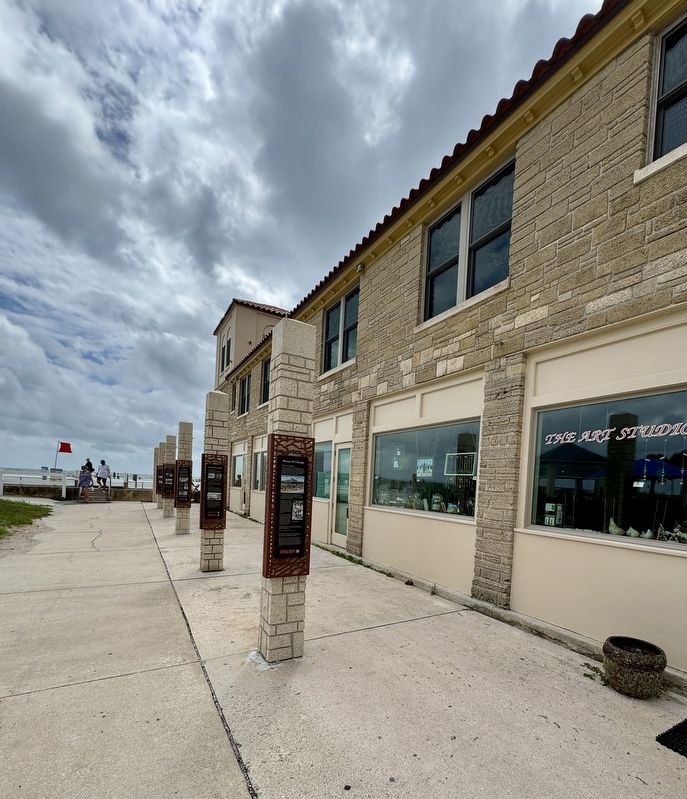
Location. 29° 51.397′ N, 81° 15.945′ W. Marker is in St. Augustine Beach, Florida, in St. Johns County. It can be reached from A1A Beach Boulevard 0.1 miles north of 16th Street, on the right when traveling north. Located in front of the St. Augustine Beach Hotel. Touch for map. Marker is at or near this postal address: 370A A1A Beach Boulevard, Saint Augustine FL 32080, United States of America. Touch for directions.

Regionally, this marker is in First Coast and in Greater Jacksonville. It is also in the American South and on the Eastern Seaboard. Globally, it is in the North Atlantic Region, North America, a Gulf of Mexico state, the Western Hemisphere, the Western World,
Photographed by Brandon D Cross, September 1, 2025
2. Waves of Change Marker
Other nearby markers. At least 8 other markers are within one mile of this marker, measured as the crow flies: Recreation and Fun (here, next to this marker); Civil Rights (a few steps from this marker); Time of Transition (a few steps from this marker); St. Johns County Black Heritage Trail (a few steps from this marker); 21st Century (a few steps from this marker); St. Augustine Beach Wade-Ins (a few steps from this marker); Veterans Memorial (approx. 0.8 miles away); Old Spanish Chimney and Well (approx. one mile away). Touch for a list and map of all markers in St. Augustine Beach.
Also see . . .
1. Waves of Change Exhibit. (Submitted on September 1, 2025, by Brandon D Cross of Flagler Beach, Florida.)
2. St. John’s County Black Heritage Trail. (Submitted on September 1, 2025, by Brandon D Cross of Flagler Beach, Florida.)
Credits. This page was last revised on September 7, 2025. It was originally submitted on September 1, 2025, by Brandon D Cross of Flagler Beach, Florida. This page has been viewed 73 times since then and 28 times this year. Photos: 1, 2. submitted on September 1, 2025, by Brandon D Cross of Flagler Beach, Florida. • Bernard Fisher was the editor who published this page.
