Downtown West in Minneapolis in Hennepin County, Minnesota — The American Midwest (Upper Plains)
Trains Can't Swim

Photographed by McGhiever, September 29, 2024
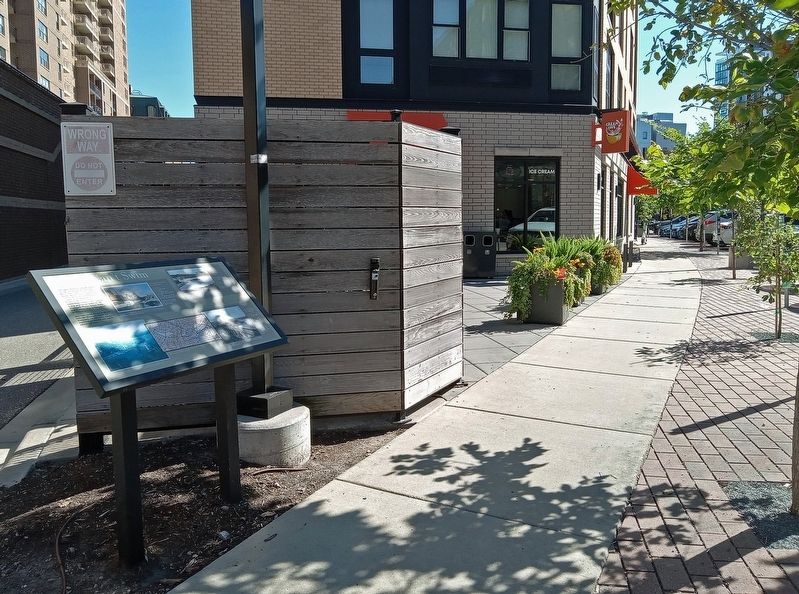
1. Trains Can't Swim Marker
The biggest obstacle for railroads passing through the area was the Mississippi River. James J. Hill's Great Northern Railway was the first to conquer the river below the falls in Minneapolis, completing the landmark Stone Arch Bridge in 1883. The Northern Pacific Railway Bridge followed in 1885, spanning a steep gorge further downriver. The Minneapolis Western Railway Bridge, located between these bridges, opened in 1891.
After trains crossed the river to the west bank, the Minneapolis Eastern and Minneapolis and Saint Louis railways transferred cars between mills and the railroad main lines.
Great Northern Railway Bridge (Stone Arch Bridge)
Type: stone arch
Engineer: Col. Chas. C. Smith
Length: 2,390 feet
Spans: 22 originally; 21 today
(1 truss replaced with 2 arches in 1961-1963)
Opened: 1883
Alterations: 1907-1910 and 1961-1963; renovated for pedestrian/bike use in 1994
A monument to railroad magnate James J. Hill and a Historic Civil Engineering Landmark.
The river side of the mill district was edged by rail tracks on trestles; the Great Northern's Stone Arch Bridge is to the right. The trestles have been demolished, but you can see their foundations at Mill Ruins Park. (Minnesota Historical Society)
Minneapolis Western Railway Bridge
Type:deck plate-girder and deck truss
Click or scan to see
this page online
Engineer: Minneapolis Western Railway
Length: 1,830 feet
Spans: 32
Opened: 1891
Demolished: 1952
This bridge became part of the Great Northern system in 1928.
Looking across the river from the East Bank in 1897. A train on the Minneapolis Western Railway Bridge (left) is heading into the West Bank milling district. A vehicular bridge (right) once connected Tenth Avenue on the West Bank and Sixth Avenue on the East Bank. Built in 1872, it was demolished in 1943. (Minnesota Historical Society)
The Northern Pacific Railway Bridge under construction in the early 1880s. The Great Northern's Stone Arch Bridge is visible in the background. (Emil Hilgarde, photographer, Minnesota Historical Society)
Detail of Map of Minneapolis, 1895. (Minneapolis City Engineer's Office map, Borchert Map Library, University of Minnesota, Minneapolis)
Northern Pacific Railway Bridge (Bridge No. 9)
Type: deck truss
Engineer: Frederick W. Cappelen
Length: 952 feet
Spans: 7
Opened: 1922
Alterations: Rebuilt in 1955; converted to pedestrian and bike use in 2000.
Tracks that ran through the Universitycampus were removed in the 1920s and this bridge was erected to replace an 1885 bridge that was slightly downstream.Photographed by McGhiever, September 29, 20242. Trains Can't Swim Marker at the 300 S. 2nd St. Parking
A train crosses the original Northern Pacific Bridge in 1913. Visible in the background are the Stone Arch and Minneapolis Western Bridges (right) and the Minneapolis City Hall clock tower (left). (C.J. Hibbard, photographer; Minnesota Historical Society)
Topics. This historical marker is listed in these topic lists: Bridges & Viaducts • Railroads & Streetcars. A significant historical year for this entry is 1883.
Location. 44° 58.855′ N, 93° 15.697′ W. Marker is in Minneapolis, Minnesota, in Hennepin County. It is in Downtown West. It can be reached from S. 2nd St. west of 5th Avenue S., on the right when traveling west. The marker is at the intersection of the 300 S. 2nd St. Parking and the alley. Touch for map. Marker is at or near this postal address: 300 S 2nd Street, Minneapolis MN 55401, United States of America. Touch for directions.

Regionally, this marker is in the Twin Cities Metropolitan Area. It is also in the American Midwest, in the Corn Belt, and in the Great River Road Region. Globally, it is in North America, the Western Hemisphere, the Western World, and the Anglosphere. Historically, it finds itself in what was once Rupert’s Land, the territory of the Mississippian Culture, and the Louisiana Purchase.
Other nearby markers. At least 8 other markers are within walking distance of this marker: A Little Railroad with a Long History (within shouting distance of this marker); Barrels / Bags / Bust / and Beyond (within shouting distance of this marker); Welcome to the Rail Maze (within shouting distance of this marker); Changing Times (within shouting distance of this marker); The Washburn and Pillsbury Clans (about 400 feet away, measured in a direct line); The Barrel-Makers' Co-ops (about 400 feet away); New Uses for Old Mills (about 500 feet away); Giants in the Land: The Power of Minneapolis Mills and Millers (about 700 feet away). Touch for a list and map of all markers in Minneapolis.
Credits. This page was last revised on September 1, 2025. It was originally submitted on September 1, 2025, by McGhiever of Minneapolis, Minnesota. This page has been viewed 100 times since then and 22 times this year. Photos: 1, 2. submitted on September 1, 2025, by McGhiever of Minneapolis, Minnesota.
