Bishop in Oconee County, Georgia — The American South (South Atlantic)
Bishop Historic District
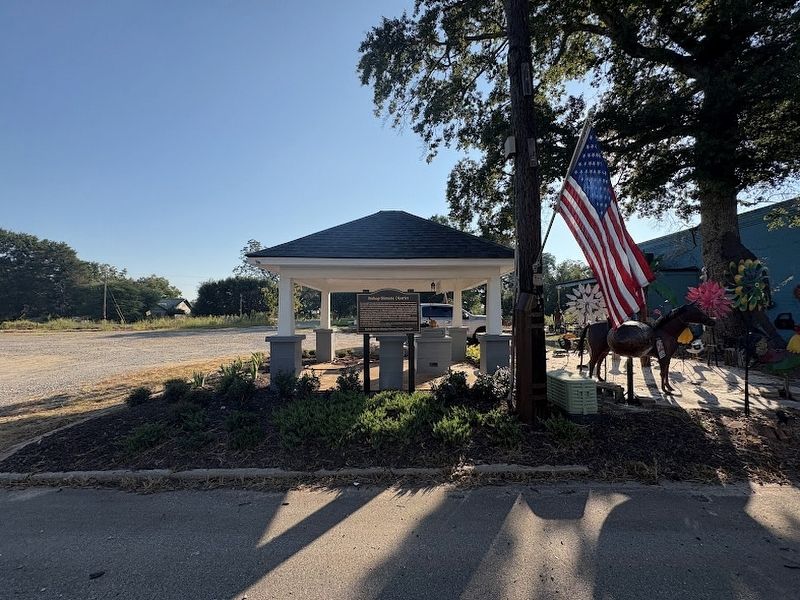
Photographed by Darren Jefferson Clay, August 31, 2025
1. Bishop Historic District Marker
Inscription.
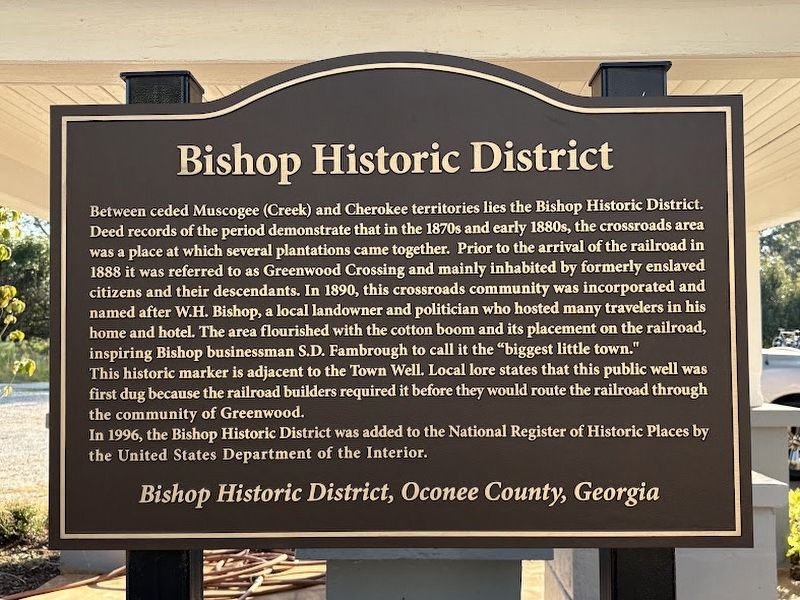
Bishop Historic District. . Between ceded Muscogee (Creek) and Cherokee territories lies the Bishop Historic District. Deed records of the period demonstrate that in the 1870s and early 1880s, the crossroads area was a place at which several plantations came together. Prior to the arrival of the railroad in 1888 it was referred to as Greenwood Crossing and mainly inhabited by formerly enslaved citizens and their descendants. In 1890, this crossroads community was incorporated and named after W.H. Bishop, a local landowner and politician who hosted many travelers in his home and hotel. The area flourished with the cotton boom and its placement on the railroad, inspiring Bishop businessman S.D. Fambrough to call it the "biggest little town." This historic marker is adjacent to the Town Well. Local lore states that this public well was first dug because the railroad builders required it before they would route the railroad through the community of Greenwood., In 1996, the Bishop Historic District was added to the National Register of Historic Places by the United States Department of the Interior., Bishop Historic District, Oconee County, Georgia
Between ceded Muscogee (Creek) and Cherokee territories lies the Bishop Historic District. Deed records of the period demonstrate that in the 1870s and early 1880s, the crossroads area was a place at which several plantations came together. Prior to the arrival of the railroad in 1888 it was referred to as Greenwood Crossing and mainly inhabited by formerly enslaved citizens and their descendants. In 1890, this crossroads community was incorporated and named after W.H. Bishop, a local landowner and politician who hosted many travelers in his home and hotel. The area flourished with the cotton boom and its placement on the railroad, inspiring Bishop businessman S.D. Fambrough to call it the "biggest little town." This historic marker is adjacent to the Town Well. Local lore states that this public well was first dug because the railroad builders required it before they would route the railroad through the community of Greenwood.
In 1996, the Bishop Historic District was added to the National Register of Historic Places by the United States Department of the Interior.
33° 49.007′ N, 83° 26.226′ W. Marker is in Bishop, Georgia, in Oconee County. It is at the intersection of Macon Highway and Crossover Road, on the left when traveling south on Macon Highway. Touch for map. Marker is at or near this postal address: 4800 Macon Hwy, Bishop GA 30621, United States of America. Touch for directions.

Regionally, this marker is in Georgia’s Antebellum Trail, in the Classic City Area, and in the Piedmont. It is also in the American South and specifically in the Deep South. Globally, it is in the North Atlantic Region, North America, the Western Hemisphere, the Western World, and the Anglosphere. Historically, it finds itself in what was once the territory of the Mississippian Culture, one of the original Thirteen Colonies, one of the Confederate States of America, and the Antebellum South.
Photographed by Darren Jefferson Clay, August 31, 2025
2. Bishop Historic District Marker
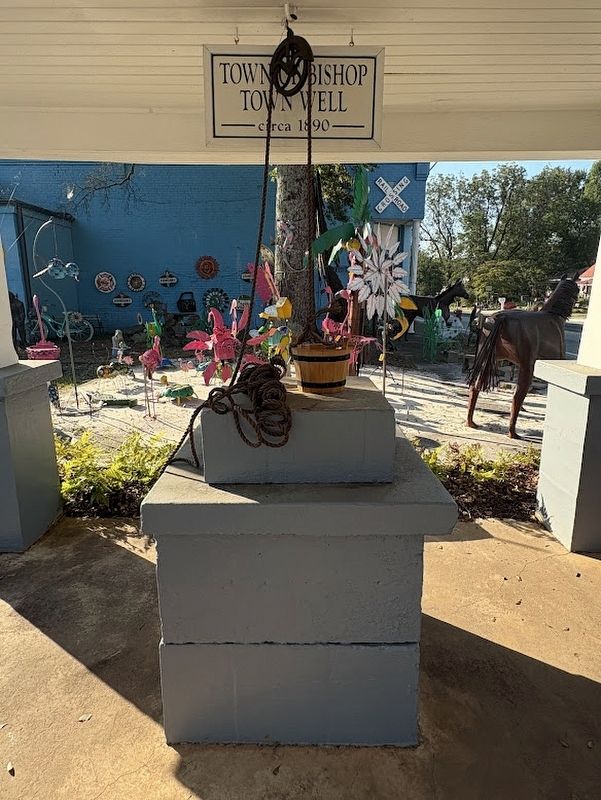
Photographed by Darren Jefferson Clay, August 31, 2025
3. Bishop Historic District Marker
Credits. This page was last revised on September 7, 2025. It was originally submitted on September 1, 2025, by Darren Jefferson Clay of Duluth, Georgia. This page has been viewed 182 times since then and 72 times this year. Photos:1, 2, 3. submitted on September 1, 2025, by Darren Jefferson Clay of Duluth, Georgia. • Bernard Fisher was the editor who published this page.