Cartersville in Bartow County, Georgia — The American South (South Atlantic)
Been Working on the Railroad
Photographed by Mark Parker, May 10, 2025
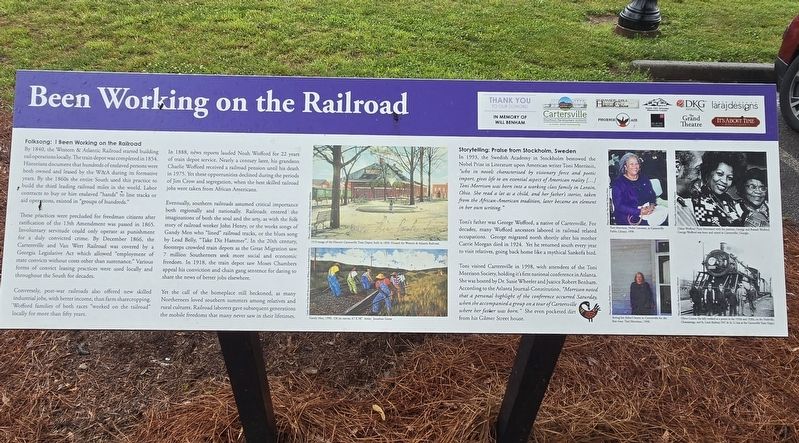
1. Been Working on the Railroad Marker
Folksong: Been Working on the Railroad
By 1840, the Western & Atlantic Railroad started building rail operations locally. The train depot was completed in 1854. Historians document that hundreds of enslaved persons were both owned and leased by the W&A during its formative years. By the 1860s the entire South used this practice to build the third leading railroad miles in the world. Labor contracts to buy or hire enslaved "hands" to line tracks or aid operptions, existed in "groups of hundreds."
These practices were precluded for freedman citizens after ratification of the 13th Amendment was passed in 1865. Involuntary servitude could only operate as punishment for a duly convicted crime. By December 1866, the Cartersville and Van Wert Railroad was covered by a Georgia Legislative Act vehicl allowed "employment of state convicts without costs other than sustenance." Various forms of convict leasing practices were used locally and throughout the South for decades.
Conversely, post-war railroads also offered new skilled industrial jobs, with better income, than farm sharecropping. Wofford families of both races "worked
this page online
In 1888, news reports lauded Noah Wofford for 22 years of train depot service. Nearly a century later, his grandson Charlie Wofford received a railroad pension until his death in 1975. Yet these opportunities declined during the periods of Jim Crow and segregation, when the best skilled railroad jobs were taken from African Americans.
Eventually, southern railroads assumed critical importance both regionally and nationally. Railroads entered the imaginations of both the soul and the arts, as with the folk story of railroad worker John Henry, or the works songs of Gandy Men who "lined" railroad tracks, or the blues song by Lead Belly, "Take Dis Hammer". In the 20th century, footsteps crowded train depots as the Great Migration saw 7 million Southerners seek more social and economic freedom. In 1918, the train depot saw Moses Chambers appeal his conviction and chain gang sentence for daring to share the news of better jobs elsewhere.
Yet the call of the homeplace still beckoned, as many Northerners loved southern summers among relatives and rural cultures. Railroad laborers
Photographed by Mark Parker, May 10, 2025
2. Been Working on the Railroad Marker
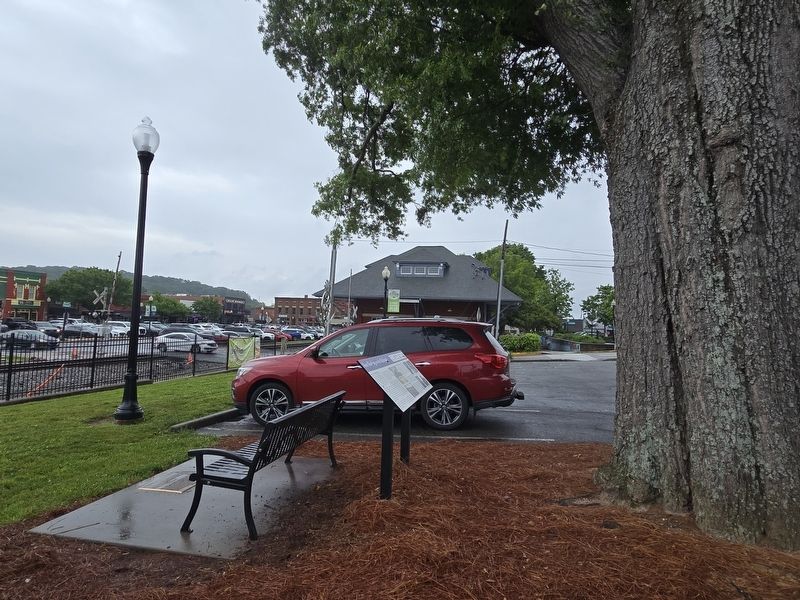
Looking south towards the railroad depot located across West Cherokee Ave
Storytelling: Praise from Stockholm, Sweden
In 1993, the Swedish Academy in Stockholm bestowed the Nobel Prize in Literature upon American writer Toni Morrison, "who in novels characterized by visionary force and poetic import, gives life to an essential aspect of American reality [...] Toni Morrison was born into a working class family in Lorain, Ohio. She read a lot as a child, and her father's stories, taken from the African-American tradition, later became an element in her own writing."
Toni's father was George Wofford, a native of Cartersville. For decades, many Wofford ancestors labored in railroad related occupations. George migrated north shortly after his mother Carrie Morgan died in 1924. Yet he returned south every year to visit relatives, going back home like a mythical Sankofa bird.
Toni visited Cartersville in 1998, with attendees of the Toni Morrison Society, holding its first national conference in Atlanta. She was hosted by Dr. Susie Wheeler and Justice Robert Benham. According to the Atlanta Journal-Constitution, Morrison noted that a personal highlight of the conference occurred Saturday when she accompanied a group on a tour of Cartersville where her father was born. She even pocketed dirt from his Gilmer Street house.
(Captions)
1910 image of the Historic Cartersville Train Depot, built in 1854. Housed the Western & Atlantic Railroad. Photo Credit: Bartow History Museum Archives
Gandy Men, 1990. Oil on canvas, 47 X98" Artist: Jonathan Green. Credit: Heart of Dixie RR Museum and the William A. Boone Memorial Library
Toni Morrison, Nobel Laureate, at Cartersville. Photo credit: The Daily Tribune News
Chloe Wofford (Toni Morrison) with her parents, George and Ramah Wofford. George Wofford was born and raised in Cartersville, Georgia. Photo credit: Lorain Public Library
Seeing her father's home in Cartersville for the first time. Toni Morrison, 1998. Photo Credit: Pearl McHaney
Oliver Cotton (far left) worked as a porter in the 1920s and 1930s, on the Nashville, Chattanooga, and St. Louis Railway (NC & St. L) line at the Cartersvlle Train Depot. Photo Credit Bartow History Museum
Erected 2020 by Cartersville Downtown Development Authority, Summer Hill Heritage Group, In Memory of Will Benham, Phoenix Air, Noble Hill - Wheeler Memorial Center, Kid in the Corner, DKG, The Grand Theatre, Lara J Designs, It's About Time Boutique.
Topics. This historical marker is listed in these topic lists: African Americans • Arts, Letters, Music • Industry & Commerce • Railroads & Streetcars. A significant historical year for this entry is 1840.
Location. 34° 9.973′ N, 84° 47.767′ W. Marker is in Cartersville, Georgia, in Bartow County. It is at the intersection of North Public Square and West Cherokee Avenue, on the right when traveling north on North Public Square. The marker stands at ground level just east of the public parking lot near the train tracks. Touch for map. Marker is at or near this postal address: 21 N Public Square, Cartersville GA 30120, United States of America. Touch for directions.

Regionally, this marker is in the Mountains. It is also in the American South and specifically in the Deep South. Globally, it is in North America, the Western Hemisphere, the Western World, and the Anglosphere. Historically, it finds itself in what was once the original Cherokee Nation, the territory of the Mississippian Culture, one of the original Thirteen Colonies, one of the Confederate States of America, and the Antebellum South.
Other nearby markers. At least 8 other markers are within walking distance of this marker: A Bench By The Road (here, next to this marker); Pathways to Freedom: A Story in Every Stitch (within shouting distance of this marker); God Bless America (within shouting distance of this marker); The Heart of the Chase (within shouting distance of this marker); Amos T. Akerman (within shouting distance of this marker); Warren Akin, Sr. (within shouting distance of this marker); Francis S. Bartow (within shouting distance of this marker); Chief Justice Robert Benham (within shouting distance of this marker). Touch for a list and map of all markers in Cartersville.
Credits. This page was last revised on September 3, 2025. It was originally submitted on May 26, 2025, by Mark Parker of Hickory, North Carolina. This page has been viewed 252 times since then and 86 times this year. Last updated on September 2, 2025, by Cathy Freeman of Cartersville, Georgia. Photos: 1, 2. submitted on May 26, 2025, by Mark Parker of Hickory, North Carolina. • Devry Becker Jones was the editor who published this page.
