College Station in Brazos County, Texas — The American South (West South Central)
Culture
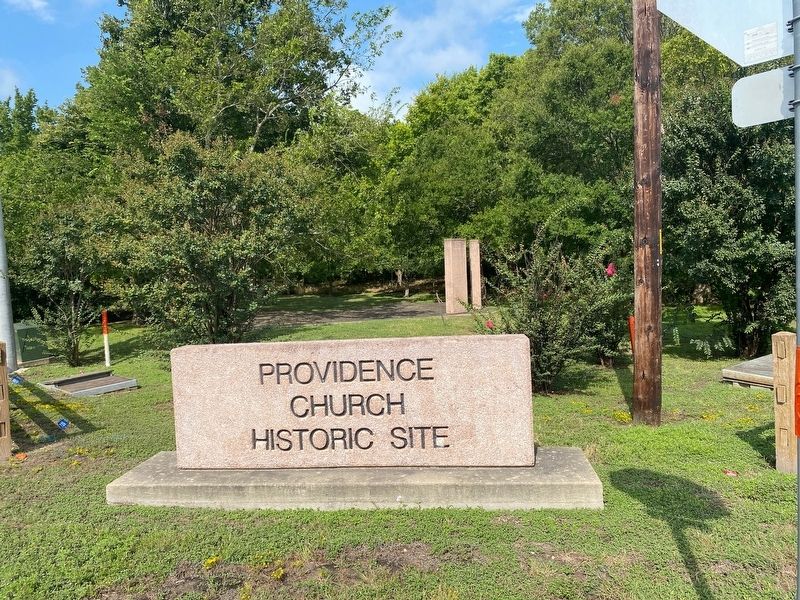
Providence Church Historic Site
Photographed by Morgan Petermann
1. Culture Marker
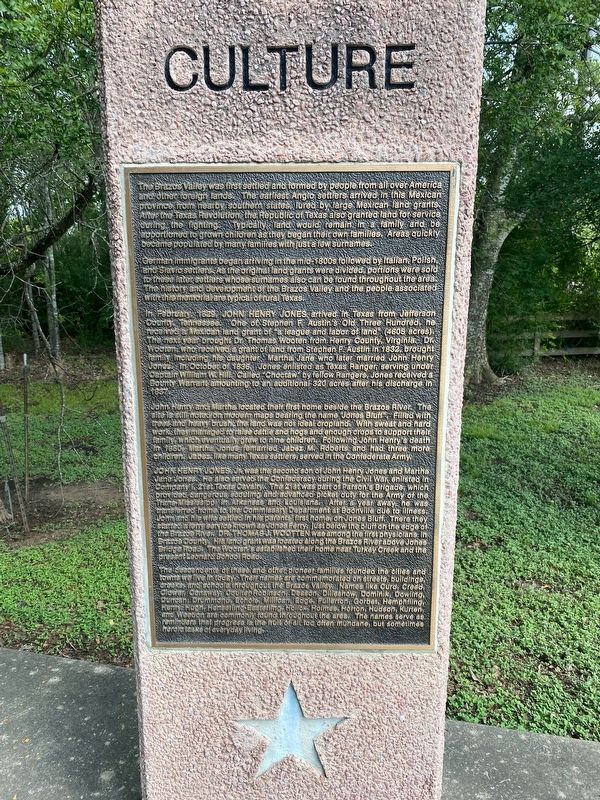
German immigrants began arriving in the mid-1800s followed by Italian, Polish, and Slavic settlers. As the original land grants were divided, portions were sold to these later settlers whose surnames can be found throughout the area. The history and development of the Brazos Valley and the people associated with this memorial are typical of rural Texas.
In February 1829, John Henry Jones arrived in Texas from Jefferson County, Tennessee. One of Stephen F. Austin's Old Three Hundred, he received a Mexican land grant of "a league and a labor of land" (4605 acres). The next year brought Dr. Thomas Wooten from
this page online
John Henry and Martha located their first home beside the Brazos River. The site is still noted on modern maps bearing the name "Jones Bluff". Filled with trees and heavy brush, the land was not ideal cropland. With sweat and hard work, they managed to raise cattle and hogs and enough crops to support their family, which eventually grew to nine children. Following John Henry's death in 1850, Martha Jones remarried Jabez M. Roberts and had three more children. Jabez, like many Texas settlers, served in the Confederate Army.
John Henry Jones, Jr. was the second son of John Henry Jones and Martha Jane Jones. He also served in the Confederacy during the Civil War, enlisted in Company I, 21st Texas Cavalry. The 21st was part of Parson's
Photographed by Morgan Petermann
2. Culture Marker
The descendants of these and other pioneer families founded the cities and towns we live in today. Their names are commemorated on streets, buildings, creeks, and schools throughout the Brazos Valley. Names like Curd, Creed, Clower, Conaway, Coulter-Robinson, Deason, Dilleshow, Dominik, Dowling, Duncan, Drummond, Eschols, Millican, Edge, Fullerton, Gorbet, Hemphfling, Henry, Hugh, Henserling-Easterling, Holick, Holmes, Horton, Hudson, Kurten, and Weedon are commonly found throughout the area.

Photographed by Morgan Petermann
3. Culture Marker
Topics. This historical marker is listed in this topic list: Settlements & Settlers.
Location. 30° 35.867′ N, 96° 22.303′ W. Marker is in College Station, Texas, in Brazos County. It is at the intersection of Turkey Creek Road and Raymond Stotzer Frontage, on the left when traveling north on Turkey Creek Road. Touch for map. Marker is at or near this postal address: 8878 Turkey Creek Rd, College Station TX 77845, United States of America. Touch for directions.

Regionally, this marker is in the Prairies & Lakes Region. It is also in the American South. Globally, it is in North America, a Gulf of Mexico state, the Western Hemisphere, the Western World, and the Anglosphere. Historically, it finds itself in what was once New Spain, the Republic of Texas, one of the Confederate States of America, and the Antebellum South.
Other nearby markers. At least 8 other markers are within 3 miles of this marker, measured as the crow flies: Community (here, next to this marker); Connection (here, next to this marker); College Station Railroad Depots (approx. 1.9 miles away); Main Drill Field, Texas A&M University (approx. 2.1 miles away); Aggies in World War I (approx. 2.1 miles away); Early Play-By-Play Radio Broadcast of a College Football Game (approx. 2.1 miles away); The Twelfth Man (approx. 2.1 miles away); Senator Matthew Gaines (approx. 2.1 miles away). Touch for a list and map of all markers in College Station.
Credits. This page was last revised on September 4, 2025. It was originally submitted on September 2, 2025, by Morgan Petermann of Hurst, Texas. This page has been viewed 96 times since then and 21 times this year. Photos: 1, 2, 3. submitted on September 2, 2025, by Morgan Petermann of Hurst, Texas. • James Hulse was the editor who published this page.
